
‘We can accomplish a lot when we talk to each other’
By Matt Witt
Communities in the rural West can stand up to giant outside gas companies, if they work together despite their differences. That’s how the Jordan Cove gas pipeline project was finally killed in Oregon by a coalition of conservative ranchers and farmers, climate activists, Indigenous tribal leaders, anglers and coastal residents.

The victory occurred last December, when a Canadian energy company called Pembina announced it would halt plans to build a 230-mile pipeline through rural southwestern Oregon, crossing more than 400 streams and rivers along the way. The pipeline was to carry fracked gas from the Rockies to a huge terminal proposed for the coastal town of Coos Bay, where it would be loaded onto ships bound for Asia.
When the Jordan Cove export project was first announced some 15 years ago, the odds of stopping it appeared slim. Supporters included the state’s governor and its two U.S. senators — all Democrats — plus most of the Republican political establishment.
But community organizers in Coos Bay and beyond didn’t give up.
“The last thing we needed was another giant fossil-fuel project and another major fire hazard just to profit an outside corporation,” recalls Allie Rosenbluth, campaigns director of Rogue Climate, a grassroots group in southern Oregon.
Rogue Climate contacted hundreds of landowners whose property would be affected, while also working with local environmental groups like Rogue Riverkeeper.
They quickly found that many ranchers were angry about threats from the company. If landowners didn’t let the pipeline cross their land in return for a one-time payment, they were told, the power of eminent domain would be invoked to impose it on them anyway. Congress granted this power to gas pipelines in 1947.
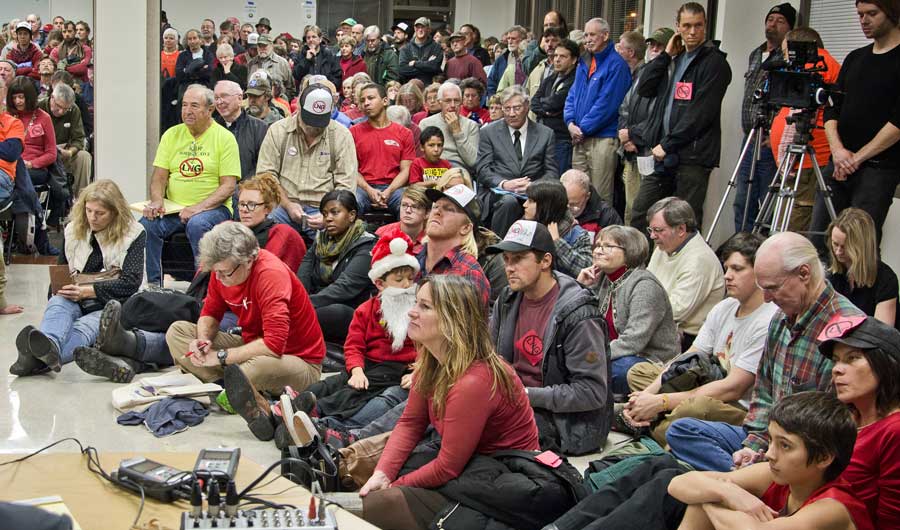
Over a seven-year period, an unlikely coalition grew in strength, turning out thousands of residents to public hearings and spurring more than 50,000 people to submit written comments to regulatory agencies. A delegation representing all parts of the coalition even held a sit-in in the governor’s office.
Seven rural landowners from across the political spectrum also published a column in the state’s largest newspaper, the Oregonian. It was blunt: “We are sick and tired of the pie-in-the-sky speculation by these for-profit corporations. We can’t build, we can’t plan and we can’t sell if we choose because of the threat of eminent domain.”
Don Gentry, chair of the Klamath Tribes, protested that the pipeline would “strip shade from streams and pollute them with sediment, harming fish central to the Klamath’s traditions and way of life.”
Bill McCaffree, a lifelong Republican, and longtime president of the local electrical workers union in Coos Bay, also publicly disagreed with construction union leaders who wanted the short-term work for their members.
“Everyone who works in the building and construction trades wants to build things that benefit communities and don’t cause harm,” McCaffree said. “Since I was a kid, there have been jobs here in Coos County from fishing, clamming and oyster farming. What would happen to those jobs when the bay is disturbed by construction and operation of this export terminal?”
A better strategy for creating good, stable jobs, McCaffree said, would be investing in energy efficiency and renewable energy development. That sector is “creating jobs at a rate 12 times faster than the rest of the U.S. economy.”
In the wake of this broad and vocal resistance, state agencies finally announced that the pipeline and terminal failed to qualify for necessary permits. That led Pembina to tell federal regulators it was dropping the project.
The coalition didn’t stop with its victory. Members convinced the Oregon legislature last year to pass bills to transition the state to 100 percent clean energy by 2040, provide $50 million for community-based resilience and renewable energy projects outside of Portland, and appropriate $10 million for energy-efficient home repairs for low-income households. The legislature also banned any new natural gas power plants in Oregon.
“Most of us who live in small towns and rural areas all want the same things,” said Rogue Climate’s Hannah Sohl. “Good jobs, a healthy climate, communities that work for everyone. We can accomplish a lot when we talk to each other and organize.”
Matt Witt is a contributor to Writers on the Range, writersontherange.org, a nonprofit dedicated to spurring lively conversation about Western issues. He is a writer and photographer in Talent, Oregon.


