
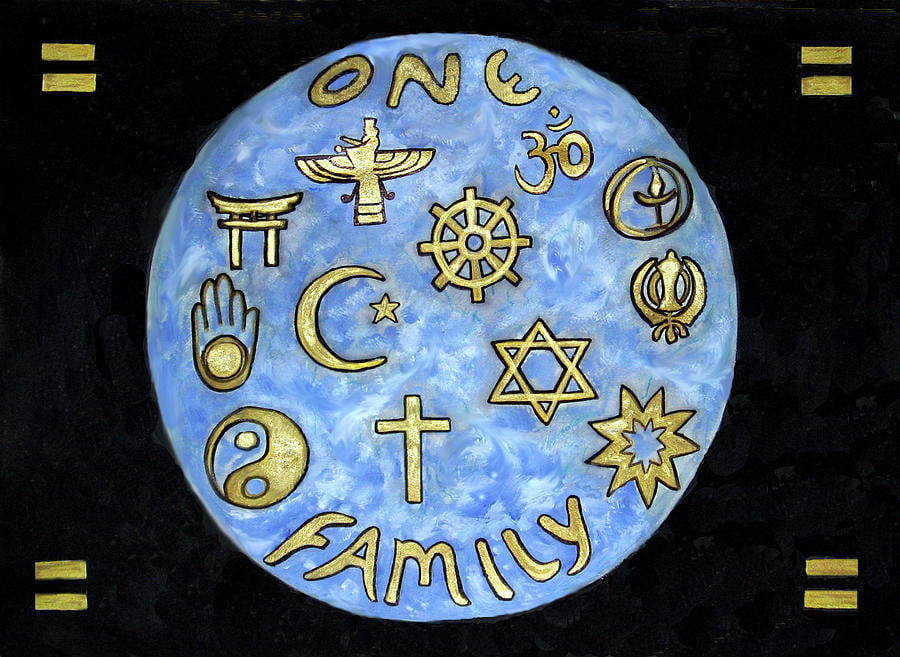
A god apart from us? Or one we are a part of?
By Jim Hatton
In ancient times, the common understanding was that there were many gods. Each god had a specialty depending on a particular human need. There was a god for the sun, rain, crops, fertility, war, peace, etc. Prayers were offered up to a particular god depending on the personal need of an individual or the collective need of a tribe.
It was also commonly accepted that these gods had physical human or animal forms, which artists conveyed through statues, wood carvings or paintings. Gods were also associated with geographical features such as forests, rivers, mountains and forest groves.

Today’s idea of a singular and invisible god dates back to at least two major sources: the Egyptian Pharaoh, Akhenaten, (who is believed to be the father of Tutankhamun) and the ancient scriptures of the Vedas and Upanishads. It was the Hebrews who popularized the idea, in the Middle East, of a singular invisible god (perhaps influenced by Akhenaten during their period of slavery in Egypt?). This monotheistic concept was adopted by the Christians and the Muslims. Western culture, religious or not, has also adopted this concept.
This popular perception of god includes a belief that god is a separate entity (i.e., separate from humanity), ruling the world and perhaps even the entire universe! This god has human-like qualities such as compassion, anger, and forgiveness, and “he” needs to be worshiped to massage his human-like ego. This old concept of “god” is evolving in today’s religious societies toward the possibility of finding the god-spirit within ourselves.
The Hindu understanding of god is based on ancient texts of the Vedas and Upanishads which have always conveyed the concept of not only “god within” but also “god emanating as us.” This is not always practiced on an everyday level, but this idea of “oneness” pervades the Eastern traditions.
Oneness, “god as us,” is also a common tenet within the mystical branch of Christianity, Judaism (Kabbalah) and Islam (Sufism, although Sufism actually pre-dated Islam).
I believe that the greatest challenge for Western traditions and Western minds is moving from a concept of god as a separate deity outside of ourselves to the concept that we humans, the animals and the physical universe are all created by god becoming its creation. The emanation of “god as us” is a very scary thought to many in Western culture. Even if we were to have a realization of oneness, we would not dare to entertain it for long nor share it with others because it might be considered blasphemy. Somewhere in our subconscious is a fear that god will judge us and/or punish us for our arrogance!
I believe that this underlying fear holds Western religion and culture from seeing the unity of all things. The old limited and limiting concepts of a human-like deity have been around for so long and repeated so many times that they can seem like truth and be very challenging to dispel from our consciousness.
“How could we humans be God?” is a question that is an ego-based human projection on the nature of god. Those who subscribe to the oneness of nature will say: “No, we are not that god with human characteristics, but yes, we embody the essence of the life force that is in all of us.” The more one recognizes this life force, the more one experiences the love-intelligence we call “God.”
The classic idea that we have to go on a journey to find god has driven countless people to look for an anthropomorphic (human-like) being somewhere on the planet. And, of course, “he” is never found (as if God had a gender!).
The mystics say: “Look within to find god,” and although that may be correct, it seems a bit unclear on just what that means. The love-intelligence that we call god is found within and without — and not just on planet Earth, but throughout the entire universe. All one has to do is to look at the intelligence in nature to perceive something beyond the physical.
Moreover, this life essence can be sensed if we were to enquire: “What is it, that is aware of others and, in particular, is aware of ourselves? What is that awareness that is in all of nature yet resides behind our eyes and sees? What is it that does not simply see in the physical world but that is aware of the physical world and is aware of itself?”
It is this awareness that permeates everyone and everything including the spacesuit we occupy and call our body. When we slow down and quietly observe the awareness in and through everything, we can see the intelligence, the consciousness, and we can feel the presence of this life force. It is not physical, but it is what gives life to the physical world. This is the oneness of which the mystics speak.
The world is not broken, be in peace ….
Jim Hatton is an author, spiritual teacher and speaker. He makes his home in the Rogue Valley, southern Oregon. Contact him at jim@jimhatton.com. Send 600- to 700-word articles on all aspects of inner peace to Richard Carey (rcarey009@gmail.com).


