We can — we must — pull each other back from the brink
By Pepper Trail
Just about every video game, young adult novel and buzz-worthy streaming series agree that we need to prepare for a post-apocalyptic world. Up ahead, around a sharp curve or off a cliff, it is waiting —The Apocalypse.

Maybe not “the complete final destruction of the world,” but certainly “an event involving destruction or damage on an awesome or catastrophic scale,” to quote the two definitions in the Oxford Online Dictionary. Not yet, but soon.
This has me wondering: How will we know when we move from pre- to post-apocalypse? This summer, my hometown in southern Oregon was crushed under a heat dome, sweltering in triple-digit temperatures. A fire across the state line ignited and within 24 hours exploded to become California’s largest wildfire this year so far.
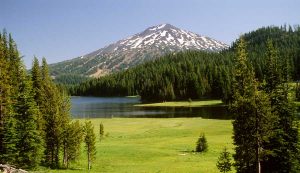
The two mountain lakes that provide water to our valley orchards and vineyards are at 2% and 6% full, that is, 98% and 94% empty. Last year, an even more severe heat dome pushed temperatures in normally cool Seattle and Portland to record-shattering levels, wildfires burned more than a million acres in Oregon and 2,000-year-old giant sequoias perished in fires of unprecedented severity in California’s Sierra Nevada.
Catastrophic extremes are becoming normal. The Great Salt Lake is at the lowest level ever recorded, spawning toxic dust storms. A mega-drought has shriveled the Colorado River, with the beginning of major cutbacks in water deliveries to Arizona and Nevada. Elsewhere in the West, flooding devastated Yellowstone National Park in June, collapsing roads and leading to the evacuation of more than 10,000 visitors.
Widening our view, Dallas was recently inundated with what was described as a “1,000-year” flooding event, following similar flooding disasters in Las Vegas, St. Louis and Kentucky earlier this summer. Across the Atlantic, Europe was scorched by the highest temperatures ever recorded this summer, triggering massive wildfires, the collapse of a glacier in Italy and over 10,000 heat-related deaths. India, China, and Japan experienced record heat waves this year.
I could go on, but no doubt you have read the news, too, about climate-caused apocalyptic events. Closely related is the global extinction crisis, with over a million species at risk by the end of this century. Bird populations in the United States have collapsed by one-third in the past 50 years, and the world’s most diverse ecosystems, including tropical rainforests and coral reefs, could largely disappear in coming decades.
Let’s also not forget the COVID-19 pandemic, which has killed at least 6.46 million people worldwide and sickened 597 million. That pandemic shows no sign of ending as the virus continues to evolve new variants. Meanwhile, the new global health emergency of monkeypox has been declared. And polio, once eliminated in this country, is back, thanks to people who aren’t vaccinated.
What about America’s social fabric? According to a poll taken this summer by the New York Times, a majority of Americans surveyed now believe that our political system is too divided to solve the nation’s problems. The nonprofit Gun Violence Archive has documented 429 mass shootings so far this year in America, with “mass shootings” defined as at least four people killed or injured.
Meanwhile, the Supreme Court’s overturning of Roe v. Wade has led to a rapid and stark division of the country into states that permit abortions versus those that outlaw it. Republicans and Democrats increasingly live in separate media universes, with both sides concerned about the possibility of a civil war.
I admit this is a staggering list of “damage on an awesome or catastrophic scale,” but I’m not ready to declare myself a citizen of the post-apocalypse. We don’t have to live there. Instead, let’s accept that humanity and the whole planet are “apocalypse-adjacent.” The apocalypse is before us and we can see it clearly. But the world is not yet ruined.
Human beings do have this redeeming and also infuriating trait: We are at our most creative and cooperative when it is almost too late. We can — we must — pull each other back from the brink. To fail is to condemn our children to live in the hellscape of a dystopian video game. As they will tell you, that is no place to be.
Pepper Trail is a biologist and writer who roams the Klamath-Siskiyou Bioregion from his home in Ashland, Oregon. His environmental essays have appeared in High Country News and on southern Oregon’s Jefferson Public Radio, and have been included in several anthologies, including “A Road Runs Through It: Reviving Wild Places,” edited by Annie Proulx and Thomas Peterson. His poetry collection, “Cascade-Siskiyou: Poems,” was a finalist for the 2016 Oregon Book Award. This column first appeared Aug. 29 in Writers on the Range (writersontherange.org), a nonprofit dedicated to spurring lively conversation about the West. Used by permission.