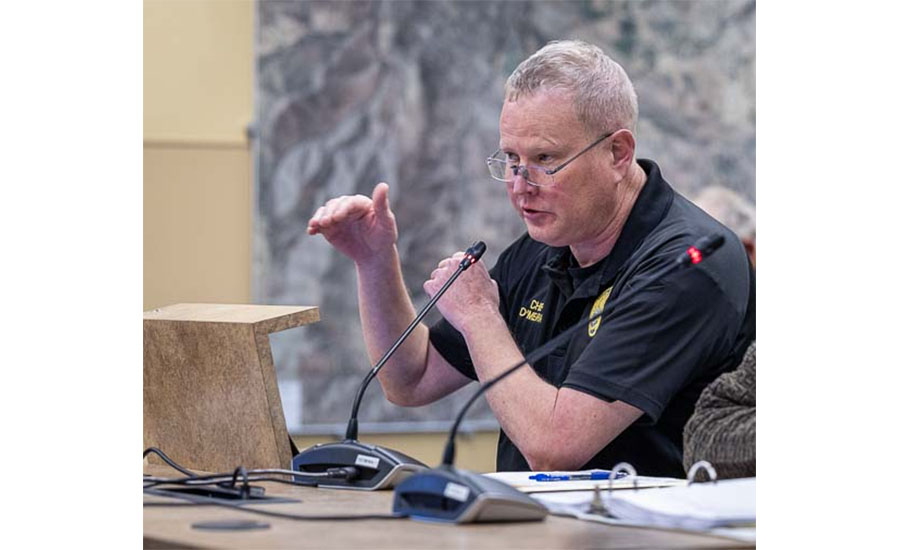
Did O’Meara and others presume racism without letting the former councilor explain himself, and is this how a ‘peace officer’ behaves?
By Skeye Hridayam
I read the two Ashland.news articles on May 21 regarding the altercation between Police Chief Tighe O’Meara and former councilor Eric Navickas at a Ashland City Council meeting the night before that addressed the proposed expansion to the Enhanced Law Enforcement Area ordinance. I downloaded the video and reviewed the relevant part of that meeting, and I listened to the comments made by councilors and attendees during the recess. And I have to question the manner in which those meetings are conducted, how Navickas’ words were interpreted as being “racist,” and how Chief O’Meara can discount intent and rationalize his behavior of confrontation as the “righteous thing to do.”
Is this how a “peace officer” behaves and supports peace within our community, by acting self-righteous and prejudicially confronting people? Could his actions have been a reaction to having his authority questioned and critiqued? And if so, is this the kind of mentality we want to foster within our police force?
During the meeting recess, Councilor Gina DuQuenne can be heard saying about Navickas: “That was a racist slur, that “‘all Black people are criminals.'”
But that is not what he said. What he said was, “Imagine this applied to a community where we have a large minority, um, a large minority of, say, Black people, impoverished Black people, who are possibly more, um, engaged in criminal activity. How does this [ordinance] apply to that community?”
Navickas may not have stated what he did very eloquently, being obviously nervous and under pressure of the three-minute time limit for comments and the sensitive nature of the issue being addressed. But it was very clear to me that he was making a contextual statement. That is to say that if this same kind of ordinance was being applied to impoverished Black communities, where crime is more prevalent, how would that be viewed? That is not saying that “all Black people are criminals” or that all Black communities are impoverished and crime-ridden, or discounting that there are impoverished white communities where crime is more prevalent as well.
If this was an actual discussion happening, Navickas would have had the time to clarify that statement, especially if he had been asked to by the mayor, councilors and the police chief so they could possibly understand how or why he was saying what he was. Instead, we see them assuming racism and, reacting from their interpretation, judging and condemning him for it. A presumption of guilt without opportunity for redress.
Which, ironically enough, is what all three of the speakers who got up to share their perspective on the ordinance were contesting: the lack of due process in this respect by the enforcement of the ordinance. This erosion of the rights of people to not be accused and tried, and perhaps summarily punished, before even being able to address accusations leveled against them.
It assumes the stance that all police, and perhaps government officials, operate under due diligence and fairness. That accusations leveled are always accurate. That what the police say represents the reality of the situation, and that their behavior is not to be considered or questioned. Instead, they get to police everyone else’s behavior, without due accountability and with an inordinate amount of power.
Another questionable aspect of the meeting was Councilor Dylan Bloom’s very adamantly stating that this ordinance was not an issue of classism, while he himself appeared to recognize that the inclusion of invalid or absent dog licenses among the qualifying violations for excluding a person was not appropriate. For him to say this ordinance is not classist seems to not take into account that the very thought of dog licenses being included in the first place indicates a targeting of the unhoused and impoverished of our community, thus making this a classist ordinance.
The U.S. has been slowly but steadily advancing into a more prevalent police state for decades now. A major advancement in that societal condition was the 1994 federal Crime Bill, otherwise known as the “three strikes, you’re out” law. If one searches: “three-strikes law racism” and “three-strikes law classism,” one can find many examples of studies and articles attempting to address why relying heavily on policing (especially with such stringent and generalized laws) to address societal ills is unjust, imbalanced, easily exploitable and exacerbates the conditions of poverty that enhance the potential of crime, creating the need for more policing. And that such heavy-handed expedited and imbalanced dealing with crime truly lacks consideration of or compassion for the conditions of the impoverished and marginalized.
This increased criminalization of and attempts to exclude the unhoused and impoverished from our community, along with the lack of willingness to actively assist them in procuring a more stable and secure living situation — while actively impeding that potential and their basic ability to just sleep undisturbed in relative safety — stings all the more amid the city’s continued PR posturing of being a “city of peace and compassion … equity and inclusivity.”
I am not seeking to shame and blame, I am merely stating things as I see them and voicing concern over what appear to be glaring contradictory words and actions. I welcome any efforts by the city to clarify, and potentially rectify, these apparent contradictions.
Skeye Hridayam lives in Ashland.