Rare whitebark pine population dwindles; listed as ‘threatened’ in 2023
By Suzie Savoie
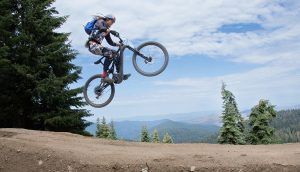
Mount Ashland is a very popular recreation hotspot locally where one can whiz past rare wildflowers on a mountain bike, stroll through lush subalpine meadows on the Pacific Crest Trail, or watch a dizzying array of pollinators buzzing amongst the flowers while walking a dog along Road 20 in the summer.
It’s easy to see the endemic Mount Ashland lupine that grows only on Mount Ashland, or the rare Henderson’s horkelia and Jaynes canyon buckwheat that grow in only a handful of locations on the Siskiyou Crest, but it is harder to find and identify the rare conifer species that inhabit the summit and slopes of Mount Ashland, relics of a colder climatic period: Engelmann spruce (Picea engelmannii), subalpine fir (Abies lasiocarpa) and whitebark pine (Pinus albicaulis).
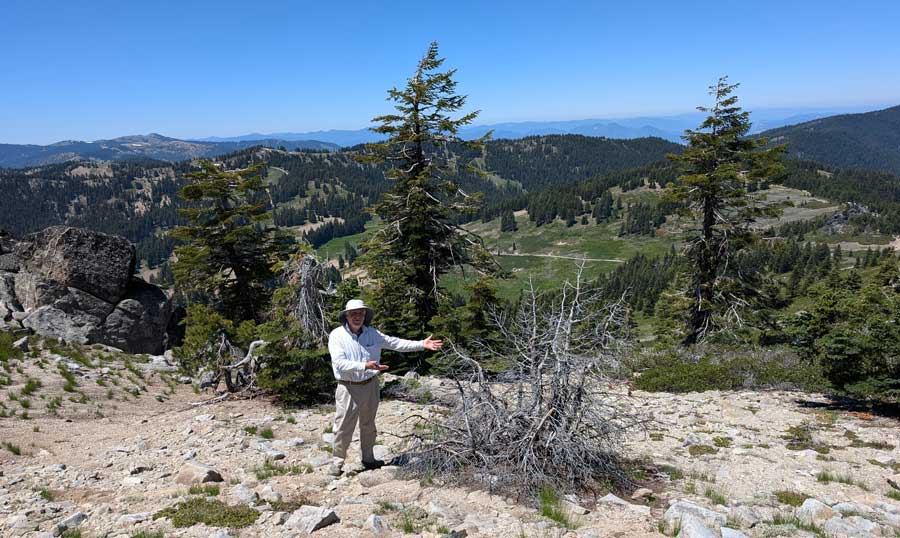
Rising to 7,532 feet in elevation above the dry grasslands and oak woodlands of the Rogue River and Klamath River, Mount Ashland is the tallest peak in the Siskiyou Mountains — a “sky island” with lush subalpine habitat. The cold, snowy and windswept winters on the mountain have long provided a small habitat niche for the only stands of Engelmann spruce and whitebark pine in the Siskiyou Mountains, as well as one of only two stands of subalpine fir; however, a non-native pathogen and other issues are threatening the extirpation of whitebark pine from Mount Ashland and, with a warming climate, the long-term fate of Engelmann spruce and subalpine fir is unknown.
The U.S. Fish and Wildlife Service listed whitebark pine as “threatened” under the Endangered Species Act in 2023. It lives at the ecological edge, only at the very top of the mountains it inhabits, at timberline and above 7,500 feet elevation. It is a slow-growing, charismatic species that is often sculpted by the harsh conditions in which it lives.
Whitebark pine had been reported on Mount Ashland since at least 1969. It is unknown exactly how many whitebark pine trees may have been impacted by the development of the Doppler radar, communication towers or ski area on the mountain.
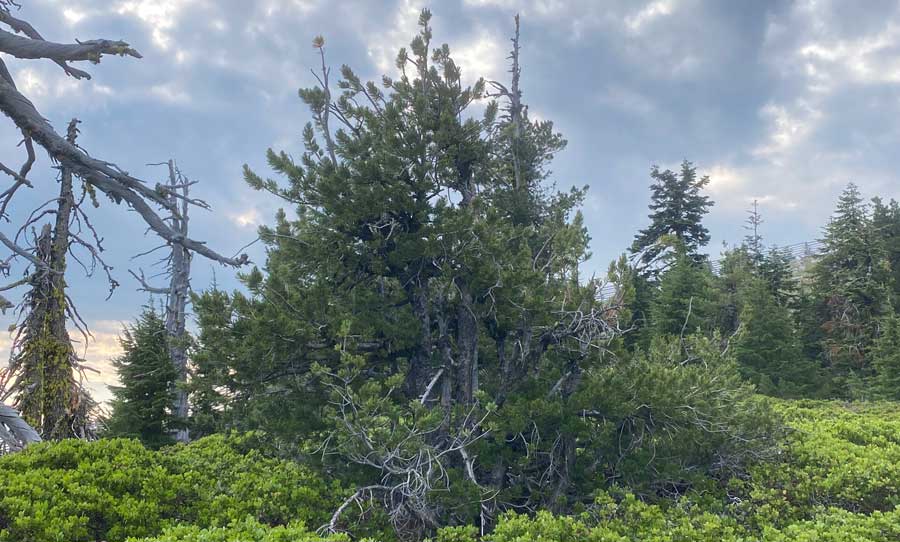
According to retired Rogue River-Siskiyou National Forest botanist and Ashland resident Wayne Rolle, “Frank Lang discovered a multi-stemmed tree on Mt. Ashland in 2003. A lot of us immediately started looking for others, and that same year Jim Duncan discovered a single-stemmed older tree fairly near Frank’s tree.”
Through genetic testing, a third, smaller whitebark pine tree was identified, “so at that point we knew of only three whitebark pine trees,” on Mt. Ashland, Rolle said. One tree died a few years later and it was down to only two trees.
Since the rediscovery of whitebark pine on Mt. Ashland in 2003, Rolle has been monitoring the trees, and even headed up a tree-planting effort, in an attempt to keep the population viable. He collected seeds from two of the remaining trees and had them grown out at a Forest Service nursery. Nineteen seedlings were planted in 2010. At least one was recently confirmed alive, and possibly more.
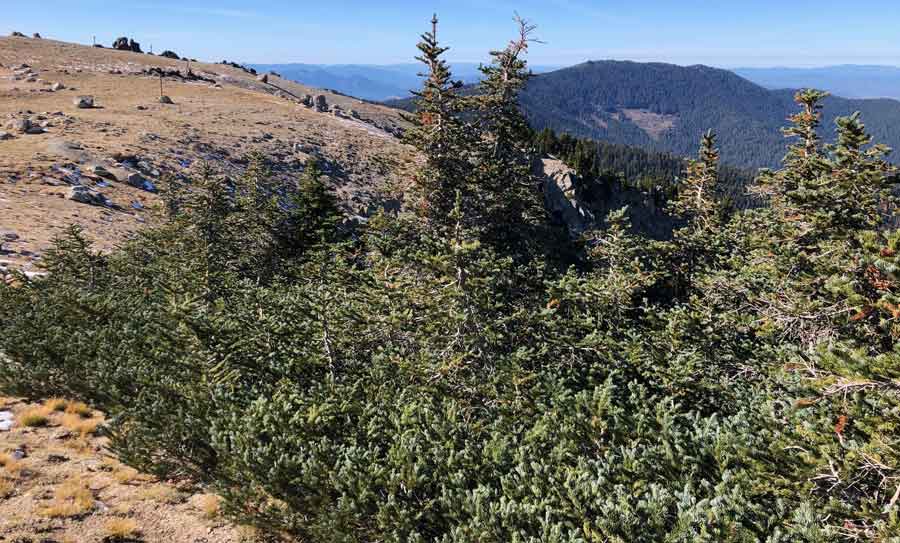
In early July, Rolle went back to Mount Ashland with retired Shasta Trinity National Forest botanist and Ashland resident Julie Kierstead, to check on the health of the most easy-to-access whitebark pine on the summit of Mount Ashland.
“Much to my dismay, the whitebark pine tree Julie and I visited yesterday, southwest of the KTVL building, is dead now. I knew it was doing poorly, but did not expect it to be totally dead. All the needles are gone, so it must have died in 2022 or 2023,” Rolle reported after the site visit. The likely culprit is the non-native fungus, white pine blister rust, that was introduced to North America in the early 1900s and is devastating “white pines” (i.e., five-needled pines) throughout the country. In our region it also impacts sugar pine and western white pines.
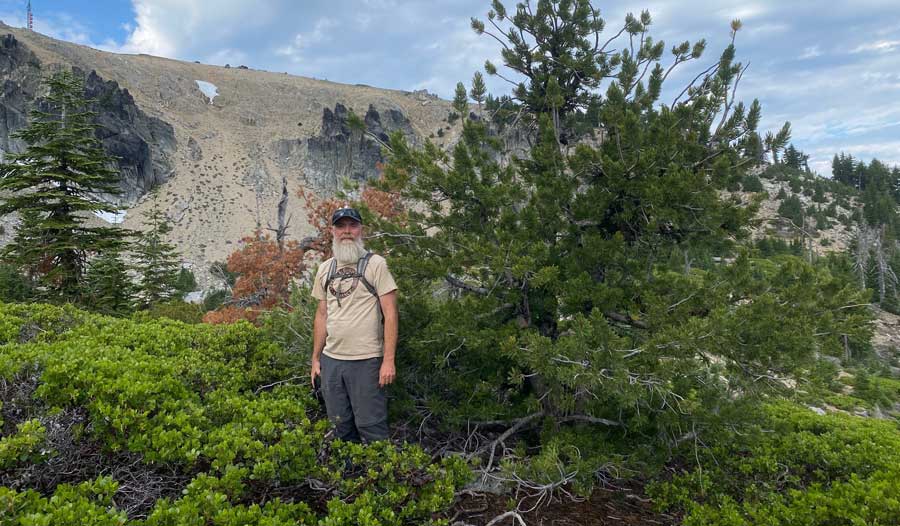
In preparation for an upcoming field trip he’s helping lead on Mount Ashland to view the rare conifers, Luke Ruediger of Applegate Siskiyou Alliance went out, with this author, in search of the tree Frank Lang found in 2003, heading down into the cirque basin below the summit, commonly referred to as “the bowl” by skiers and snowboarders. The GPS coordinates Lang had with his original site visit were inaccurate, but Ruediger was able to use Lang’s location description to find the tree. Much to his delight, the tree is still alive.
Mount Ashland Rare Conifers Field Trip
Luke Ruediger of Applegate Siskiyou Alliance and botanist Julie Kierstead will lead a field trip to Mount Ashland to view the rare conifers on Saturday, Aug. 3. For more information and to register for the field trip, click here. There is a fee of $45.
“The Siskiyou Crest is at the heart of the Klamath Mountain range which has more conifer species than any other temperate forest in North America — 35 species. The Siskiyou Crest alone has 25 species. This one mature, live whitebark pine tree remaining on Mount Ashland is now the most imperiled in the Siskiyous. I hope the recent listing of the species as threatened will help garner more attention to protecting this tree, and I hope the seedlings that Wayne had the foresight to plant 15 years ago will survive,” Ruediger said.
The long-term fate of whitebark pine on Mount Ashland is uncertain. Rolle reports that the Forest Service nursery, “tested the seeds and determined they had no blister rust resistance.” With how slow-growing whitebark pine trees are, it will take a long-term effort to monitor the species into the future.
Elsewhere on the mountain, the other rare conifers — the Engelmann spruce and subalpine fir — appear to be doing well.
“Although more abundant in other regions of the country, these disjunct stands of subalpine associated conifers highlight the overall conifer diversity of the Siskiyou Crest. Known as a hotspot for botanical diversity, Mount Ashland not only has this unique concentration of conifer species, but many endemic, rare and beautiful flowering species as well,” said Kierstead.
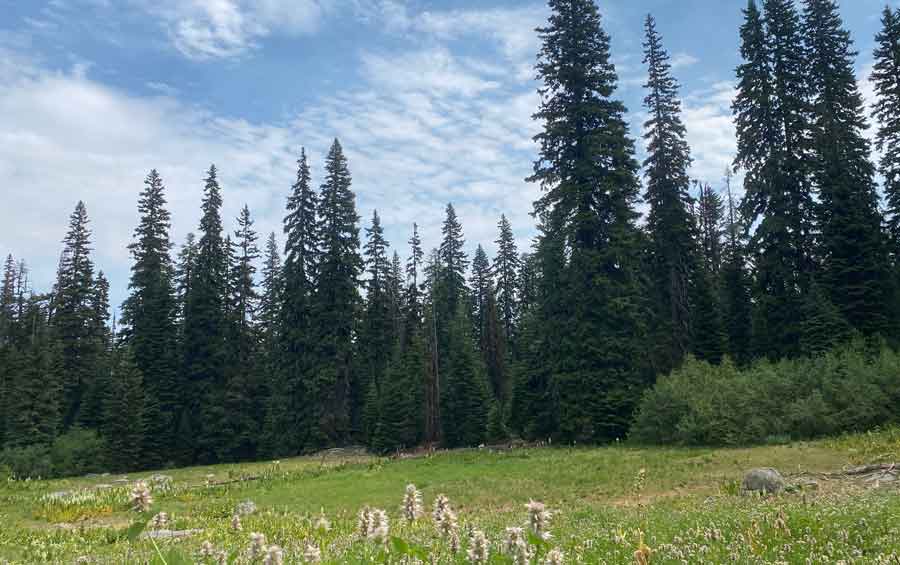
The public has a chance to view these rare conifers with botanist Julie Kierstead and hike leaders Luke Ruediger and Suzie Savoie on Aug. 3, on the final field trip of Applegate Siskiyou Alliance’s Siskiyou Crest Conifer Field Trip Series that has taken participants to all 25 conifer species in the Siskiyou Crest region this spring and summer. The field trip will include easier options for botanizing on the summit of Mount Ashland and around Rabbit Ears, but to see the Engelmann spruce, this will not be a typical Mount Ashland field trip, as participants will experience a different side of the mountain, getting off-trail into little-visited areas.
Suzie Savoie, a member of the Siskiyou Crest Coalition, was an editor of “The Siskiyou Crest: Hikes, History & Ecology,” a book devoted to the unique ecology of the Siskiyou Mountains, and co-author of ”Native Pollinator Plants for Southern Oregon,” an introductory guide for native pollinator plants in Southern Oregon. Email her at klamathsiskiyou@gmail.com.