Israel’s violent ethnic cleansing of the Palestinians has created an existential crisis for Jews
By Herbert Rothschild
If Israel and Judaism were either one and the same or entirely distinct, then Israel’s unconscionable treatment of the Palestinians would pose an existential threat to Palestinians but not to Jews. The pages of history are splashed with blood spilled by states, both religious and secular, that oppress, displace and/or exterminate peoples within the borders of the lands they claim as theirs and then simply turn those pages so they can continue to think well of themselves. The self-proclaimed Jewish state would have been just one more of those.

But Israel is intertwined with the self-understanding of Jews living outside Israel as well as inside, and in multiple ways the future of Judaism itself has become contingent on what unfolds there. If Israel is the face of Judaism and much of the world now finds that face repugnant, then its behavior poses an existential threat to all Jews, albeit a threat of a very different kind than it poses to the Palestinians.
Actually, the post-Biblical intertwining of Israel and Jewish identity is of quite recent origin despite the Zionist assertion that the traditional prayer for the restoration of Israel proves that Jews in the Diaspora have always longed to return to a “Jewish homeland.” What could be more probative than the fact that almost all Jews who fled pograms in Russia and Poland chose to resettle in the United States, not Palestine? Between 1890 and 1920, approximately 2 million Jews emigrated to the U.S. In contrast, between 1878 (the last Ottoman census) and 1922 (the first British Mandate census), the Jewish population in Palestine grew from 15,001 to a mere 83,790.
Reform Judaism, which began in Germany and was brought to the U.S. by German Jewish immigrants, asserted that Judaism is a universal religion and Jews are a religious community. The Pittsburgh Platform of 1885, the most important statement of the American Reform Movement, specifically rejected Jewish nationalism: “We consider ourselves no longer a nation, but a religious community, and therefore expect neither a return to Palestine, nor a sacrificial worship under the sons of Aaron, nor the restoration of any of the laws concerning the Jewish state.”
While Hasidic Jews could hardly have been further removed in their understanding and practice of Judaism than Enlightenment-spirited Reform Jews, generally they too were uninterested in a Jewish state. Major sectors of Hasidism — especially the Haredi communities — specifically condemned it, believing that the establishment of a Jewish state before the coming of the Messiah is not in accord with Jewish law.
But Jews always had an identity other than as adherents of a world religion or as residents of a Jewish state. That was Jews as a historical people. Even the Pittsburgh platform owned the historical identity: “We are convinced of the utmost necessity of preserving the historical identity with our great past.” And just as in 586 BCE (Babylon’s conquest of Jerusalem and the destruction of the First Temple) and in 70 CE (Rome’s crushing of the Jewish revolt and the destruction of the Second Temple), so in the 1930s and 1940s historical events again forced a major reevaluation of what it meant to be a Jew. In quite different ways, Hitler and the Holocaust challenged both Hasidic and Reform Judaism.
Historians estimate that the Nazis murdered between 80% and 90% of Hasidic Jews. The lucky ones found refuge in New York City and what became Israel in 1948. They now constitute perhaps 10% of Israel’s Jewish population, but most remain non-Zionists. As for Reform Jews, racially based antisemitism and its horrific consequences shook their belief that Jews would ever be identified by dominant societies simply by their religion. Reform Jews in the U.S. largely muted or abandoned their anti-Zionist position, and American Jews in general allied themselves in one way or another with the State of Israel.
But what now, now that the wheel of history has taken still another turn and the State of Israel has violated almost all norms of morality and international law? Indeed, now that Israel is coming close to reenacting the very horror that led so many Jews in the Diaspora to involve their identity with the Jewish state?
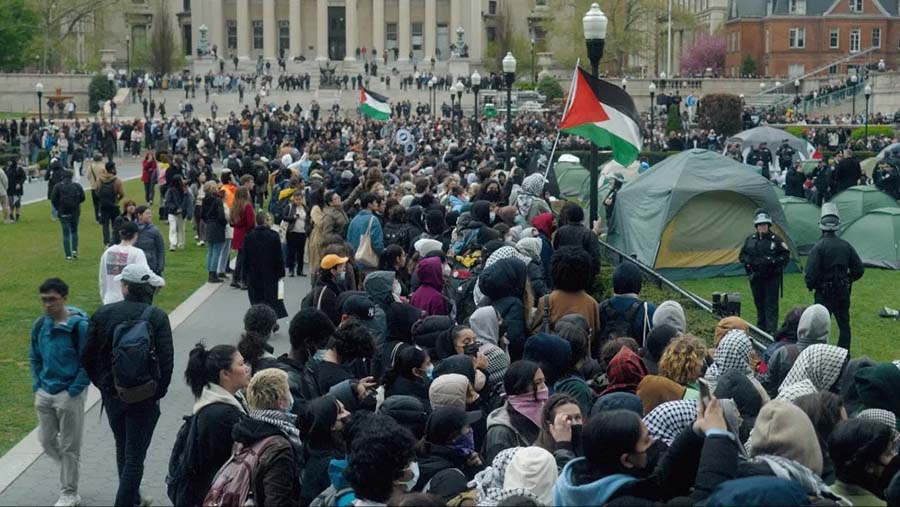
Last Friday, Deborah and I attended a screening of “The Encampments” at the Varsity Theater. It’s a documentary about the agitation at Columbia University against U.S. complicity in Israel’s violent campaign of ethnic cleansing and the national and global campus protests the Columbia protest sparked. Noting its close resemblance to the student protests against our war in Vietnam, I sensed that this issue has now become the defining moral issue for this country.
The war in Gaza exposed what had been largely hidden for too long, and now people of conscience feel they must take a stand. For American Jews, where we stand will depend on our self-understanding. Will we adhere to a problematic idea of national identity or will we champion the values we accused the Nazis of so egregiously violating in the name of “Aryan” supremacy?
Might it emerge again that what is essential to Jewish identity is the prophetic calling? That calling is a mixture of heightened moral sensitivity, revisionary imagination, self-criticism, self-love and, along with all of those other characteristics, courage, both physical and spiritual. It’s dreadfully ironic that the greatest of all Jewish prophets was appropriated by people who persecuted Jews in his name. But what has today’s column been about if not dreadful historical ironies?
Herbert Rothschild’s columns appear Fridays. Opinions expressed in them represent the author’s views. Email Rothschild at herbertrothschild6839@gmail.com.