If Ukraine’s spring offensive doesn’t change the course of the war, Zelenskyy should seek a diplomatic resolution
By Herbert Rothschild
For at least the last six months, the war in Ukraine has been a war of attrition. The primary theater was the city of Bakhmut. The city was of no strategic military value to Ukraine, but its government justified a block-by-block defense of the ruined city by saying the fighting took a high toll on Russian lives. That was true. Yevgeny Prigozhin, head of the Russian paramilitary Wagner Group, said he lost more than 20,000 men there.

The government of Ukraine doesn’t report casualties, but they also were high. The New Yorker ran a “Letter from Ukraine” in its May 29 issue. It was Luke Mogelson’s report on the weeks he spent with the 28th Brigade on the front line just south of Bakhmut. He learned that within weeks of the battalion’s posting on the edge of a village south of Bakhmut, it “faced annihilation: entire platoons had been wiped out in close-contact firefights, and some seventy men had been encircled and massacred.”
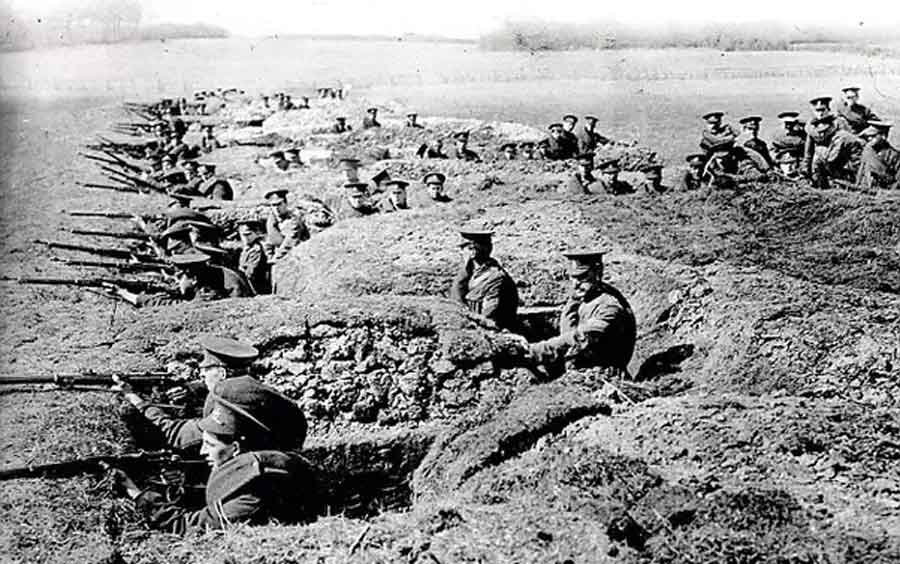
Mogelson’s reporting reads like accounts of the stalemated Western front in World War I, with its constant artillery shelling, machine gun fire, and exhausted infantrymen living in miserable conditions in their trenches. Ukraine’s much-anticipated spring offensive may have begun this week, and its forces may make a decisive breakthrough. An equal likelihood is that it will resemble the 1916 Somme Offensive. Launched along a 12-mile front by British forces on July 1, that first day they sustained 60,000 casualties. By the time the offensive ended on Nov. 18, more than a million men on both sides had been either killed or wounded, and the British and French had pushed just 10 kilometers (6.2 miles) at the farthest beyond their original positions.
Volodymyr Zelenskyy is a hero. Instead of fleeing when it seemed that Russian tanks would roll into Kyiv at the start of the war, he stayed and rallied the population to fight. Ukraine will remain a sovereign state thanks to the brave resistance he led. He has served his country magnificently. The issue now is whether his insistence that the fighting won’t stop until Ukraine regains every inch of territory that it controlled before 2014 is a service to his people.
Fighting for one’s country is fighting for an abstraction. Not every abstraction is vapid; patriotism certainly isn’t. But the lives of Ukrainians shouldn’t be sacrificed on an altar of national honor. The suffering of those who have stayed and those who chose exile is too great to prolong if there is a way to end it that doesn’t entail equal or greater suffering.
In December Putin indicated a willingness to negotiate. The invasion proved to be a costly miscalculation, and undoubtedly he knows that his original goal of absorbing Ukraine into Russia is beyond reach. But while he seems ready to cut his losses, it’s folly to think he will simply withdraw. He has at least as much capability as Ukraine to prolong a war of attrition. If the spring offensive doesn’t change the course of the war, Zelenskyy should seek a diplomatic resolution.
This weekend an International Summit for Peace in Ukraine is being held in Vienna. It’s an effort by civil society activists from North America, the Global South and Europe, including representatives from Russia and Ukraine, to induce national governments to open negotiations. The conference program can be found at peacevienna.org.
Also on that site is a statement by Werner Wintersteiner, founding director of the Centre of Peace Research and Peace Education at Klagenfurt University, Austria, about the rationale of the conference. He notes the world-wide impacts of the war. These include “rising food and energy prices and a shortage of cereal products, which is exacerbating poverty and triggering famines, especially in the Global South.” The war is “draining valuable resources that are desperately needed for food and health and the fight against ecological disasters.”
Because our greatest leverage as Americans is on our own government, I found two passages in Wintersteiner’s statement of special interest. Readers of this column will recognize them as matters I addressed even before the invasion began (Note: At places his statement has been awkwardly translated):
“While there is no excuse or justification for the Russian aggression, it is, globally speaking, only one of many examples of violations of international law. In regard to the historical, political-economical and geopolitical contexts of this war, we must be aware of US’ and NATO’s co-responsibility for the non-resolution of the deeper conflicts regarding the European security architecture after 1989 and especially over NATO-enlargement, contributing to the escalation of this long-term conflict. The insight of this mistake and this wrong basic attitude is also a prerequisite for a lasting peace settlement.
“The deeper historical and geopolitical context of this war transcends Ukraine and Russia and includes the conflict between Russia and US over the control of Eastern Middle Europe. It is due to this complex constellation that the fighting is being waged with such bitterness, and that there is always the threat of uncontrollable escalation, to the point of a world war and even a nuclear war.”
I fear that powerful segments of our national security establishment want the war to go on indefinitely. They see it weakening Russia while costing us no lives. As for the cost of our material support of Ukraine, it’s a boon to our military-industrial complex, which is a major driver of our foreign policy.
Interestingly, it’s Republicans who have objected to writing a blank check to Zelenskyy. Their motives may ignore the valid claims Ukraine’s resistance to aggression have on us. Trump has deferred to Putin in puzzling and objectionable ways, and MAGA Republicans have taken their cue from him. Still, his and their general unwillingness to kowtow to the orthodoxy of our national security establishment is in my view welcome, and may provide peace activists with allies in D.C. to advocate for a diplomatic end to a war that defies a military resolution.
Herbert Rothschild is an unpaid Ashland.news board member. Opinions expressed in his columns represent the author’s views and may or may not reflect those of Ashland.news. Email Rothschild at herbertrothschild6839@gmail.com.