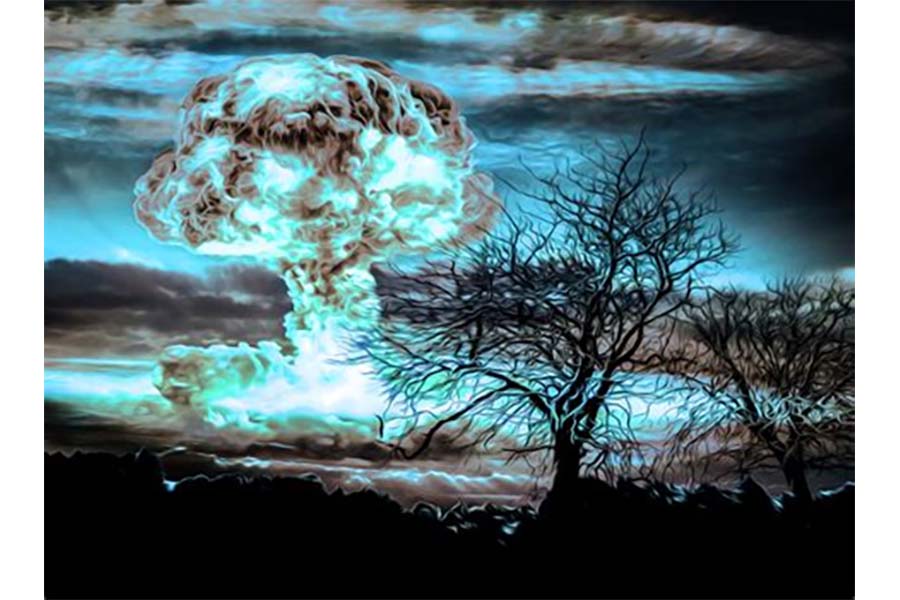
You and I are alive today by the skin of our teeth
By Herbert Rothschild
Neither we humans nor our technologies are infallible. Nonetheless, we have given ourselves little margin for error to avert a nuclear holocaust. Fewer than 30 minutes, to be precise. That is because the U.S. and Russian land-based ICBMs are kept on “launch on warning” status and, once launched, they cannot be recalled.

That policy was adopted because in the 1970s, as both the United States and the Soviet Union improved the accuracy of their ballistic missiles, their silo-based missiles became more vulnerable. If one side could strike the other’s missiles before the other side could launch them in retaliation, then a first strike was thinkable, at least in theory. So, the two nuclear superpowers adopted a “use them or lose them” strategy. They built early warning systems consisting of ground-based radars and satellite sensors to enable them to launch their missiles before an incoming attack could destroy them.
Given that both the U.S. and Russia have submarines at sea carrying nuclear-armed long-range ballistic missiles and their locations are extremely hard to determine, keeping our land-based ICBMs on high alert doesn’t really affect the likelihood of an intentional nuclear war. It has greatly increased, however, the likelihood of an unintentional nuclear war. Indeed, you and I are alive today by the skin of our teeth.
At 3 a.m. Nov. 9, 1979, Zbigniew Brzezinski, national security adviser to President Jimmy Carter, was awakened with the news that the North American Aerospace Defense Command was reporting a Soviet missile attack. U.S. nuclear forces were put on high alert before officials realized it was a false alarm caused by a training tape being run in the system.
Months later, in May and June 1980, three more false alerts occurred. The alleged cause of the errors was the failure of a 46 cent integrated circuit in a NORAD computer, but Secretary of Defense Harold Brown reported to President Carter that NORAD “has been unable to get the suspected circuit to fail again under tests.”
Prompted by these glitches that could have triggered a nuclear war between the U.S. and the U.S.S.R., in 1980 the House Committee on Government Operations held hearings on nuclear war strategy and false alerts. The committee found that there had been numerous false alarms and system malfunctions in recent years, more than had been publicly disclosed.
The U.S.S.R.’s warning system experienced similar near-disastrous errors. We know of at least three.
On Sept. 26, 1983, its system falsely reported the launch of multiple U.S. intercontinental ballistic missiles. Soviet Lt. Col. Stanislav Petrov, the officer on duty, correctly identified it as a false alarm, averting a nuclear war.
Later that year, the Soviets misinterpreted a NATO military exercise called Able Archer 83 as preparation for a genuine nuclear first strike. That led the Soviets to ready their nuclear forces and air units in East Germany and Poland for possible retaliation.
On Jan. 25, 1995, Russian radar operators detected a rocket launch off the coast of Norway. Initially believed to be a U.S. submarine-launched ballistic missile, it triggered Russia’s nuclear command and control system. The rocket was actually a Norwegian scientific rocket studying the aurora borealis, but by mistake Russia had not been notified of the intended launch.
Since then, the chances for such errors have multiplied because China and North Korea have developed nuclear-armed ICBMs and their relationships with the U.S. have been cast as adversarial.
There is no reason to perpetuate this enormous folly. Without compromising our ability to retaliate and thus effectively to discourage a nuclear attack on us, we should end our launch-on-warning policy. We could and should go further and scrap our land-based ICBMs entirely. Their sole utility is to launch a first strike on an adversary, an option so stupid and evil that you may be shocked to learn our government has refused to foreswear it.
Rather than lead the world to greater safety in these ways, we have now embarked on a total replacement of our land-based ICBMs, the Minute Man III, with something called the LGM-35 Sentinel. Originally projected to cost $77.7 billion, the estimate has been revised upward to $141 billion.
The decision to build this new generation of ICBMs didn’t arise from any real or perceived threat, nor from any urgent need for modernization. It came about as part of a deal struck between President Barack Obama and the ICBM Coalition. The ICBM Coalition consists of six senators (five Republicans and one Democrat) representing the states that house the U.S.’s land-based missiles launch sites — North and South Dakota, Wyoming, and Montana, as well as Utah. Obama needed those six votes to ratify the new START treaty; the senators wanted a pledge to modernize that component of our nuclear forces.
As I’ve said before in Relocations, it’s often impossible to separate our foreign and military policy decisions from the economic self-interest of our military-industrial complex. That’s not the case with the Sentinel program. It is all about the money. It’s true that after the decision to build and deploy it was made, the U.S. Strategic Command justified the program by asserting that without our ICBMs, an adversary would need to attack only six targets — two submarine bases, three bomber bases, and Washington, D.C. — to defeat the U.S. That assertion purposely ignored the reality that at any given time most of our subs are at sea and that our bombers can be airborne within a few minutes and can be recalled if the alert proves erroneous.
Such bad-faith appeals to national security can’t disguise the most important reality about the country we live in — that it’s a military empire and those who profit from the empire wield preeminent political power. In my lifetime there were two opportunities to change that reality. The first was in 1976, after the Vietnam War. The second was in 2008, after the wars in Afghanistan and Iraq had proved disastrous. Sadly, neither Jimmy Carter nor Barack Obama had the vision or perhaps the moral courage to capitalize on popular disenchantment with U.S. militarism.
I don’t foresee another such opportunity arising. Those of us who know the true cost of the empire, to ourselves and to other peoples, must speak our truth without hope of meaningful change.
Herbert Rothschild’s columns appear on Friday in Ashland.news. Opinions expressed in them represent the author’s views. Email Rothschild at herbertrothschild6839@gmail.com.