At any time, any place on earth can be one of its dark places
Warning: This column contains descriptions of historical violence, including sexual violence, readers may find offensive or disturbing.
By Herbert Rothschild
Jane Austen’s “Mansfield Park,” published between the better-known “Pride and Prejudice” and “Emma,” like them has a young woman as its central character and her rocky journey to matrimonial bliss as its main plotline. Uniquely, though, all the significant action takes place on the country estate where she comes to live at age 9 and grows to maturity. Thus, the title of the novel.

For the heroine, Fanny Price, Mansfield Park epitomizes civilized order. After being forced at 18 to return to her far less wealthy parents’ home in Portsmouth for three months, she contrasts that rather chaotic household to the one she left: “In her uncle’s house there would have been a consideration of times and seasons, a regulation of subject, a propriety, an attention toward everybody which was not here.”
Actually, all is not well at Mansfield Park. The two oldest of the four children are selfish and willful. In different ways they threaten its order. Its master, Sir Thomas Bertram, like Mr. Bennett in Pride and Prejudice, is finally forced to recognize that he has partially failed as a father. But the gravest threat to this idyll of civility and consideration of others neither he nor Jane Austen acknowledges — that its monetary prop is slave labor.
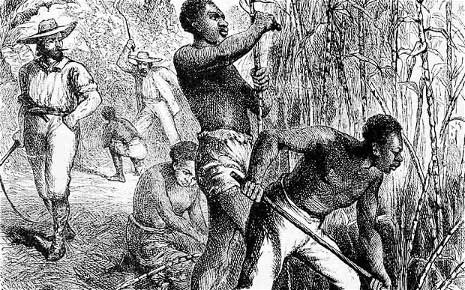
Not that Sir Thomas’s sugar plantation in Antigua is kept a secret. Early in the novel he and his older son leave to set things straight there. It’s just that no mention is made of its slave labor, much less of the appalling conditions under which slaves lived and labored on Britain’s Caribbean plantations. Parliament didn’t end slavery in the British colonies until 1834, more than two decades after Austen completed her novel.
The creators of a 1999 film adaptation of Mansfield Park made slavery an issue. It attributed the older son’s waywardness to his horrified reaction to what he witnessed when he accompanied his father to Antigua. At one point, the sketches Tom made there spill out before his father and Fanny (and us), depictions of rape and torture. That’s not part of Jane Austen’s world.
Or of England generally. Only recently have the British begun to acknowledge the worldwide oppression that undergirded their country estates and urban gentility. Far from being free of the bloodshed and cruelty that characterize the administration of all imperial regimes, their historical record is splashed with gore.
For example, when you and I were young, we were led to believe that the brutality of the Mau Mau uprising in Kenya (1952-1960) was all perpetrated by “black savages.” In fact, what the rebels did paled in comparison with the actions of the British forces that suppressed the rebellion.
The Kenya Human Rights Commission has reported that 90,000 Kenyans were executed, tortured or maimed during the crackdown, and 160,000 were detained in appalling conditions. David Anderson, a professor of African Politics at Oxford University, wrote, “Everything that could happen did happen. Allegations about beatings and violence were widespread. Basically you could get away with murder. It was systematic.” In “Mau Mau: An African Crucible” (1990), UCLA anthropologist Robert B. Edgerton wrote, “Electric shock was widely used, and so was fire. Women were choked and held underwater; gun barrels, beer bottles, and even knives were thrust into their vaginas. Men had beer bottles thrust up their rectums, were dragged behind Land Rovers, whipped, burned, and bayoneted.” Barack Obama’s grandfather was among those tortured. According to his widow, British soldiers forced pins into his fingernails and buttocks and squeezed his testicles between metal rods.
Such are the intertwinings of civility and savagery. No nation refrains from cruelty when it dominates another. Within every people is a heart of darkness. On the deck of a ship waiting in the lower reach of the Thames for the tide to turn, Conrad’s narrator says without preamble, “And this also . . . has been one of the dark places of the earth.” Thus begins Marlow’s story of the Belgian civilizer Kurtz’s descent into barbarism in the Congo. By the end of the famous tale, we know that at any time any place on earth can be one of its dark places.
Must we infer that civility is only a veneer hiding our true nature? Is Mansfield Park a fiction within a fiction, the construct of an author who would not look at the truth of the world she depicted? This isn’t a literary question. The most consequential of the culture wars now raging in the U.S. is whether we can acknowledge the savagery of our past, especially our campaigns to exterminate Native Americans and our enslavement of Africans, and still believe the nation merits our loyalty. Must we choose between truth and patriotism?
It’s difficult for the Western mind to affirm two opposing truths — that the English, say, could bequeath to their subject populations democracy and the comprehensive rule of law even as they knelt on their necks, or that the Israelis can build an intellectually and culturally extraordinary society even as they brutalize the Palestinians whose land they’ve never stopped stealing. For all the betrayals of its proclaimed values, this nation was founded on an historically unique faith in the capacity of people freely to choose the good life individually and collectively, and the nation is gradually purging itself of its defective understandings of which people share that capacity.
Our Mansfield Parks need not be inextricably bound to slave plantations in Antigua. Technology has created a world of material abundance; we no longer must live at a high cost to each other. But unless we look into the heart of darkness, we surely will.
Herbert Rothschild is an unpaid Ashland.news board member. Email him at herbertrothschild6839@gmail.com.