Such campaigns exact a huge human toll for little-to-no strategic gain
Oct. 10, 2022: Russia targeted civilian areas and energy infrastructure as air raid sirens sounded in every region of Ukraine, except Russia-annexed Crimea, for four straight hours. (Yahoo! News)
By Herbert Rothschild
Starting in October, Russia has been attacking Ukraine’s power and water infrastructure with long-range cruise missiles, launching as many as 100 in one day. As Ukraine’s President Volodymyr Zelensky said in a caption he wrote for a video showing a huge blast in the city of Dnipro on Nov. 17, “The terrorist state (Russia) actually wants to bring Ukrainians only more pain and suffering.”

The missile strikes certainly have done that. They’ve disrupted delivery of heat and electricity to the civilian population just as winter has set in. I’ve seen no reports, however, that they’ve eroded Ukraine’s ability or will to defend itself against the invasion, and I doubt that I will. If military objectives are the rationale for the attacks, Putin should have known better.
This air campaign by a combatant losing the ground war puts me in mind of the U.S. bombing of Hanoi and Haiphong in December 1972. Militarily, we named it Operation Linebacker II (Johnson’s bombing campaign was Linebacker I); it’s usually referred to now as the Christmas bombings. In Vietnam, it’s called “12 days and nights.” From Dec. 18 to 29, with a pious pause on Christmas Day, 741 B-52s conducted the heaviest bomber strikes since World War II; more than 20,000 tons of explosives were dropped. I drove with my wife and three children from Santa Cruz, where I was spending a sabbatical year, to San Francisco to participate in what may have been the last large rally to protest the war. The useless devastation was heartbreaking.
Nixon and Kissinger said the goal of the bombings was to bring the North Vietnamese back to the bargaining table. They had left it after Nguyễn Văn Thiệu, head of the government in Saigon, objected to the tentative agreement reached in talks between the U.S. and the government in Hanoi, talks from which Saigon had been excluded. But the Christmas bombings didn’t weaken the resolve of the North Vietnamese. Instead, they further weakened the resolve of Americans, who had become sick of the war. All Nixon and Kissinger achieved was to bring the Vietnamese more pain and suffering.
It’s hard to dismiss spite as a motive for aerial assaults on civilian targets unassociated with ground offenses against them. That’s especially true because retrospective studies of such assaults during WWII had revealed that they do little to impede fighting capacity and, if anything, strengthen the popular will to carry on.
Germany’s planned invasion of England depended on achieving air superiority. Despite sustained bombing of British airplane factories and airfields in August and early September, 1940, fighter production slightly increased during that period. “The Blitz” — meaning the bombing of metropolitan London — began in mid-August with attacks on port facilities, power stations, armament factories and docks. On Sept. 7, more massive raids began and, as daylight raids were soon phased out and night raids continued into May 1941, civilian casualties rose. Yet, the Mass-Observation project, which collected thousands of testimonies by British volunteers during World War II, concluded that the Germans gained nothing by bombing British civilian targets. In fact, Hitler had indefinitely postponed the invasion of England on Sept. 17 and turned his attention to planning the invasion of the Soviet Union. In large part the continuation of the Blitz was a way to mask that redirected focus.
The same futility was largely true of the more intense Allied bombing of German and Japanese cities. The United States Strategic Bombing Survey, an assessment of the effectiveness of the air war against Germany initiated in November 1944 and released to the public in October, 1945, reported that the overall rate of production of war materiel by Germany actually increased in response to strategic bombing by the Allies. Destroyed factories were quickly reconstituted in hardened sites. The survey also studied the effectiveness of our massive bombing of Japanese cities. Its conclusions generally echoed those about the bombings in Germany. In various ways the bombings probably hampered Axis war efforts somewhat, but far from decisively. And the civilian death tolls were terrible.
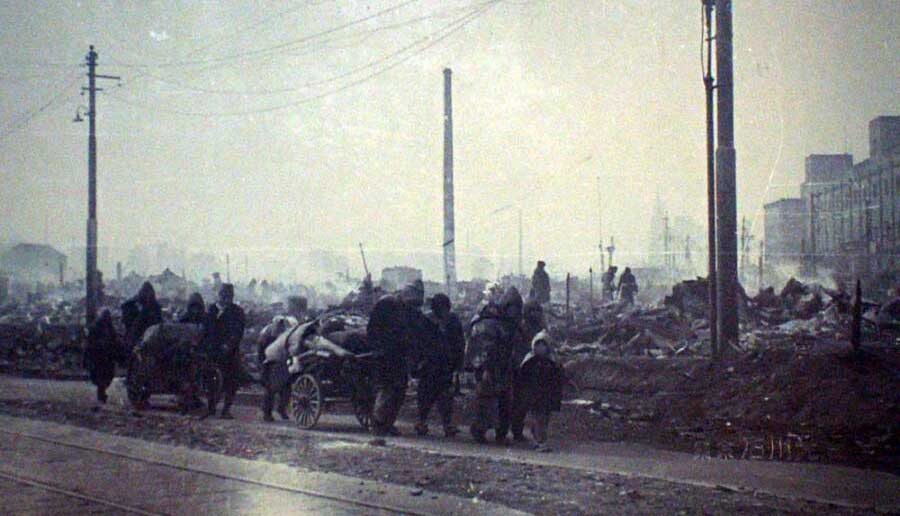
Every major German city was decimated. The firebombing of Dresden, for example, claimed 25,000 lives. A single attack on Tokyo (March 9-10, 1945) left 16 square miles of its downtown burned out, with estimates of fatalities ranging from 88,000 to 100,000. A British Air Staff paper, dated Sept. 23, 1941, said, “The ultimate aim of an attack on a town area is to break the morale of the population which occupies it.” That never happened. The Japanese wouldn’t give up even after both atomic bombs were dropped. Only when the U.S. agreed to let them retain their emperor, which we could have done earlier, did they surrender.
According to the Office of the UN High Commissioner for Human Rights, from Feb. 24, when Russia invaded Ukraine, through Nov. 13, 6,557 Ukrainian civilians have been killed and 10,074 injured. That’s far fewer casualties than in the previous wars I’ve mentioned. But Russia’s recent reliance on long-range bombardment bodes ill. It may be Putin’s way of masking despair over a military victory, his attempt to stem disenchantment with the war at home, and sheer spite. That’s a toxic brew.
Herbert Rothschild is an unpaid Ashland.news board member. Opinions expressed in columns represent the author’s views and may or may not reflect those of Ashland.news. Email Rothschild at herbertrothschild6839@gmail.com.