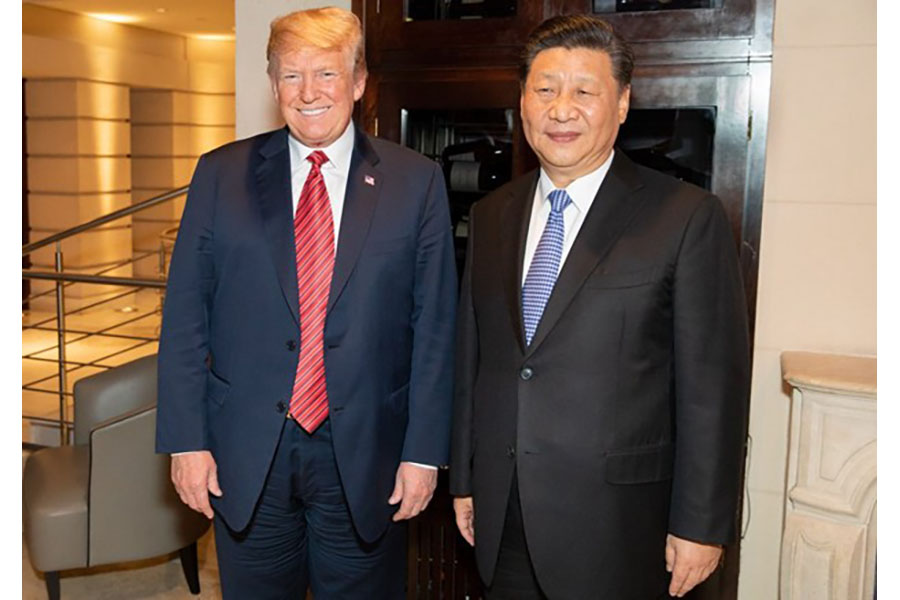
We now find ourselves in a schizophrenic relationship
By Herbert Rothschild
Recently, I had the privilege of being at a social gathering that included Nicholas Kristof, Pulitzer Prize-winning columnist for The New York Times. Kristof is brilliant, which made me hesitate to engage him in political conversation. But he’s also down-to-earth sociable, which got me over my hesitation.

I began by asking him whether he had received pushback for his pieces criticizing Israel’s treatment of the Palestinians. Some, he replied, but not enough to create a problem. I then said I was glad I no longer had to watch Antony Blinken (Biden’s secretary of state) simultaneously wagging his finger at (Israeli Prime Minister Benjamin) Netanyahu and defending Israel from attempts by the international community to call Israel to account.
Referring to him as Tony — which struck me as the difference between being a columnist for The New York Times and for Ashland.news — Kristof said Blinken had done excellent work strengthening our alliances in the Pacific region against China. “If you think that’s the right way to approach our relations with China,” I said, and dropped the subject. Others wanted his attention.
But I would have liked to talk with Kristof about our stance toward China. I would have profited from it. Indeed, our country would profit from a thoughtful conversation about the relationship, but I fear we won’t have it. One of the few points of agreement between Republican and Democratic politicians is that China is the primary threat to our national security and it is best countered by military containment.
The two primary influences shaping that consensus in D.C. are a misapplication of historical experience and the power of the military-industrial complex.
Our policy of military containment of the Soviet Union that began shortly after World War II is largely attributable to George F. Kennon, who was then U.S. chargé d’affaires in Moscow. In his famous “long telegram,” Kennon argued that the U.S.S.R. wouldn’t consider peaceful coexistence with the capitalist West, so the U.S. had to contain the spread of Communism by military and economic means. His understanding became the basis of a “Cold War” strategy that, with varying intensity, prevailed until the emancipation of Eastern European countries from Soviet domination and the breakup of the U.S.S.R.
That strategy, and especially the way it played out in developing countries, can be criticized, but if its goals were to prevent Soviet territorial expansion and ultimately to eliminate the only challenge at that time to our global hegemony, undoubtedly it worked. Thus, it’s tempting to apply the same strategy to a China that is challenging our dominance in the Asia-Pacific region.
The role of the military-industrial complex in promoting containment of China is obvious. “If all you have is a hammer, everything looks like a nail.” We do have other policy tools, but none nearly as large and politically powerful. That tool requires reasons to justify its cost, now more than $1 trillion annually.
To indicate how profitable to our weapons makers the military containment of China will be, consider “Pillar 1” of AUKUS, a military alliance of Australia, the U.K. and the U.S. that Blinken midwifed. Central to Pillar 1 is Australia’s acquiring nuclear-powered attack submarines. Raytheon Australia was awarded a $202 million contract to provide in-service support and combat system upgrades to Australia’s diesel-electric submarines as they transition to nuclear power. As I noted in a column last year about the connections between our foreign policy establishment and military contractors, Raytheon was the largest client of Westexec, a strategic consultancy firm that Blinken co-founded before he became secretary of state.
Powerful as the military-industrial complex is, however, the combined might of U.S. corporations is greater. When China invited them to shift their manufacturing operations there, offering very cheap labor and few regulations, the intertwining of our two economies began. Thus, we now find ourselves in a schizophrenic relationship with China, both halves of which strike me as wrongheaded. I don’t think we should have granted China Most Favored Nation trading status, but neither do I think we should regard it as a hostile power against which we should prepare to make war.
Because of abiding anti-Communist sentiment and China’s miserable record on human rights and democracy, only in 2001 was China’s temporary MFN status, first granted in 1980, made permanent. Early in his first term, President Bill Clinton had linked renewal of China’s MFN status to seven human rights conditions, but a year later he reversed himself. Then, near the end of his second term he successfully pressed Congress to pass the United States-China Relations Act of 2000, allowing China to join the World Trade Organization and gain permanent MFN status.
China hasn’t played fairly, though. It did cut tariffs on U.S. imports, but among other violations of WTO rules it continued to steal U.S. intellectual property and forced U.S. companies to transfer technology to access the Chinese market.
On balance, the American people haven’t benefited from our trade relationship with China. Many goods got cheaper, but the offshoring of production helped hollow out our domestic manufacturing and repress wages generally. Further, our national security has been jeopardized by our reliance on Chinese manufacturing of critical goods like computer chips and the processing of rare earths, which we could source elsewhere. The dollars China gains from its annual trade surpluses with us help fund its Belt and Rail development assistance projects, a major way it has gained global influence. And it has used 757 billion of them to buy bonds funding the U.S. debt.
To give so much leverage over us to a country we regard as the chief threat to our national security makes little sense. But so does treating China as if it is identical to Stalin’s U.S.S.R. Other than a desultory attack on Vietnam after the U.S. finally withdrew, China has shown no interest in acquiring territory that, unlike Tibet and Taiwan, it hasn’t long regarded as historically part of China. Rather, it has relied on trade and aid and diplomacy to expand greatly its influence around the world.
I have no space in this column to lay out what I regard as a proper policy toward China. I’ll just say that I mostly align myself with “competitive co-existers” like Jessica Chen Weiss, professor of government at Cornell, and leave it at that for now.
Herbert Rothschild’s columns appear Fridays. Opinions expressed in them represent the author’s views. Email Rothschild at herbertrothschild6839@gmail.com.