Supporting the global effort to make corporations take responsibility
By Herbert Rothschild
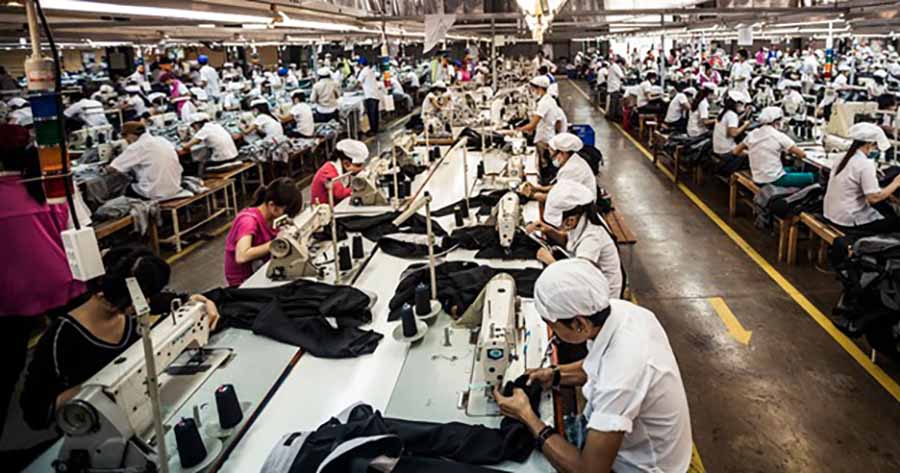
In a globalized economy, it’s impossible to keep our hands clean. The supply chains of so many of the products that end up in our homes are long and complex, and they often begin in countries like China, India and Vietnam, where labor protections are weak.

Beginning with the Tariff Act of 1930 (Smoot Hawley), by law no products made with forced labor can be legally imported into the U.S. Identifying such products, however, has become increasingly difficult. The most progress has been made with imports from China. In the last few years, Congress and the executive branch have taken specific steps to reduce the importation of goods made by forced labor there, with a particular focus on China’s use of Uyghur labor.
Forcing Uygyhurs to work in conditions approaching slavery has been part of the Chinese government’s unconscionable treatment of them and other Turkic and Muslim-majority peoples living in Xinjiang Province. In addition to making them to work in the Xinjiang cotton fields, it makes them work in factories built inside or near their “reeducation” camps and transports them to factories across the country.
The Chinese retailer Temu, a vast on-line bazaar for cheap goods, almost certainly sources goods made with forced Uyghur labor, and the fast-fashion online purveyor Shein almost certainly uses Xinjiang cotton in its products. In 2022, Congress passed the Uyghur Forced Labor Prevention Act. Until this year, however, Temu and Shein had largely been able to escape enforcement by using the de minimis rule that excluded from inspection and duties packages with a declared value of less than $800. The administration of President Donald Trump ended that exclusion for packages from China. Early last month, Temu stopped all direct shipments to the U.S., and Shein changed its home base to Singapore.
Corporations based in the U.S. as well as China have sourced their products, or components thereof, from farms and factories using Uyghur labor. In a 2020 report titled “Uyghurs for Sale,” the Australian Strategic Policy Institute asserted, “Under conditions that strongly suggest forced labour, Uyghurs are working in factories that are in the supply chains of at least 82 well-known global brands in the technology, clothing and automotive sectors, including Apple, BMW, Gap, Huawei, Nike, Samsung, Sony and Volkswagen.”
To single out one company from this list, Apple repeatedly pledged to end human rights abuses, including child labor, poor working and living conditions, forced overtime, and more, at facilities run by its Chinese suppliers. Still, it has acted to rectify abuses only after watchdog groups have outed it, as they did with the Foxconn factory in Zhengzhou, the largest iPhone factory in the world, and O-film, which supplied camera modules for iPhones.
Given Trump’s tariff war with China, U.S. corporations are looking elsewhere to source products or components. India is a likely choice. Regarding forced labor and child labor, that’s like going from the frying pan into the fire. While there’s no evidence that the Indian government itself engages in such practices — indeed, forced labor and child exploitation are illegal there — according to the Global Slavery Index, there were an estimated 7,989,000 people enslaved in India in 2018.
Returning to Apple, when it transfers its entire iPhone production to India and its production of almost all iPad, Mac, Apple Watch and AirPods products sold in the U.S. to Vietnam (CEO Tim Cook announced those moves on May 1), probably it will use the same manufacturer it used in China. Hon Hai Technology Group, the parent company of Foxconn, is the world’s largest electronics manufacturer. It’s now making a $1.5 billion investment in India. If its labor record in Zhengzhou is any indication, Foxconn will only behave well in India and Vietnam under scrutiny.
Given that maximizing profits is the cornerstone of the capitalist ethos, scrutiny with severe consequences is the only reliable check on bad corporate behavior of all sorts. Such scrutiny is far beyond our capacity as individuals. Fortunately, regarding forced and child labor, there is increased scrutiny by the U.N.’s International Labor Organization and nonprofits like Walk Free, Transparentem and Freedom United, as well as some governments, such as the United Kingdom, Norway and the U.S.
The Bureau of International Labor Affairs (ILAB) within the U.S. Department of Labor maintains a list of goods and their source countries that it has reason to believe are produced by child labor or forced labor in violation of international standards. Unfortunately, the products are not listed by brand name, only by what they are (e.g., cobalt, textiles, chocolate). Nor does the ILAB require corporations to disclose whether they are sourcing such products, much less cease doing so. It only offers a tool to help them do so if they choose.
The 2010 California Transparency in Supply Chains Act does require disclosure. The act applies to all retailers and manufacturers, no matter where headquartered, if they do business in California and have an annual worldwide gross revenue exceeding $100 million. Covered corporations must publish annual reports detailing their efforts to eradicate human trafficking and modern slavery in their direct supply chains. There are no penalties, however, for sourcing such goods. The goal is transparency for the sake of the consumer.
As the global movement ramps up to broaden and strengthen laws identifying and penalizing corporations producing or sourcing materials made by forced or child labor, we should welcome that work. We might even try in the next general session of the Oregon Legislature to pass a law similar to California’s, but with more enforcement tools. Perhaps Phil Knight will support it as a way of authenticating Nike’s contested claim that it is committed to fair labor practices in its supply chain.
Herbert Rothschild’s columns appear Fridays. Opinions expressed in them represent the author’s views. Email Rothschild at herbertrothschild6839@gmail.com.