Though Big Pharma and intermediaries known as pharmacy benefit managers blame each other, they both bear responsibility
By Herbert Rothschild
When Lars Fruergaard Jørgensen, the CEO of Danish drugmaker Novo Nordisk, appeared before the Senate Health, Education, Labor and Pensions Committee on Sept. 24, he was grilled about the high prices U.S. consumers must pay for the popular diabetes and weight loss drugs Ozempic and Wegovy.

Sen. Bernie Sanders, the committee chair, noted that the list price for a four-week supply of Ozempic is $969 in America, but the drug can be purchased for $155 in Canada, $122 in Denmark and $59 in Germany. Similarly, Wegovy’s list price is $1,349 in the U.S., but it costs $186 in Denmark, $140 in Germany and $92 in the United Kingdom.
Jørgensen at one point said that the key drivers of high drug costs in the U.S. were pharmacy benefit managers. He contended that PBMs — the middlemen who negotiate drug prices between pharmaceutical companies, insurers, and pharmacies — play a significant role in the complex pricing structure that leads to high medication costs.
Until I read a report on that hearing, I had never heard of PBMs. It turns out that Jørgensen was right to the extent that they do play a major role in determining the prices that consumers must pay. Their function, as stated on the website of the Pharmaceutical Care Management Association, the PBMs’ industry group, is to “administer prescription drug plans for more than 275 million Americans who have health insurance from a variety of sponsors including: commercial health plans, self-insured employer plans, union plans, Medicare Part D plans, the Federal Employees Health Benefits Program (FEHBP), state government employee plans, managed Medicaid plans, and others.”
In our country, pharmaceutical companies go through the PBMs. As intermediaries, the PBMs negotiate drug prices, manage formularies (menus of approved drugs that patients can get at a reduced cost through their insurance plans) and process prescription claims.
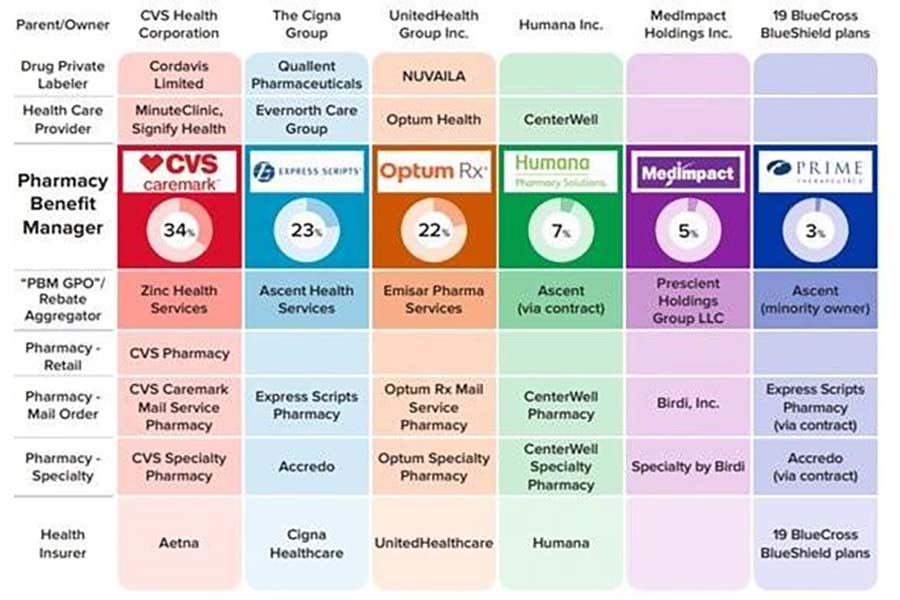
Six PBMs control 95% of the business. Three of those — Humana Pharmacy Solutions Inc.; Prime Therapeutics LLC; and MedImpact Healthcare Systems Inc. — together control 15%. The other 80% is controlled by CVS Health (Caremark), a division of CVS Health, which also owns the CVS chain of drug stores and health insurer Aetna; Express Scripts, a division of the insurance company Cigna; and OptumRx, a subsidiary of UnitedHealth Group, a major health insurance company. Aetna, Cigna and United Health Care administer Medicare Advantage plans. In all three cases, the corporate integration of PBMs, drug retailers and health insurers offers many opportunities to maximize profits at consumers’ expense.
I subsequently learned that Jørgensen’s effort to pass the blame for high drug prices onto the PBMs is what the pharmaceutical industry as a whole is doing. PhARMA is the lobbying group for the major pharmaceutical companies. Unsurprisingly, its mission statement goes like this: “As we work toward a patient-centered health care system, we seek to advance innovation, make medicines more affordable and create a more just system. As such, our programs and initiatives strive to build greater equity into health outcomes, clinical trial participation and talent, as well as improve access and affordability and work toward better health.”
And so why isn’t the system getting more just? According to PhARMA, it’s those PBMs. “Patients are paying more than they should and facing barriers to care because middlemen are using medicines as a profit center. In fact, over half of every dollar spent on medicines goes to health insurance companies, PBMs, big pharmacies, and others. They are driving up costs for patients.” PhARMA’s message to Congress is that it “should make sure medicine savings go directly to patients, not middlemen.”
Under this assault, the PBMs haven’t remained silent. In response to Jørgensen’s testimony, the Pharmaceutical Care Management Association released a statement accusing him of trying to shift attention from drugmakers’ practices that keep costs high. “PBMs are the only entities in the health care system working to mitigate the impact on patients, employers, and taxpayers of Big Pharma’s outrageous prices on blockbuster GLP-1s.” Ozempic and Wegovy are GLP-1 drugs. On its website the association claims that “Big Pharma . . . games the system to block competition and keep drug prices high.”
Actually, the drive by both drug makers and drug middlemen to maximize their profits has created a shared blame. A good analogy for their behavior under congressional scrutiny is that of two associates in crime ratting on each other during interrogation at the police station.
It’s difficult to know exactly how to apportion blame between the drug makers and the drug brokers. Probably we would need to examine what happens with the pricing of each drug. Let’s assume that the crime we’re investigating is the price U.S. consumers pay for Wegovy. If that price is listed at $1,349 and parties other than Novo Nordisk get over half, then the drug maker is getting a payoff somewhat shy of $675. That’s still a great deal more than Wegovy’s $186 list price in Denmark, $140 in Germany and $92 in the U.K.
The point here is that the drugmakers do set the starting prices, and if they are high, what consumers will pay will still be high no matter what happens between their entering the market and their end purchase. The PBMs contend that they reduce those starting prices by negotiating down the prices they pay the drug makers. What’s in question, however, is if, and if so, how much of those discounts are passed on to consumers. As we noted above, PhARMA contends that they don’t.
Well, middlemen are entitled to a fair payment for their work, and in some cases the negotiated discounts do reduce the prices we pay. But PBMs have other practices to enrich themselves. One is by extracting rebates from the pharmaceutical companies to list them in the formularies. The rebates aren’t used to reduce what we pay at the pharmacy. Indeed, one charge against the PBMs is that they steer patients to drugs that yield the highest rebates rather than to the most cost-effective or clinically appropriate options.
Another criticism is about what’s called “spread pricing.” PBMs may charge health plans more for a drug than they reimburse the pharmacy, keeping the “spread” as their profit. Still another is called “clawbacks.” The PBMs may require pharmacies to return a portion of the amount they reimburse the pharmacies. And independent pharmacies claim that PBMs reimburse them at rates below cost while favoring PBM-owned or affiliated mail-order and retail pharmacies.
In 2022 the Federal Trade Commission launched an investigation into the impact PBMs have on the accessibility and affordability of therapeutic drugs. This past July it issued an interim report, which confirmed the criticisms discussed above. In September, the FTC brought suit against Caremark Rx, Express Scripts and OptumRx for engaging in anticompetitive and unfair rebating practices that have artificially inflated the list price of insulin drugs. Let’s hope that action is the start of a more comprehensive reform.
Herbert Rothschild’s columns appear Fridays. Opinions expressed in them represent the author’s views. Email Rothschild at herbertrothschild6839@gmail.com.