The end of white male hegemony is imminent, but that’s unlikely to change the world
By Herbert Rothschild
I pledged last week that, until Israel allows the resumption of food aid into Gaza, I would begin every column with a reminder that it is intentionally starving 2 million people. As I write, it’s been 71 days since the last shipment entered.

Now to my topic. Saturday, Deborah and I attended the spring commencement at the University of Texas at Austin because a granddaughter was receiving her BS there. More than 13,000 degrees were awarded. Because there were so many, each college held a separate ceremony during which the graduates walked across the stage and received their diplomas. Then, on Saturday evening, everyone came together in the football stadium for what felt to me like a combination of a traditional commencement and a rock concert. It was very loud and ended with fireworks and a drone light show.
Our granddaughter majored in chemistry, so we attended the ceremony for the College of Natural Sciences. Although math and the sciences were once a male province, I noticed that more women than men were crossing the stage, and WASP names like Jackson and Higgenbotham were no more prevalent than Suarez, Lam and Nguyen. This morning, that small sample sent me to the internet to check out demographics in U.S. higher education.
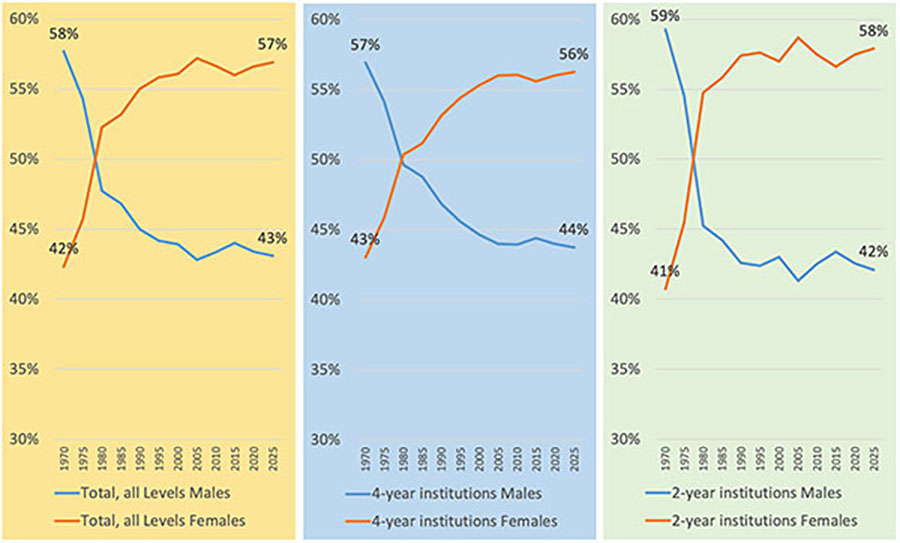
I already knew that women greatly outnumbered men, because that’s an old story. As the graphic I chose for this column indicates, in 1990 the gender imbalance had begun to shift from male to female. A slight reversal of that trending imbalance began in 2005, but in 2015 the gap began widening once again. It now stands at 57% to 43%. There’s a slight difference between four-year and two-year institutions.
When it comes to racial and ethnic diversity, that difference is more pronounced. One would expect this, given that, on average, the family incomes of the largest minorities — Hispanic and Black — are significantly lower than those of white families. Using 2023 data, the percentage of white college students was 41% overall, but it was 45% in public four-year institutions and only 37% in public two-year schools. The largest percentage of white students (46%) was in private four-year schools, where tuition is the highest.
In terms of what matters, majority-minority has always been more about power than numbers. After all, white males never were a numerical majority in the U.S., but we monopolized economic, political and cultural power until the second half of the 20th century. The demographic shifts in higher education that I’ve been discussing will perpetuate and intensify the large gains in power that women and people of color have already made, because college-educated people control the centers of power.
In the 2024 U.S. presidential election, 69% of white men without a college degree voted for Donald Trump, 29% for Kamala Harris. That’s an extraordinary spread. One out of every four votes Trump secured were cast by that demographic.
I’m saying nothing new by asserting that President Trump’s political success has hinged on his promise to restore power to those who believe they’ve lost it. White men without a college degree are the group that most believes it has lost power, and they are right. Unfortunately, they have no understanding of why.
Trump is only the latest Republican who has told them that they lost their power because women and especially peoples of color have been given advantages they didn’t have. Actually, they lost power because automation and globalization changed the structure of our economy, because only 6% of blue-collar workers are now represented in the workplace by labor unions (it was 36% at its height), and, largely because of that shrinkage, the wealthy and the corporations they control came to dominate the Democratic Party as well as the Republican, although Biden worked hard to reverse that trend.
Trump stokes the bigotry of white males and feeds their fears, but he will not improve their lot. He won’t raise the federal minimum wage, which remains at the shameful level of $7.25, and while many states, cities, and counties have set their own higher minimum wages, that is true in blue areas, not red. Nor is he likely to generate more well-paying jobs than Biden’s policies are already on track to create. Indeed, his assault on government programs is certain to worsen the plight of those in his most loyal demographic, because as a whole they are more dependent on government services like Medicaid than the college-educated.
I don’t know how long it will take white males without college educations to realize they’ve been conned. Judging from my experience in the pre-Civil Rights South, where the wealthy played the race card to dissuade poor whites from joining labor unions or building political coalitions with Blacks, I doubt if it will happen soon.
Now for a less data-driven reflection on the UT-Austin graduation. I heard two guest speakers, one at the College of Natural Sciences commencement and another at the university-wide event. They were well-spoken, humane and blessedly brief. They weren’t, however, original. They both developed the familiar theme of individual agency, assuring the graduates of their ability, despite inevitable setbacks, to shape their personal destinies and change the world for the better.
I hope that at least some in their audiences had learned from their studies about the ways systems shape human behavior and about the powerful forces that shape those systems. Doubtless, most of the graduates will be happy to work within those systems and perhaps believe that they are changing the world if they succeed within the limits those systems permit. But for those who really want to have a go at changing the world, they will have to deconstruct those systems intellectually and challenge them practically.
It would have surprised me to hear such a message at the UT commencement. Like so much of U.S. higher education now, UT is deeply involved with corporate money. There was even an electronic billboard near the stadium entrance continually running paid commercials. Given the political climate of the state of Texas, I wouldn’t count on its flagship university — a great university by most measures — to incubate the kind of change agents we so desperately need. White males without college degrees aren’t the only U.S. demographic mystified by power.
Herbert Rothschild’s columns appear Fridays. Opinions expressed in them represent the author’s views. Email Rothschild at herbertrothschild6839@gmail.com.