Sanctions inflict pain on people, not governments
By Herbert Rothschild
“It is hard to think of other policy interventions that continue to be pursued amid so much evidence of their adverse and often deadly effects on vulnerable populations. This is perhaps even more surprising in light of economic sanctions’ extremely spotty record in achieving their stated objectives of inducing changes in the conduct of targeted states.”

So wrote Francisco R. Rodriguez in “The Human Consequences of Economic Sanctions,” a May 4, 2023, paper published by the Center for Economic and Policy Research.
Beginning with Russia’s reclaiming of Crimea from Ukraine in 2014 and intensifying since Russia invaded Ukraine in 2022, the U.S. has attempted with sanctions to isolate Russia from the global financial system, reduce the profitability of its energy sector and deny its access to critical military supplies. These sanctions, supported in part by European Union nations, haven’t achieved their goals.
In February, the Council of Foreign Relations, in an article about the effectiveness of the sanctions, concluded, “Sanctions have inflicted some pain on Russia’s economy, with oil and gas revenue declining in the months after the price cap was implemented and Russian central bank assets at risk of confiscation. But those sanctions have not caused widespread economic collapse or halted Russia’s aggression against Ukraine. In fact, the International Monetary Fund estimates that Russia’s gross domestic product actually increased by 2.2% in 2023 thanks to massive war spending.”
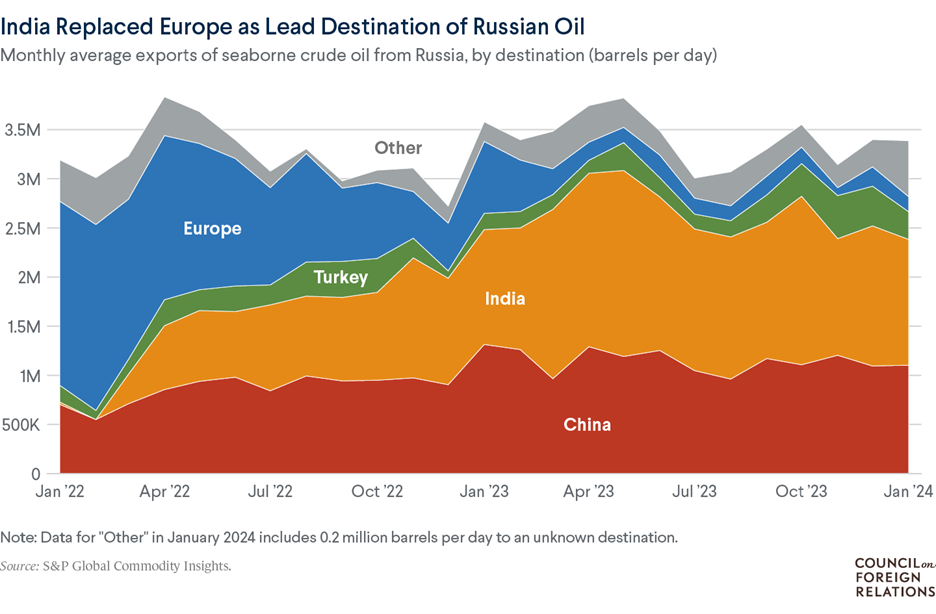
There are two reasons our sanctions against Russia haven’t worked. One is that Russia exports large quantities of materials — oil and gas, fertilizers, wheat and precious metals — that other countries need. Tellingly, the U.S. hasn’t ended its importation of uranium from Russia. The EU, which at the time of the invasion was Russia’s largest energy export market, imposed bloc-wide restrictions on oil and refined oil products, although not a ban on natural gas. India, however, took up almost all the slack.
The second reason the sanctions have failed is that the U.S. and the EU don’t dominate the global economy to the extent they used to. Prior to its 2022 invasion, Russia built up more than $640 billion in central bank reserves, only half of which the West was able to freeze. It is now conducting much of its bilateral trade in rubles. Trade with China has grown significantly, and 90% of it is conducted in rubles and Chinese yuan, compared with 25% before the invasion.
Sanctions have never achieved our stated aims — usually regime change — although our government and its allies in the EU use them with increasing frequency. In the early 1960s, fewer than 4% of countries were subject to sanctions; today it’s 27%. Nearly one-third of the global economy is now subject to sanctions by the U.N. or Western nations. The U.S. currently maintains comprehensive sanctions against Cuba, Iran, North Korea, Syria, Russia and Venezuela, and partial sanctions against Afghanistan, Belarus, Myanmar, the Central African Republic, the Democratic Republic of the Congo, Iraq, Lebanon, Libya, Mali, Nicaragua, Somalia, Sudan, South Sudan, Yemen and Zimbabwe, as well as against a slew of individuals and corporations.
We might ask what justifies U.S. sanctions on Cuba and Venezuela other than our outrage that they have resisted with some success our determination to call the shots in the Western Hemisphere. Neither country is on our list of terrorist states. Nor is their human rights record nearly as bad, say, as it is in Honduras or was in countries like Chile under Augusto Pinochet. And again I’ll note that Saudi Arabia, a country with which we are more than friends, hasn’t even the semblance of democracy, freedom of religion or freedom of the press, and in 2013 the European Parliament declared that Saudi efforts to export Wahabism, its fundamentalist version of Islam, was the main source of global terrorism.
Well, we don’t expect our national leaders to be troubled by hypocrisy. However, we would like to think they would be troubled by condemning the populations of sanctioned countries to suffering and death. Apparently not. Who can forget the answer Madeleine Albright, President Bill Clinton’s secretary of state, gave in 1996 on “60 Minutes” when Leslie Stahl asked her about the deaths of 500,000 Iraqi children due to our sanctions and whether “the price is worth it”?
“I think this is a very hard choice,” she said, “but the price — we think the price is worth it.” In February 2019, Mike Pompeo, President Donald Trump’s secretary of state, responded to a question about the effects of sanctions on Iran by saying, “Things are much worse for the Iranian people, and we are convinced that will lead the Iranian people to rise up and change the behavior of the regime.”
His answer was as callous as it was stupid.
More recently, Jim McGovern, chair of the U.S. House Rules Committee, asked President Joe Biden to lift all secondary and sectoral sanctions the Trump administration imposed on Venezuela. In his May 2021 letter, McGovern noted, “the impact of sectoral and secondary sanctions is indiscriminate, and purposely so. Although U.S. officials regularly say that the sanctions target the government and not the people, the whole point of the ‘maximum pressure’ campaign is to increase the economic cost to Venezuela. … Economic pain is the means by which the sanctions are supposed to work .… It is not Venezuelan officials who suffer the costs. It is the Venezuelan people. Credible sources have consistently found that such sanctions have worsened the humanitarian crisis in the country.”
One might note that since 2018, more than 500,000 Venezuelan immigrants have entered the U.S.
The U.N. Charter provides for the use of sanctions as a tool to dissuade nations from invading other nations. And no country is obliged to do business with any other country. I can also approve the sanctioning of individuals, businesses and organizations that flagrantly violate international laws by, say, laundering drug money or funding terrorists. But I cannot approve sanctions imposed to effect regime change. Leaving aside the arrogance of that intention, they don’t work and they usually impose immense harm on ordinary citizens of the targeted countries. Also, it would be as wonderful as it would be unexpected were the U.S. use of sanctions to reflect the moral integrity we never cease to lay claim to.
Herbert Rothschild’s columns appear Fridays. Opinions expressed in them represent the author’s views. Email Rothschild at herbertrothschild6839@gmail.com.