Humans are inherently more than matter and motion
By Herbert Rothschild
From time to time I’ve wondered what would have been different if the biological, not the physical, sciences had created the mindset of modern Western science. In particular, I’ve wondered about the difference it would have made in the way we conceive of our connections to each other — social and political — and beyond that our connections with nature as a whole.
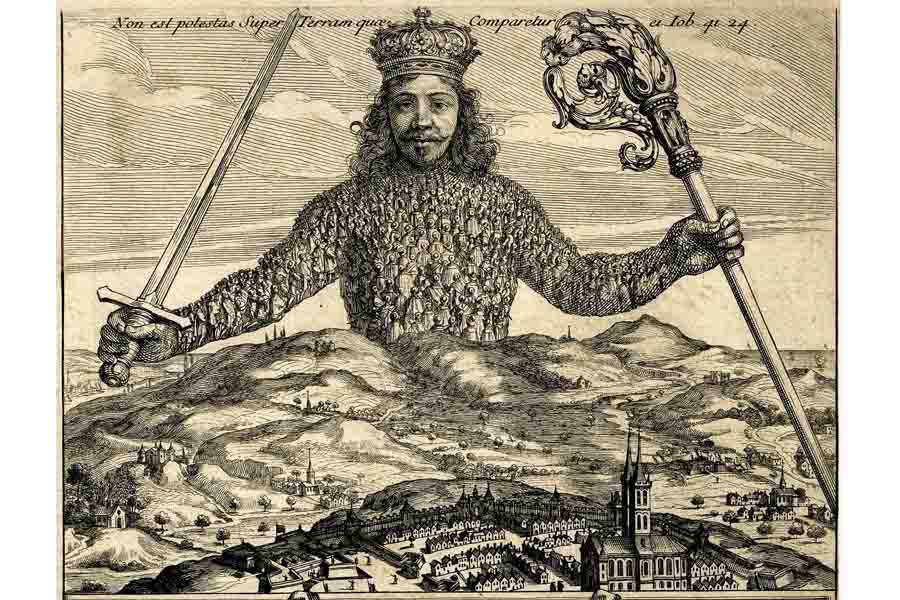
The prevailing way we think of society and of the state is as an assemblage of discrete individuals. The physical parallel is matter as an assemblage of discrete particles. We are bound together by certain conditions and forces, but if those bonds are dissolved, the constituents will retain their identities. Thus, the notion of the “social contract” or the political constitution. One good implication is that we are all naturally equal. One bad implication is that we are naturally disconnected and solitary beings.
This understanding was given its first systematic expression by Thomas Hobbes in his “Leviathan” (1650). The image I chose for this column is the frontispiece of that book. If you look at it closely, you’ll see that the body of the political state is composed of individuals. They are somewhat differentiated by dress but not by position. Nor are they relating to each other in specific ways. They are simply assembled within the outline of the image. Without them it couldn’t exist. Without it they could exist but not together.
The prevailing images of state and society (the latter meaning primarily the church) in earlier Western culture were organic. They were the body politic and the body of Christ. These existed prior to the individuals within them. Individuals didn’t create state and society but were born or reborn (baptized) into them. Further, their places within them were differentiated by status and function. Some were its head, some its hands, etc. They weren’t as completely integrated into the whole as differentiated cells in a living organism; each person, for instance, went to heaven or hell on his/her own. Still, the images expressed a belief that individuals were the matter that cycled through entities — state and church — that had their own natures, or forms, and especially their own intrinsic purposes.
Such terms — matter, form and purpose — were what Aristotle used to explain the why of things. They are the names of three of his four “causes” — “material,” “formal” and “final.” His fourth cause was “efficient,” which referred to anything external that caused something to change its location or motion or shape (e.g., one billiard ball striking another). Both the Muslim and Christian worlds thought Aristotelian explanation worked very well. So well, in fact, that those who were creating modern Western science in the 17th century had to overthrow Aristotle’s dominance to clear a space for their explorations and explanations of natural phenomena.
What they had to discard were Aristotle’s formal and final causes, which were closely linked. If everything has a distinct nature, or form, then it also has an intrinsic purpose, or goal. For Aristotle, even inanimate nature had forms and purposes. A rock’s purpose was to rest “at the center,” and so it would fall down toward the center of the earth until its motion was impeded by some external force or obstacle. This, of course, is nonsense. At the least, his system had to be rejected for explaining nonorganic phenomena.
As it was, his system was discarded for all phenomena. As Francis Bacon, the first great publicist of modern Western science, wrote in “The Advancement of Learning” (1605), science “doth make inquiry, and take consideration of the same natures (phenomena): but how? Only as to the material and efficient causes of them, and not as to the forms.” A later statement of that view was that reality must be understood as matter and motion and expressed in the laws of physics.
The total body of modern Western scientific thought may be humankind’s greatest achievement. We have come to understand the operations of an enormous range of phenomena — almost inconceivably large and small — and thus greatly enhanced our agency over the conditions of our lives. But we are confused about our relationships to the world and to other people, and so we wreak harm on them and on ourselves.
What the life sciences tell us is that we are by nature connected, not isolated, and that we have form and purpose, not simply matter and motion. Our form and our purpose are not exactly what Aristotle conceived. Especially, what it means to be our best selves, individually and collectively, isn’t simply the actualization of a unitary human nature. Still, organic life in general moves toward complexity, and human life in particular moves toward meaning. And meaning is to be found in relationships and in the development and exercise and sharing of individual talents.
Such thoughts comfort me as I stare at a darkening horizon.
Herbert Rothschild’s columns appear on Friday in Ashland.news. Opinions expressed in them represent the author’s views and may or may not reflect those of Ashland.news. Email Rothschild at herbertrothschild6839@gmail.com.