In 1964, the Supreme Court ended the disproportionate clout that rural and small-town residents enjoyed in state legislatures, but it continues in the Senate.
By Herbert Rothschild
My column last Friday focused on the backlash to the erosion of Christian privilege in the U.S. As I wrote, two key U.S. Supreme Court decisions banning officially sponsored prayers and Bible reading in the public schools were decisive in establishing that there would be no governmental promotion of Christianity over other religions or the promotion of any religion, which for most of U.S. history hadn’t been the case at the state level.

Those decisions were handed down in 1962 and 1963. Writing about them and the widespread outcry they occasioned led me to reflect on how many major changes took place in that decade to upset conservatives. The civil rights movement will occur to all of us, and the growing resistance the war in Vietnam and all it represented about our nation’s abuse of power internationally. Even more pervasive was a rebellious youth culture prompted by the sheer numbers and economic power of the Baby Boomers. Related to the latter was the sexual revolution, made possible by the general availability of effective contraception.
Other sharp breaks with the past piled on top of the ones I’ve mentioned, cumulatively creating a sense that this was no longer the country of Beaver Cleaver and Father Knows Best. In this column I want to highlight one that didn’t rise to general public awareness but made an enormous and continuing difference. And I’ll use it to reflect on a facet of the right-wing backlash that has intensified in recent years.
In 1964, the U.S. Supreme Court ruled in Reynolds v. Sims that the electoral districts of state legislative chambers had to be drawn to reflect roughly equal numbers of residents. You might think that “one person, one vote” had been the rule before that, but it wasn’t. There were gross deviations. In the Nevada senate, for example, the largest district contained 127,000 people while the smallest contained 568. In the Vermont General Assembly, the largest district had 35,000 residents, the smallest 36. In Alabama, where Reynolds v. Sims originated, the state constitution mandated one senator from each county regardless of population. Needless to say, the suit was brought by residents of Birmingham, the state’s largest city.
The under-representation of urban areas and the over-representation of rural areas was the norm. Los Angeles County, then with six million people, had one senator; so did the 400 people of Alpine County. The urban-rural divide had racial implications as well, because people of color tended to be concentrated in the cities. Reynolds v. Sims mandated a structural change that immediately, and ever since, affected public policy formation throughout the country. Just ask Oregonians who live east of the Cascades and south of Eugene.
Conservatives hated Reynolds v. Sims, since shifting the balance of political power in the state legislatures toward urban areas significantly diminished their clout. They had to comply with the court order, but they groused that state senates, at least, shouldn’t have been required to reflect “one man, one vote” because the U.S. Senate didn’t.
That argument was raised by the State of Alabama to justify its practice, but the Supreme Court didn’t credit it. In his majority opinion, Chief Justice Earl Warren wrote, “The superficial resemblance between one of the Alabama apportionment plans and the legislative representation scheme of the Federal Congress affords no proper basis for sustaining that plan, since the historical circumstances which gave rise to the congressional system of representation, arising out of compromise among sovereign States, are unique and without relevance to the allocation of seats in state legislatures.”
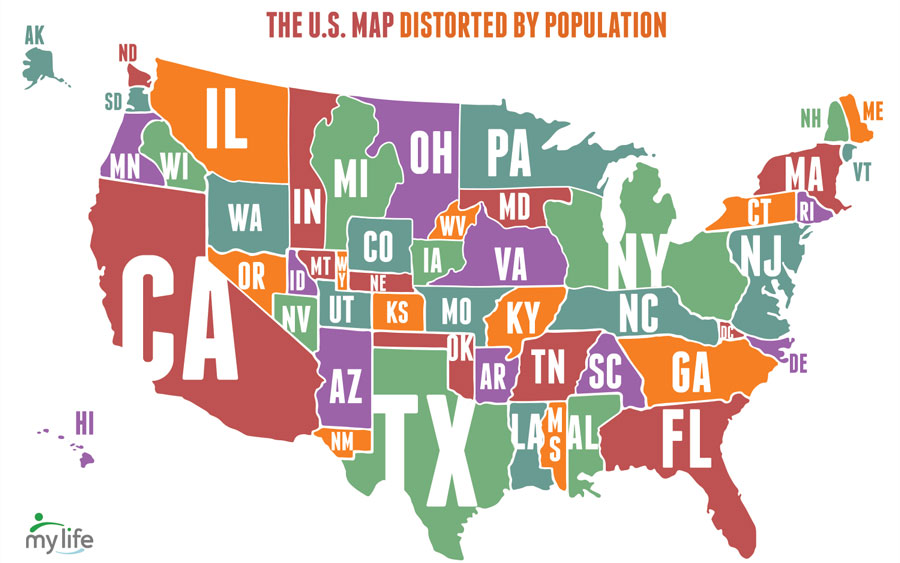
Still, it’s true that the legislative representation scheme of the U.S. Congress does very much resemble the undemocratic advantage so many state schemes invalidated by Reynolds v. Sims gave to small town and rural residents. The 39 million people of California have the same number of senators as the 581,000 people of Wyoming.
Currently, there are 49 Republican senators, 48 Democratic senators, and three Independents who caucus with the Democrats. All but seven of the 50 states have elected both their senators from the same party. Of those 43, Democrats plus the Independents have 22 (Blue), Republicans have 21 (Red). What those nearly equal number of states disguise is a marked difference in the numbers of people represented.
Based on the 2022 estimated census figures, which I rounded off to the nearest million, 173 million people live in the Blue states, 126 million in the Red states. That 47 million is a 37% difference. And were we to allow Congressional representation for Puerto Rico (ranked #31 by population) and the District of Columbia (ranked #50), it would add another four million to the difference. Yet, Republicans may very well win control of the senate in 2024 by shifting half a million votes or fewer.
There are some policies a majority of Americans favor, such as Medicare for all and a smaller military budget, that Republicans thwart with the support of all too many Democrats. But just about all the policies Republicans favor — unregulated gun ownership, curtailed reproductive freedom, ending same-sex marriage, privatization of public education, government stimulus of fossil fuel production, the weakening of environmental protection, regressive federal taxation, and the declaration of the U.S. as a Christian nation — are minority positions. They couldn’t enact those policies were the majority to prevail. Thus, among the many trends that began in the 1960s, our progress toward democracy is the overarching one that Republicans must reverse. They take that challenge with the utmost seriousness.
Herbert Rothschild is an unpaid Ashland.news board member. Opinions expressed in columns represent the author’s views and may or may not reflect those of Ashland.news. Email Rothschild at herbertrothschild6839@gmail.com.