‘You taught me language, and my profit on’t/ Is I know how to curse’
By Herbert Rothschild
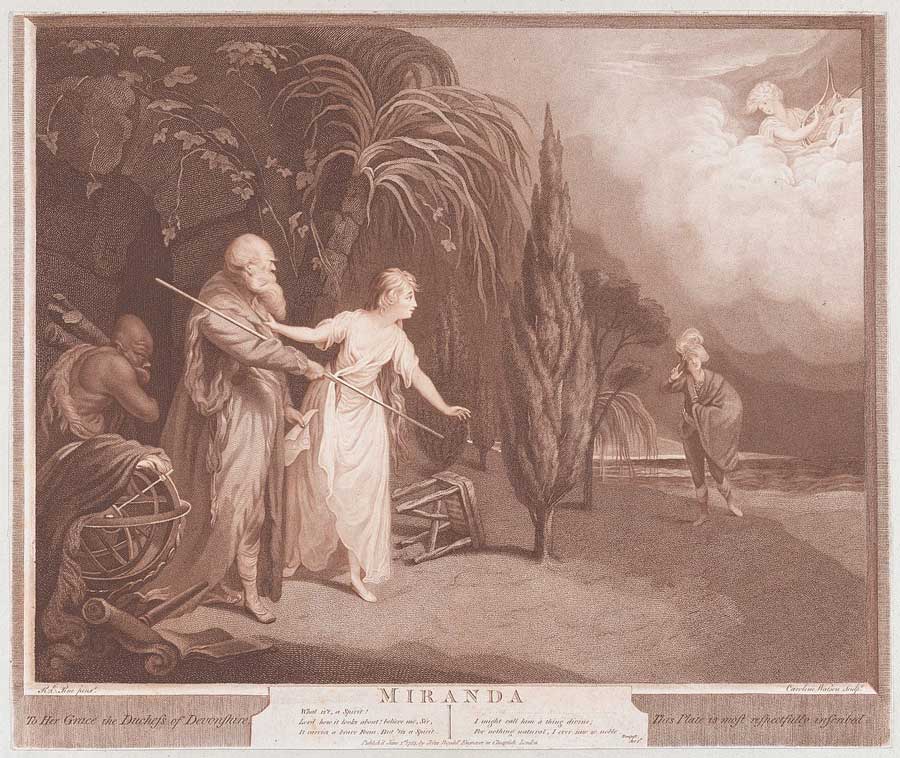
Early in “The Tempest,” Shakespeare introduces us to Caliban, who, along with Prospero, Ariel and Miranda, forms the island community. Prospero keeps Caliban in a strict subjection against which he chafes angrily and later rebels. What prompted this treatment was Caliban’s attempt to rape Miranda. Prior to that, Prospero and his daughter treated him with kindness and tried to “civilize” him.
Part of that effort was teaching him language. Miranda says,

I pitied thee,
Took pains to make thee speak, taught thee each hour
One thing or other. When thou didst not, savage,
Know thy own meaning, but wouldst gabble like
A thing most brutish, I endow’d thy purposes
With words that made them known.
Caliban’s response is, “You taught me language, and my profit on’t/ Is I know how to curse.”
Caliban does curse, but not incessantly. At one point he tells the befuddled Stephano and Trinculo, on whom he foolishly stakes his hopes to attain his childish notion of freedom,
Be not afeard, the isle is full of noises,
Sounds, and sweet airs, that give delight and hurt not.
Sometimes a thousand twangling instruments
Will hum about mine ears; and sometimes voices,
That if I then had wak’d after long sleep,
Will make me sleep again, and then in dreaming,
The clouds methought would open, and show riches
Ready to drop upon me, that when I wak’d
I cried to dream again.
This speech never fails to stun, so revelatory is it of a sensibility exceeding that of the subhuman creature we had been led to think Caliban was. How characteristic of Shakespeare’s genius to render through fitting speech the complexity of our condition.
“The Tempest” is now playing at Oregon Shakespeare Festival. James Ryen’s Caliban stands out in a production that overall is a fine one. Concurrently playing is “Revenge Song, A Vampire Cowboys Production.” Last week, Ashland.news published a review of it by Lee Juillerat, who pronounced it “easily the worst” play he had ever seen at OSF. The review elicited several letters to the editor and many Facebook comments energetically defending the play.
I’m not in a position to pass judgment on “Revenge Song” because I haven’t seen it. What attracted my attention is the cursing in it. Juillerat remarked on its “non-stop use of the F word — you’ll hear it screamed and sung hundreds of times in two hours.” Because none of the responses contradicted this observation, I’ll assume that it’s true.
When I was publishing Relocations in the Ashland Daily Tidings (RIP), part of my Feb. 22, 2020, column was devoted to the F word. I wrote that in my youth it was a class marker; it was used by lower-class people. Sometimes more socially respectable men used it among themselves, but women never did. That’s no longer the case. I concluded the column this way: “Something’s going on with the F word. I’m not sure what … Whatever, I find its ubiquity annoying. I’m thinking of swearing off it.”
Many species of animals have systems of communication. While we aren’t yet sure whether certain highly evolved species like whales and chimps can use their repertory of sounds to generate new combinations and thus new meanings, most species have a fixed repertory of signs and sounds connected to immediate external and internal states, such as danger and pleasure. At least to date, we don’t think that they use language to reflect on and understand themselves.
I’ve devoted much of my life to literature. Shakespeare’s plays were the primary focus of my scholarship, but I taught a wide range of texts. Most of them would be called Great Books. That term now smacks of elitism, the creation of white males. And it’s true that we’ve all benefited from an expansion of the “canon” thanks to the advocacy of women, LGBTQ people, peoples of color, and voices from the non-Western world. But the additions of lasting value are texts that use words to help us know our own meaning.
The public space in our country is now filled with people who do little else than spew the F word. If they were willing to engage with others in conversations about the state of their world, they might learn something about why they are incessantly angry. But it seems that all the profit they’ve derived from language is to know how to curse.
In Act V of “The Tempest,” Prospero uses his magic to put on a show for the newly engaged Ferdinand and Miranda. The masque is dazzling, but it isn’t the play. The play doesn’t just entertain us; it helps us understand ourselves and the terms on which we must live. Self-knowledge can be painful, and most of our entertainment dollars are spent avoiding it. But such entertainments, like lives wedded to self-avoidance, are insubstantial pageants that quickly fade and leave not a cloud behind.
Herbert Rothschild is an unpaid Ashland.news board member. Email him at herbertrothschild6839@gmail.com.