In Israel/Palestine, leaders on both sides are consumed by their own grievances
‘Where will it end … this murderous hate, this Fury?’
— ‘Oresteia’ by Aeschylus
By Herbert Rothschild
In 5th century BCE Athens, the writers of tragedy chosen to have their plays performed at the annual Great Dionysian festival had to submit three related plays. To our everlasting regret, of the several hundred plays that were performed, only 33 survived to our time, and none of them constitute a trilogy — with one exception.

And what an exception. Aeschylus’s “Oresteia,” composed of “Agamemnon,” “The Libation Bearers” and “The Eumenides,” is both a literary masterpiece and a dramatization of the transition from tribal societies to legally organized city-states, a transition which Aeschylus conceived as the movement from revenge to justice.
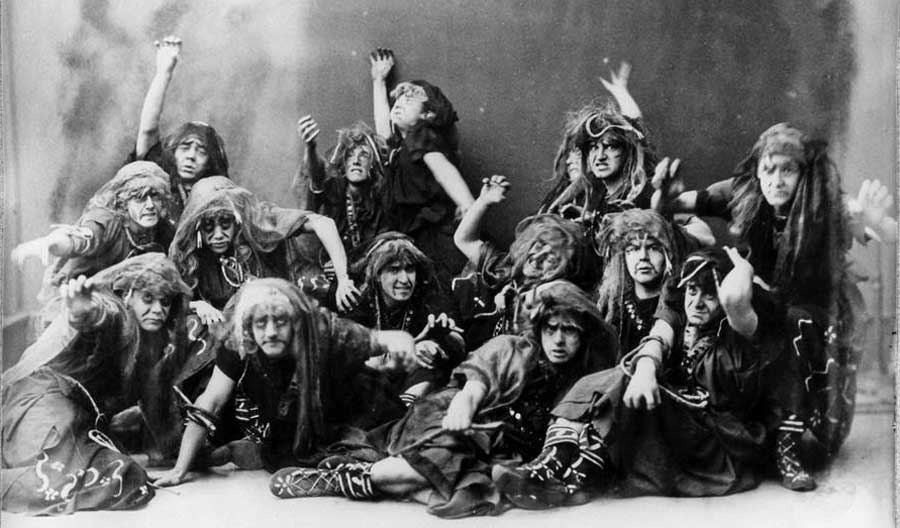
The Eumenides, or “kindly ones,” are the Furies, whose role in human life is, in the last play, transmuted from a terribly destructive force to a component of beneficial order. That can only happen when particular conflicts are viewed in a larger context than the antagonists, consumed by their own grievances, are capable of achieving by themselves.
That subjective partiality is one defining characteristic of the Furies. The other is their savagery. They are hideous creatures associated with hideous acts. It’s Apollo who points out their savagery as he defends Orestes, his suppliant.
(N)ever touch my halls, you have no right.
Go where heads are severed, eyes gouged out,
where justice and bloody slaughter are the same,
castrations, wasted seed, young men’s glories butchered,
extremities maimed, and huge stones at the chest.
And the victim’s wail for pity —
Spikes inching up the chest, torsos stuck on spikes.
(translations by Robert Fagles)
In the second play, Orestes with great reluctance fulfills his obligation to avenge his father’s murder by killing his mother and her paramour, Aegisthus, who killed Agamemnon on his return from Troy. Pursued by the Furies, he seeks sanctuary at Apollo’s shrine at Delphi. For the Greeks, Apollo is, among other things, rationality. He points out to the Furies that Clytemnestra was herself a murderer. But that argument has no force with these Furies. “We have our mission.” These Furies are the avengers of matricide, not patricide. “Some things stir your rage, I see,” Apollo responds. “Others, atrocious crimes, lull your will to act.”
The Furies don’t make their appearance as personae — entities in themselves — until late in the second play. Nonetheless, they are present from the start. In the first play they mainly live in Clytemnestra, who is furious at her husband because he sacrificed their daughter, Iphigenia, so that the gods would change the winds and allow the Greek ships under his leadership to sail to Troy. The fires she tends waiting for his return are the outward manifestation of her blazing anger. And fuming inside the palace is Aegisthus, son of the man whose power struggle with his brother, Agamemnon’s father, led to a dreadful act of revenge. To these overlapping injuries Aeschylus adds the rape of Helen, which precipitated the Trojan War and the sacrifice of Iphigenia.
It seems that everyone is enmeshed in an historical web of interconnected violence, yet they still exult in their temporary triumphs. Only Orestes has some sense of moral counter-claims, which is why he seeks purification from his blood guilt after avenging his father.
In the final play the action moves from Delphi to Athens, where the parties contending for Orestes’s fate — Apollo/reason and the Furies/the primal need to punish a wrong — agree to allow Athena, goddess of wisdom and patron of the city-state, to decide the case. She convenes a jury, depicted as the first trial by jury in history, and allows both parties to make their case. The vote is tied, and Athena breaks the tie in favor of reason. But wisdom and reason aren’t synonymous, and by persuasion she allays the anger of the Furies and gives them a crucial role in the economy of justice.
What we are now witnessing in Israel/Palestine is a dance of the Furies. It is where leaders on both sides are steeped in their own grievances, “where justice and bloody slaughter are the same” and victims wail for pity. They are caught in a web of intersecting injustices but seem unable to acknowledge the historical context of the immediate events.
A world of self-interested nation-states is analogous to a world of tribes or clans. It was a world of atrocious warfare. After the ghastliest and most far-reaching war, World War II, there was a move to create a framework to justly adjudicate grievances. The State of Israel was born out of that movement in recognition of the terrible suffering of Jews at the hands of the Nazis.
Jewish settlement, however, had come at the expense of those Arabs who for centuries had inhabited the land. Beginning early in the century, they had struggled against an increasing tide of Jewish immigrants, and both had struggled to throw off the yoke of Great Britain, which had seized the territory from Turkey after World War I. The Nakba (Catastrophe), the forced and uncompensated displacement of the majority of Palestinian Arabs in 1948, became their equivalent of the Holocaust. Nor did the assaults on their dignity, their peace and their property cease after 1948.
The overwhelming majority of nations acknowledged Palestinian grievances, and all but a handful voted repeatedly at the United Nations for a two-state solution. Among the handful, though, was the U.S., and that sufficed. We used our veto power in the Security Council to prevent Israel from being forced to accept a Palestinian state within the pre-1967 borders.
It’s frustrating to hear U.S. leaders still talk about a two-state solution, first because the settlements in the West Bank long ago made it impossible (which was their intention), and second because — apart from Israel and Hamas — we were its chief impediment and could have overcome the other two. American Jews of my generation bear responsibility for U.S. behavior. Our money and influence made it politically suicidal for any member of Congress to support Israel less than 100%. We share the blood-guilt.
There is little prospect that the Israeli-Palestinian conflict will be adjudicated by international law, although international law applies to most of what has happened beginning in 1948. No just resolution is in the offing. We are left with the questions that end Aeschylus’s second play:
Where will it end?
where will it sink to sleep and rest,
this murderous hate, this Fury?
Herbert Rothschild is an unpaid Ashland.news board member. Opinions expressed in columns represent the author’s views and may or may not reflect those of Ashland.news. Email Rothschild at herbertrothschild6839@gmail.com.