Their long-awaited proposal calls for court-ordered programs and more resources for people who need treatment
By Ben Botkin, Oregon Capital Chronicle
Oregon Democratic legislators plan to fight the state’s war on drug addiction and overdoses on multiple battle fronts.
They want to build residential facilities to treat people, give police the ability to arrest people for possession and have programs to help people get off drugs, from offering medication in jails to sobering centers and clinics. They want dealers to face tougher penalties when they sell drugs in parks or within 500 feet of homeless shelters and drug addiction treatment centers, and they want to reinstate penalties for drug possession.
They hope to pass bills to accomplish this and more within the 35-day legislative session, which starts Feb. 5.
Oregon Democratic lawmakers on Tuesday released their proposal for how to address the state’s drug addiction and overdose crisis. The release, which comes almost two weeks before the session starts, underscores the urgency of the state’s drug addiction crisis. Hundreds of Oregonians die every year, particularly from fentanyl overdoses, an epidemic that ramped at the start of the pandemic, prompting voters in 2020 to pass Measure 110, which decriminalized possession of small amounts of hard drugs and put a share of cannabis revenue toward addiction programs and services that aren’t funded by Medicaid.
The proposal would not abolish Measure 110, and it would still allow money to flow into those programs, which pay for peers to counsel people, harm reduction services like overdose reversal medications and help with housing and other services. But the proposal would change a key part: the decriminalization of possession. Measure 110 only allows police to issue $100 citations to people found with small amounts of drugs, which can be waived if they have an assessment. The citations don’t carry the weight of a misdemeanor charge, which can include jail time, fines or both. The proposal would make drug possession a misdemeanor, which carries up to 30 days in jail.
Democratic lawmakers do not want to simply put people addicted to drugs in jail, a policy that failed to stem addiction. But they say the current system is not working and they are seeking a middle road that gives police the ability to help people in the throes of addiction without ending the benefits and programs that Measure 110 funds.
“Our goal was to create the best policy that we can for Oregonians while still listening to everybody,” Senate Majority Leader Kate Lieber, D-Beaverton, said in an interview with the Capital Chronicle. “We’ve spread a wide net on this. And we believe that this is really the compromise path.”
Not everyone was pleased.
Republicans who’ve called for abolishing Measure 110 for months were quick to criticize the plan. In a statement, they called it “window dressing.” And Measure 110 supporters said the proposal would reverse progress and return to a failed war on drugs that disproportionately incarcerated people of color.
Lieber co-chairs the Joint Committee on Addiction and Community Safety Response that has been working on the proposal since last fall. Starting in October, it held hours-long meetings once a month, with testimony from state officials, treatment specialists, advocates, police and more.
Here’s a look at what the proposal would do:
Public health measures
Lawmakers want to have more clinics, housing and residential facilities and reduce obstacles to treatment.
They proposed:
- Doctors would be able to prescribe medication-assisted treatment more easily, and the state would prohibit insurers from denying or delaying treatment through the pre-authorization process, which typically slows the time between a doctor prescribing a treatment and an insurer approving it.
- The length of time for welfare holds would increase from 48 to 72 hours because fentanyl stays in a person’s system for longer than alcohol and other drugs. Welfare holds put someone in a sobering center or treatment centers temporarily. The extra time would give people more time to make a decision to enter treatment rather than returning to a drug-infused life on the streets.
- Lawmakers want to put a potential $30 million into recovery housing, which provides a supportive environment for people who are overcoming addiction and getting back on their feet.
- Lawmakers also want to fund apprenticeship programs for behavioral health workers, set up a task force to analyze gaps and ask the Alcohol and Drug Policy Commission to study youth addiction and prevention.
Lawmakers also will consider funding for projects, including potential shovel-ready projects to expand addiction treatment, the removal of trash and graffiti and fentanyl awareness campaigns.
Public safety
Rep. Jason Kropf, D-Bend, and co-chair of the joint committee, said the proposal is based on input from law enforcement and aims to give police officers additional tools to deal with the crisis. Police officials have complained that the citation system under Measure 110 lacked teeth to encourage people to enter treatment: a majority ignored the citations and didn’t pursue treatment.
“Officers are seeing things on the streets that they don’t feel like they have the tools to intervene on,” he said.
The proposal would create a class C misdemeanor for drug possession, which carries a penalty of up to 30 days in jail, a fine of up to $1,250 or both. This would allow police to seize drugs and address drug use in public areas, something that has angered residents, particularly in Portland.
The proposal would require a deflection program to be offered to the person before prosecution that would include treatment and other services. They could only be prosecuted if they declined to enter the program.
The plan would target dealers, too.
The proposal would:
- Change the law so someone found with a large quantity of drugs and paraphernalia could be charged with delivery of a controlled substance, a move that comes after a 2021 Hubbell decision in the courts that limited the ability to do so.
- Create steeper penalties for drug dealing in a public park or within 500 feet of homeless shelters and addiction treatment centers.
- Direct the courts’ Chief Justice’s Criminal Justice Advisory Committee to evaluate the criteria that determines whether people stay in jail while facing drug delivery or manufacturing charges.
Some law enforcement officials said the proposal doesn’t go far enough. Crook County Sheriff John Gautney, president of the Oregon State Sheriffs’ Association, said the proposed requirement for a deflection program instead of arrest is a “complex and resource-intensive approach that we are unable to support.”
McMinnville Police Chief Matt Scales, president of the Oregon Association of Chiefs of Police, agreed.
“The proposal outlined today lacks the necessary incentives for individuals struggling with addiction to actively seek help and places our law enforcement officers in the challenging position of engaging without the tools necessary to be effective,” Scales said in a statement.
Range of criticism
Though the committee that worked on the proposal included Republicans, they were not happy with the plan and released a statement Tuesday saying it would do little to help Oregonians.
“The proposal we saw today is one chalked full of farcical fixes which will work about as well as the drug treatment hotline,” said Republican Rep. Christine Goodwin of Canyonville and a member of the committee. “Measure 110 has proven that voluntary addiction treatment does not work and keeps people chronically addicted. Oregonians overwhelmingly agree that we must scrap this naïve approach, but the Democrats’ proposal keeps the status quo in place.”
Another Republican member of the committee, Rep. Kevin Mannix of Keizer, said the penalty for drug possession should be stiffer than the Democratic proposal of a class C misdemeanor.
“Oregonians have made it abundantly clear: we must reestablish hard drug use as a class A misdemeanor so that rehabilitation treatment can be required,” Mannix said. ‘The current system does not include such power and a low-level class C misdemeanor only provides 30 days in jail as an alternative. This is nowhere near the amount of time needed to address addiction.”
Class A misdemeanors can carry up to 364 days in jail, a fine of up to $6,250 or both. The Coalition to Fix and Improve Measure 110, which backs ballot measures on Measure 110, also wants a tougher penalty to motivate drug users.
“Anything short of reclassifying deadly drugs as a Class A misdemeanor crime will be inadequate to effectively steer more people into more treatment more quickly. With addictions and overdoses on the rise, the Legislature needs to act swiftly and boldly to fix Measure 110 when it meets in February,” said Max Williams, a coalition backer.
Another group, Oregonians for Safety & Recovery, a coalition that includes the ACLU of Oregon and the Health Justice Recovery Alliance, also criticized the proposal but for a different reason: It said the proposal marks a return to the failed war on drugs rather than bolstering services.
“The Legislature today rolled out a proposal to recriminalize addiction with jail and fines,” said Tera Hurst, executive director of Health Justice Recovery Alliance, a statewide group with members who provide Measure 110-funded services. “This is a complicated, costly and ineffective approach that is doomed to fail. Instead of writing the criminal justice system a blank check that will ultimately divert dollars away from treatment services, they should be investing in expanded treatment services without threat of arrest.”
Unknowns ahead
Lawmakers said the proposal could change during the legislative process and that they’d need to approve several bills. For example, Rep. Pam Marsh, D-Ashland, is working on a bill that would get more treatment into jails.
A bill allocating money for recovery housing would be separate, as would bills to increase the behavioral health workforce.
At this point, legislators don’t know how much everything would cost.
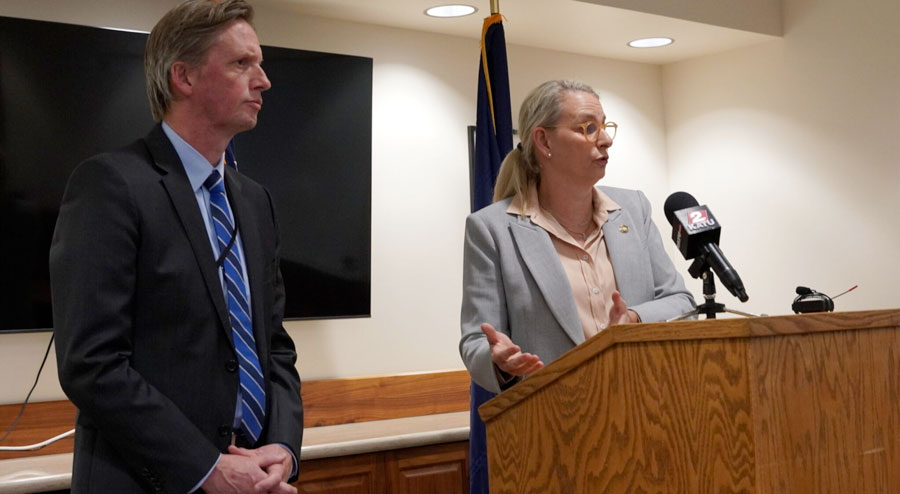
Lieber and Kropf, in a press conference, said the goal is simply to give police tools to help people, not criminalize addiction.
Ben Botkin covers justice, health and social services issues for the Oregon Capital Chronicle.