Ashland’s homeless have four tiers of places to stay, from a place to pitch a tent to relatively long-term rooms with ready access to resource portals
By Morgan Rothborne, Ashland.news
“Every day, we are full. The only time we have vacancies is when someone moves out. … The emergency shelter is much like the big shelter, it’s always full,” said Lisa Smith, the director of program services for Opportunities for Housing, Resources & Assistance (OHRA).
Demand for beds is high, she said. Both the “big shelter” — the former Super 8 motel at the corner of Ashland Street and Washington Street — and the emergency shelter at 2200 Ashland St. have long waiting lists.
While there’s a list, it’s not first-come, first-served. Rooms aren’t given based on anyone’s place on the list, but rather their score on what’s known as the “SPDAT,” Smith said.
The Service Prioritization Decision Assistance Tool is a survey that creates a vulnerability score designed to help organizations serve the most vulnerable individuals first. As rooms become available, those on the list with the highest “vulnerability score” are contacted, she said. The highest score possible is 16.
Smith looked at the waiting list for the big shelter on Feb. 12 and shared numbers that were not atypical. The list had 80 people — 30 of them with a vulnerability score of 13, nine with a score of 14. Those without a high enough score are often waiting a long time, she said.
OHRA operates all three shelters in Ashland. It operates a 52-bed shelter in a former motel at 2350 Ashland St.
Through a contract with the city, OHRA also operates the two shelters opened by the city at 2200 Ashland St. The emergency shelter has 32 cots, which dips to 30 when the adjacent severe weather shelter is open. The severe weather shelter has a capacity cap of 28 people.
The emergency shelter — also called the 24/7 shelter and emergency homeless shelter — operates in the main space of the building. When it is called for, the city’s severe weather shelter opens in a space separated from the main building by a locked door, said Kelly Burns, emergency management coordinator.
In consultation with Interim City Manager Sabrina Cotta and under guidelines set by the city’s resolution establishing temperature thresholds for opening the shelter, Burns decides when the severe weather shelter will open. It is open only for nights that fall into the weather conditions dictated by the resolution. Last year, the city opened the shelter some 63 nights and, so far this year, 22 nights through the winter, with three more nights scheduled this week: Tuesday, Wednesday and Thursday evenings. (Severe weather shelter open nights are posted on the Ashland.news community calendar.)
What it offers is minimal.
“It is low barrier, there are sleeping pads but no frills. If you’re somebody that just wants shelter to get warm, just to get out of the weather, you can come,” Burns said. The shelter opens in the evening and closes the next morning.
The other two shelters — the big shelter and the emergency shelter — are consistently open, but serve slightly different populations with slightly different restrictions. The big shelter mostly serves “individuals who are justice involved,” and cannot take families, Smith said. The emergency shelter can house families, meaning those seeking shelter there will need to pass a background check and have a high SPDAT score.
The emergency shelter’s 32 cots will be gone soon. After March 31, Governor Tina Kotek’s emergency order no longer allows the city to supersede fire code for the building, Burns said. The severe weather shelter is operated with a separate occupancy answering to a different fire and building code requirement, he said, allowing the city to continue using the space for that shelter after March 31.
The building’s future after the emergency shelter closes is “up in the air,” he said. It could be an operations center for first responders and storage of supplies for disasters.
“We’re going to have wildfires. We need a place,” Burns said.
Ashland homeless residents decry shelter shortcomings
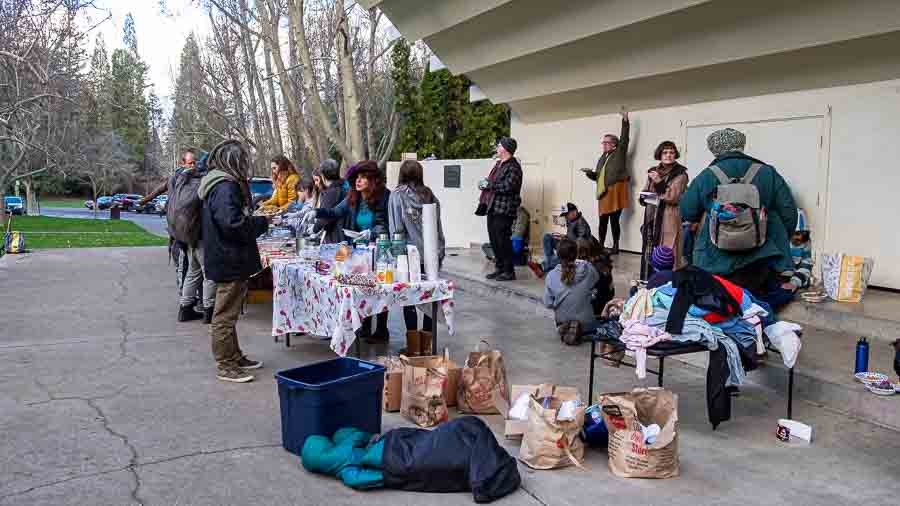
At a recent Peace Meal — a free meal served up by volunteers with Southern Oregon Jobs with Justice — in Lithia Park, Deborah Dupuis said she lives in her van with her three dogs.
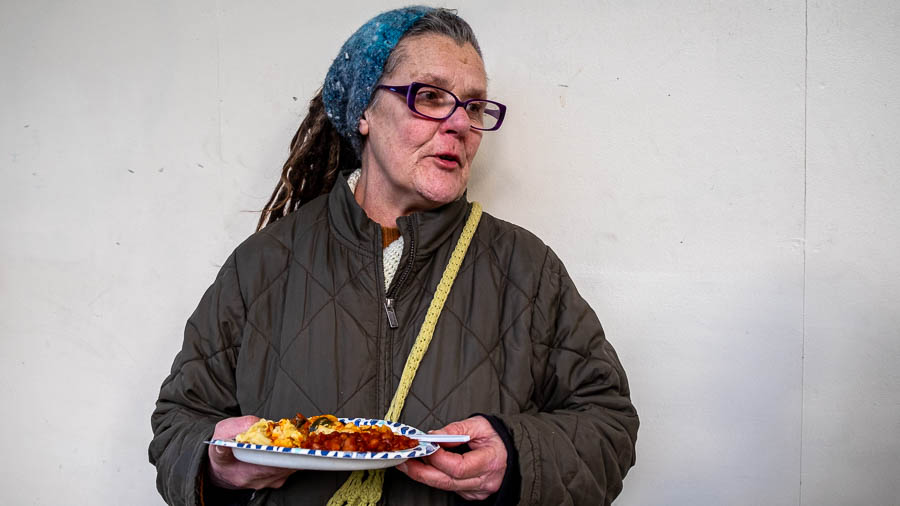
“I applied for all the places in the valley, haven’t gotten a call yet. I applied for rapid rehousing, OHRA ran out of rapid rehousing money. So I called ACCESS. I called ACCESS again. I said, ‘I’m over 60 and I’m medically fragile. I don’t know if I’m going to live over the winter.’ I’m still waiting on a call,” she said.
Dupuis said she was previously a college professor teaching sign language and deaf culture at Paul Smith’s College and she worked with the state of New York in forensics as a sign language interpreter for those with developmental disabilities. DuPuis also said she was a chef by training and had traveled across the country by van “on a mission to help people.” She volunteered at the Peace Meal when it was held in Pioneer Hall.
With pride, Dupuis referenced an Ashland.news story on vandalism in city parks, where Parks staff stated gratitude for a homeless person who called to report vandalism at North Mountain Park.
“That was me,” she said.
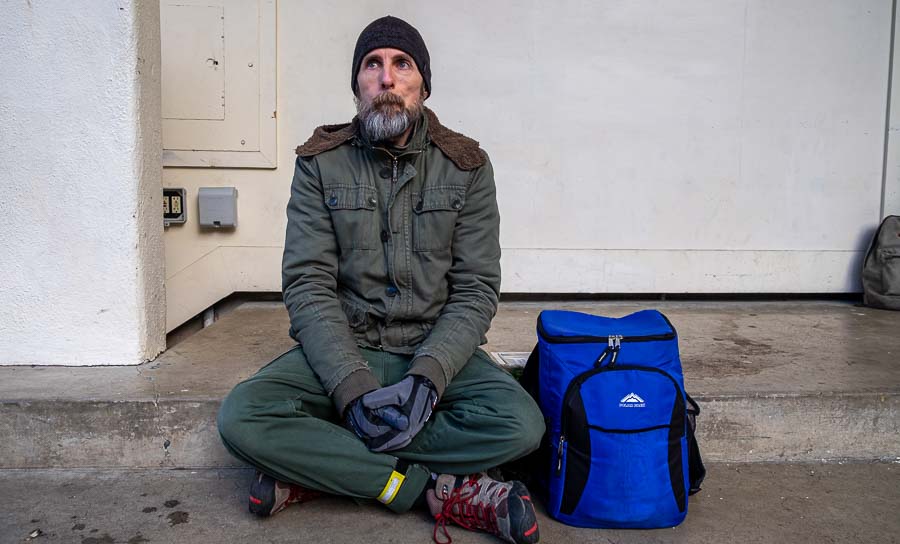
Skeye Hridayam said he had given up seeking shelter, employment or assistance of any kind and instead lives in a tent in the backyard of a friend and uses the facilities at another friend’s home.
“I’ve been housing insecure my whole life. Below poverty level. My mother was on welfare until I was 18. You know, we’d be in and out of regular homes and shelters sometimes. I’ve had lots of experience with it, let’s say,” he said.
Hridayam said he has chosen to live his life in simplicity, seeking and hoping for social change and has spurned possessing even a photo ID.
“I’ve extricated myself from that system. I used to take food stamps, I don’t do that anymore, I used to have OHP (Oregon Health Plan). I don’t have that anymore. I see how the system is so mismanaged, corrupt and I don’t feel the benefit from that. I don’t blame anyone that feels they need to,” he said.
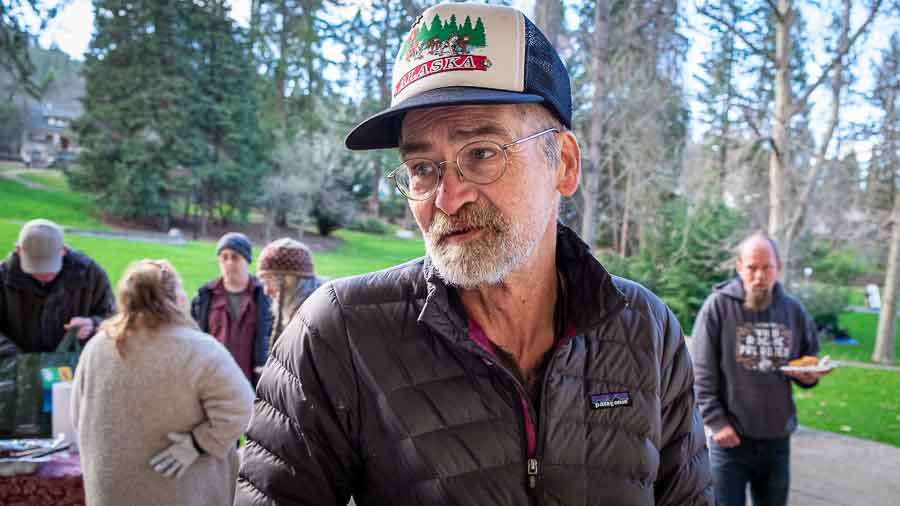
William Scott was also over the age of 60 and newly without a home after a fight ended his relationship with his girlfriend.
“Rather than have any more problems, I moved out. She kept the place cause she’s got a dog. We had a dog,” he said.
When asked what services he would want, he said he only wanted a job and a place. He moved to Ashland five years ago to be with his girlfriend after spending most of his life in Eastern Oregon. He said he has worked various jobs, including at a lumber mill, and most recently did seasonal work at Harry & David. He had been staying on the night lawn camping area on East Main Street behind the police station for about a week and didn’t mind it — except the rats, he said.
City limits camping places, homeless population growing
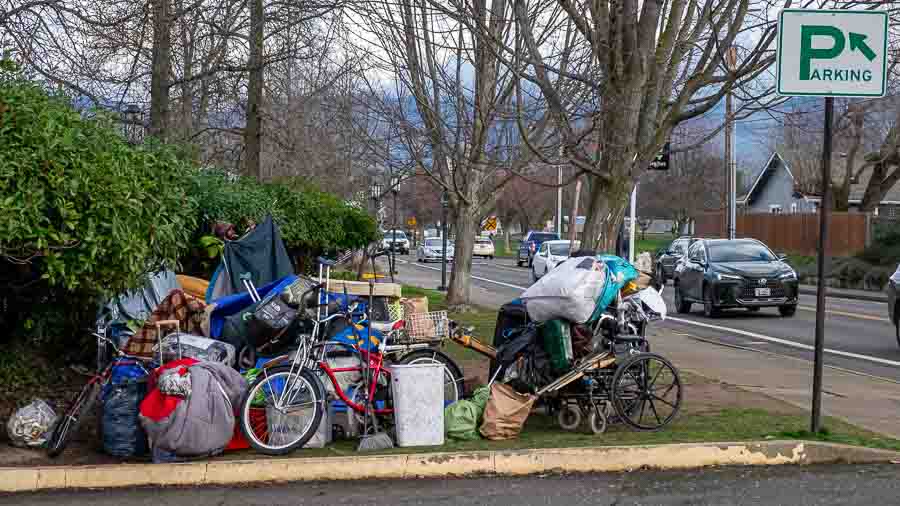
Those who can’t get in or give up on the shelters can find few places to camp within city limits. In a split vote at the Dec. 19 council meeting, Ashland City Council approved Ordinance 3228, Amendments to the Prohibited Camping Ordinance.
Ordinance 3228 prohibits camping on, or attached to or within the following locations: sidewalks, bike paths, walkways, Lithia Park or parks with “child or youth recreational equipment,” enhanced law enforcement areas, within 250 feet of schools or childcare, within 250 feet of a designated space or shelter, within 250 feet of freeway entrances or exits, 150 feet of other campsites, 100 yards of any river or stream, and any fence, tree, or building, according to the ordinance.
Ashland police officer Jason Billings confirmed officers are now obligated to remove those they find sleeping in prohibited areas. Campsites that appear to be “established” under the ordinance are required to receive a 72-hour notice for removal. Otherwise, removal is immediate but not “cold-hearted,” he said.

Greenwood said she has received six $115 tickets for illegal camping in two months of living homeless in Ashland. Five of them were for not moving off the night lawn fast enough as guests are required to in the morning, she said. The first ticket came when she was new in town and chose a place to camp in ignorance of the law. Comparing years spent camping in Central Point, she said Ashland officers are “meaner,” though she made exceptions for some, including Billings, whom she described as a “sweetheart.”
Billings said he has been gladly giving homeless people rides to shelters and offering resources for years, even enlisting the school resource officer’s pick-up truck to help move tents and other belongings.
“There’s not a lot of resources I can offer. We’re trying to be as creative as we can, but not everything fits into that cookie cutter,” Billings said.
He described two problems in helping people find somewhere to sleep. Medford has more resources, yet many homeless people in Ashland are “Medford adverse,” he said. And the city’s homeless population appears to be growing. He referred to the big OHRA shelter as a regional “bat symbol.”
When he meets a fresh face on the street, Billings said he asks them where they came from and what brought them to Ashland. Individuals have told him they came from places such as Nevada, the coastal region and Northern California.
“They’ll tell me, ‘I thought I could get a hotel room. I’m on the wait list, I don’t know how long that will take,’” he said.
Email Ashland.news reporter Morgan Rothborne at morganr@ashland.news.