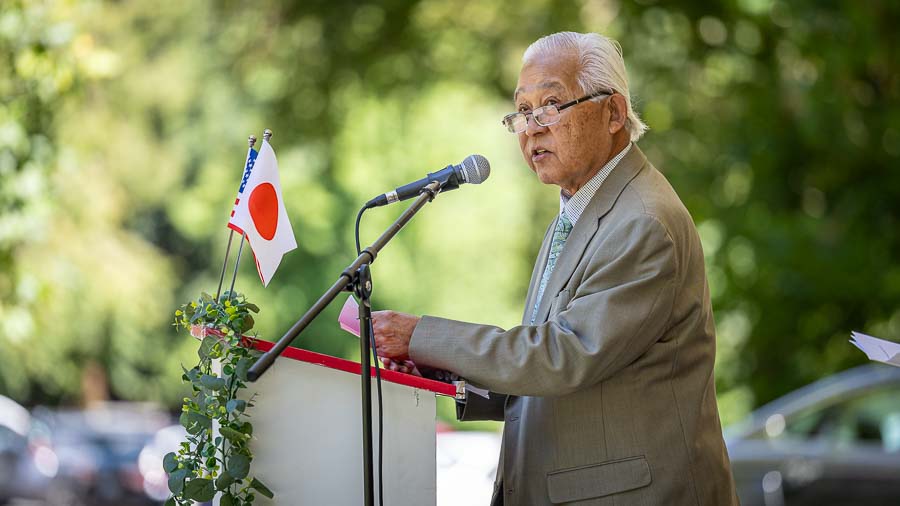
Former SOU President Roy Saigo ‘transports’ Japanese, Southern Oregon athletes back in time during 3rd annual peace ceremony at Lithia Park’s Butler Bandshell
By Holly Dillemuth, Ashland.news
“I want you to take a trip with me, are you OK with that?”
Former Southern Oregon University President Roy Saigo posed the question to dozens who attended the third Pacific Rim Bowl Peace Ceremony on Tuesday at Lithia Park’s Butler Bandshell.
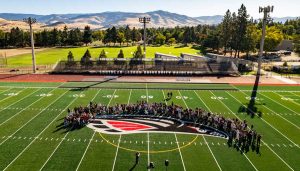
Players from both the Japan All-Stars and the South Valley Wolfpack football teams sat in the shade along with family members, supporters and local community leaders seated nearby.
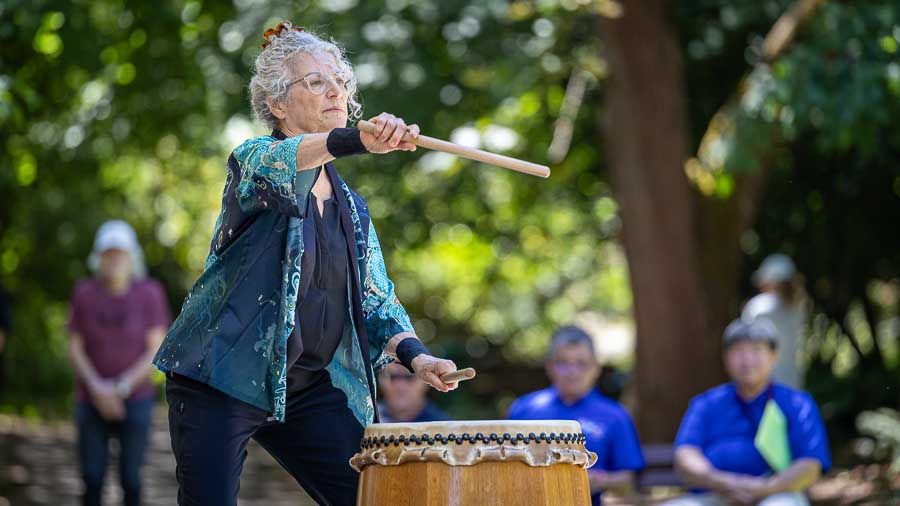
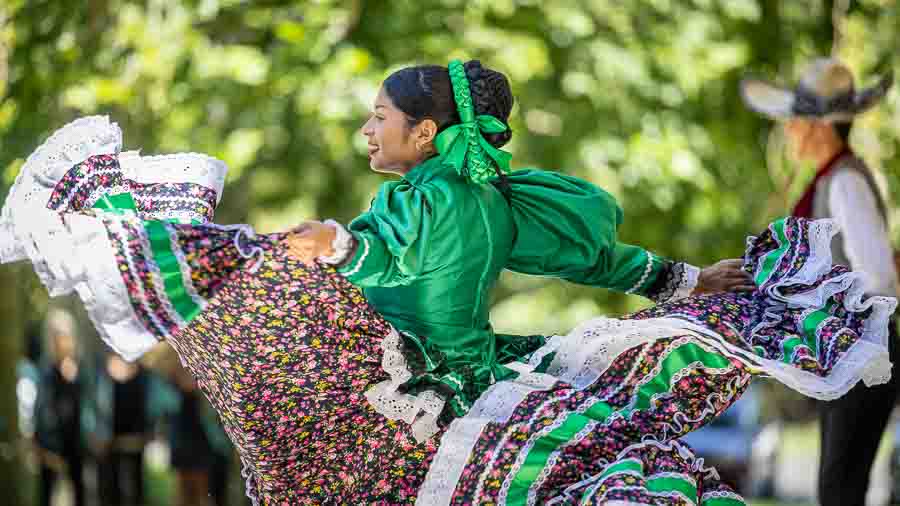
The program also included taiko drumming and Ballet Folklorico. Attendees included SOU President Rick Bailey, Ashland Mayor Tonya Graham, Ashland School District Superintendent Joseph Hattrick and Phoenix-Talent Superintendent Brent Barry.
The Pacific Rim Bowl is a partnership between Ashland High School and Kobe, Kyoto and Osaka, Japan that started in 1988. The exchange brings student-athletes to Ashland and Japan on a bi-annual basis, and this year incorporates the Phoenix High School football program, coached by Charlie Hall, former football coach for Ashland, SOU, and the PRB.
Both teams are participating in a week of events, including the ceremony, as part of the PRB week, which culminates with a game at 7 p.m. Friday, July 25, at Walter A. Phillips Field in Ashland. (To watch the game live on YouTube, click here.)
At the event Tuesday, Saigo asked attendees to travel back with him in time.
“I want you to transform yourselves right now,” Saigo said.
“You are living a comfortable life, living, working, learning, adjusting to life in a new America. Then Japan attacks Pearl Harbor. President Roosevelt signed Executive Order No. 9066.
“This meant that 120,000 people of Japanese ancestry must be transported from their homes to relocation camps, away from the (coastal) states. You can only take what you can carry.
“What are you thinking?” Saigo asks.
Saigo, an American citizen, said he knew he had the right to habeas corpus (mandating a court hearing on whether detention is justified) and due process of law.
With the executive order, this would change the lives of Saigo’s family and those of thousands of other Japanese-American families in an instant.
“Are you getting angry?” he asks attendees. “This cannot be happening, but nobody’s coming to help. Then, despair. Reality is sinking in. What to do with our furniture, private papers, wedding albums, tea sets, cars, crops.
“(After) two weeks, the neighbors can rummage through our house,” he added.
Saigo and his brother Takeshi and sister Chiyo, along with their parents, lived in California before being displaced, according to reporting by the The Westfield News.
“My family chose to throw everything into a ravine,” Saigo said on Tuesday. “Broke all our dishes and tea sets, private papers, furniture, sofas, clothes, suits, kimono, albums, we destroyed our family history.”
Saigo and his family were first sent to an assembly center in Sacramento, California, in what was described to them as a “temporary relocation.”
More reading
“Only What We Could Carry: The Japanese American Internment Experience” edited by Oregon’s fifth poet laureate, Lawson Fusao Inada, who was interned as a child at camps in California, Arkansas and Colorado. He is an emeritus professor of English at Southern Oregon University.
“Experiences of Japanese American Women During and After World War II: Living in Internment Camps and Rebuilding Life Afterwards” by SOU Professor Dr. Precious Yamaguchi.
“Last night we slept in our comfy beds, tonight we are given bags to fill with straw to use for (a) mattress,” Saigo said.
As interim president of Westfield State University in Westfield, Massachusets, Saigo told The Westfield News in 2021 that the assembly centers were “horse stalls with manure piles often stacked nearby.”
Saigo and his family were then sent to a relocation center in Gila River, Arizona, an American Indian reservation, where they were detained for the next three years.
“Most historians only teach about this dreadful time and finish when we were released,” Saigo said.
Saigo read from a statement from the California Farm Bureau in May 1942, which describes some of the post-war sentiment:
“We don’t want them back when the war is over,” Saigo said. “It has been 80 years since that terrible war, and still, we have hatred in the minds of many who lived through that time.”
Saigo condemned the current U.S. administration for its censorship of books about women, gender and minorities as well as the “rounding up of darker people” by ICE enforcing mass deportations occurring across the country.
“So each generation must learn and not repeat the errors of our past,” Saigo said.
Hall echoed Saigo’s sentiments during his introduction.
“If we don’t learn from history, we are doomed to repeat it,” Hall said.
For more information about the PRB and/or week of events, go online here at https://ashlandfootballclub.com/pacific-rim-bowl/.
Reach Ashland.news reporter Holly Dillemuth at hollyd@ashland.news.
Related stories:
Phoenix teams up with Ashland as South Valley Wolfpack in first joint Pacific Rim Bowl (July 21, 2025)
Football: Japan All-Stars arrive in Ashland, start practice Monday at Walter A. Phillips Field (July 21, 2025)
Football: Ashland, Phoenix set to join forces for Pacific Rim Bowl in July (April 1, 2025)
Hiroshima survivor: ‘My mother had said, “Go to the river”’ (Aug. 14, 2023)
‘More than just a game’: Ashland High School football team to return to Japan after hiatus (July 27, 2023)