Ashland High School senior is among those arriving where the Klamath River pours into the Pacific Ocean
By Lee Juillerat for Ashland.news
REQUA, California – After 30 days and 310 miles of paddling, the journey is over.
The 310-mile paddle from the headwaters of the Wood River near Klamath Falls to Requa, where the Klamath River pours into the Pacific Ocean, ended July 11 when a group of teen-aged kayakers from tribes living along the river and its tributaries arrived at a spit at the river’s end.
“Here they come!”
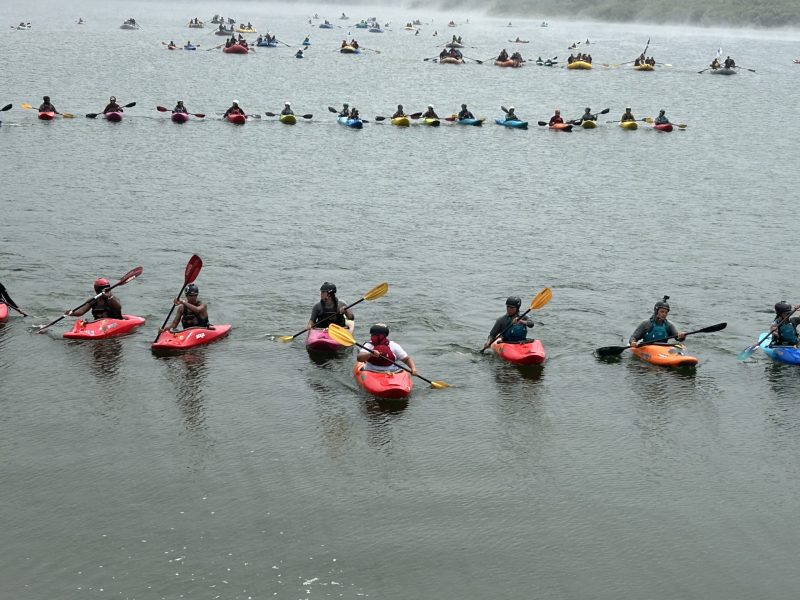
A gathering of relatives, friends and others watched as the kayakers, who were joined for the final day’s short paddle by more than 150 family and friends, broke through the fog and into view.
As brown pelicans soared and glided overhead, the group worked their way toward the ending point, growing larger as the fog lifted and the kayakers worked their way to the sandy spit. Immediately after touching land, they sprinted across the sand to the Pacific, where some dove in and others dipped their toes.
“We want you to feel our warmth, our love, our welcome,” said Sue Masten, a member of the Yurok Tribe who lives in Requa and is a member of the Karin Tribe. “You are not the same person you were before you traveled this river. You’re our future and we need you to be the best you can be.”
A series of others spoke, including elders from various tribes and several of the youth, who ranged in age from 13 to 18. Among them was Keeya Wiki, 17, who will be a senior at Ashland High School this fall. The daughter of Geneva and Reweti, Keeya had attended whitewater training schools in preparation for the journey.
“We couldn’t see anyone until we were right off the spit,” Keeya said afterwards. “The whole thing was so incredible. Every day was better and better.”
Along with congratulating the young paddlers and giving them words of encouragement, a recurring theme was celebrating the removal of four Klamath River dams and the return of salmon. Fittingly, the ceremonies, which moved from the spit to the road to Requa, were adjacent to what was intended to be a fish processing plant, no longer in operation because of the lack of salmon. Speakers also noted that weeks after the removal of the dams, salmon were seen beyond the John C. Boyle Dam near Keno.
While dam removal was a frequent story, the larger focus was on the youth. Before attempting the journey, Keeya and others had trained in whitewater paddling under the guidance of the organization Rios to Rivers, some for three years, with some traveling to Chile.
“This whole trip is a letter of love … it’s also a letter of promise, a promise we will be able to keep this river free-flowing,” said Danielle Frank, Rios to Rivers director of community relations.
“By opening this river, the river is healing itself,” Masten said, “Because the river remembers, the fish remember … This is a day we are bringing balance to our world.”
Symposiums and celebrations were held Saturday and Sunday in Klamath, culminating with the signing of the first-ever Klamath River Accord by Indigenous youth, tribal leaders, and allied organizations from river basins in Chile, Bolivia, China and New Zealand. Leaders describe the Accord as “a call to action for dam removal and a half to new construction of dams across the globe.”
The signing of the Klamath River Accord was the culmination of a two-day “Global Free Rivers Symposium” held at the mouth of the Klamath River following the first source-to-sea descent of the Klamath by multi-tribal youth that celebrated the largest dam removals in history on that river.
Conceived and written by a coalition of Indigenous youth, the Accord’s preamble “recognizes these dam removals on the Klamath River serve as a model for future climate resilience efforts and acknowledge the urgent need to protect the world’s remaining free-flowing rivers, ensuring that the mistakes made on dammed rivers are not repeated elsewhere.”
Email freelance writer Lee Juillerat at 337lee337@charter.net.