Speaker recalls past, but says focus is on the future
By Art Van Kraft for Ashland.news
Indigenous Peoples Day was honored and celebrated at Southern Oregon University over the weekend. Native tribes from across the Western states gathered to share past experiences and hopes for the future through cultural longevity and articulation of self. The theme of this year’s celebration was “Honor the past, empower the present, inspire the future.”
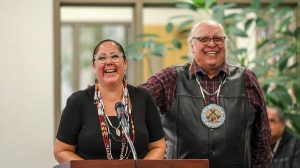
David West, a member of the Citizen Potawatomi Nation and director emeritus of the Native American Studies Department at SOU, spoke to the crowd about past injustices endured by Native Americans. He described the notorious American Indian boarding schools that crippled the futures and sometimes caused the deaths of past generations. But now, he said, his emphasis and energy are dedicated to the future. One way, he says, is to engage with new methods of expression — namely, a new play that’s touring the country.
“During the last 28 years, (Oregon Shakespeare Festival) has given us 65 tickets every year to a play with a Native American theme. I am hoping OSF will present the Native American musical ‘Distant Thunder.’ It’s a play with an all-Native American author, cast and production team,” West said.
According to A.R.T. New York, “In ‘Distant Thunder’ a child is taken from his Blackfeet tribe and returns as a young attorney with an opportunity that unwittingly sets off a firestorm. Pop-rock merges with Native drumming and dancing, fusing cultures in this ultimately joyful first-of-its-kind musical, the first mainstream Indigenous musical in New York City.”
Dan Wahpepah, a local native American storyteller, spoke to the crowd gathered Sunday afternoon, relaying a message he has tailored to describe social and economic problems and solutions.
“Decolonization are the forces that colonize us which bring out the reactionary human being. Media, fashion, sports, agriculture, money — all these things that go against nature,” he said. “Why this society is in such divisiveness. Why we are conquered, divided and diminished. Decolonization is the healing of that wound. It’s identifying of colonizing forces like religion, the sports industry and agriculture.”
Wahpepah explains what he describes as a cultural decline.
“We just parrot what we’ve been taught without critical thought, and critical thought is of primary essence at this time now. Colonization is an addiction, you’re addicted to the supermarket, to the illustion it presents. We’re connected to each other without the illusion of disconnection of nuclear families,” Wahpepah said.
“The re-indigenization is the healing of that wound … that means finding out who our elder relatives are, such as plants, animals, cycles — elements that contribute to life. Then we learn how to heal ourselves, then we can naturalize and be beneficial creatures on the earth,” he added.
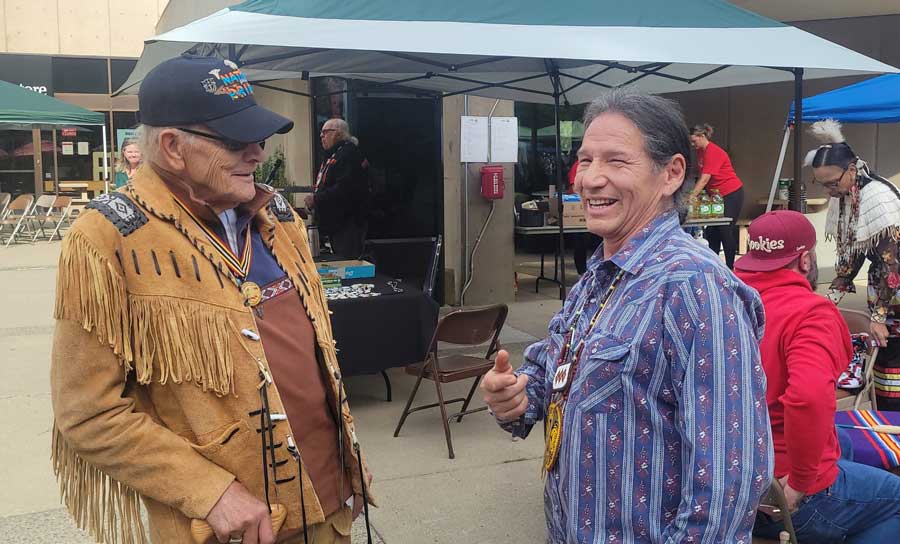
Wahpepah said the elders are giving us a cultural lens in a effort to heal what is broken.
“If you have a cultural lens, you can go throughout your world viewing things through this lens, and that might help you come to some conclusion and ideas that you can pass on to your family,” he said.
Wanapepah is a trained permaculture designer as well as a teacher, consultant and speaker about native American ways. He founded Red Earth Descendants, a Native-based nonprofit serving Southern Oregon since 2005.
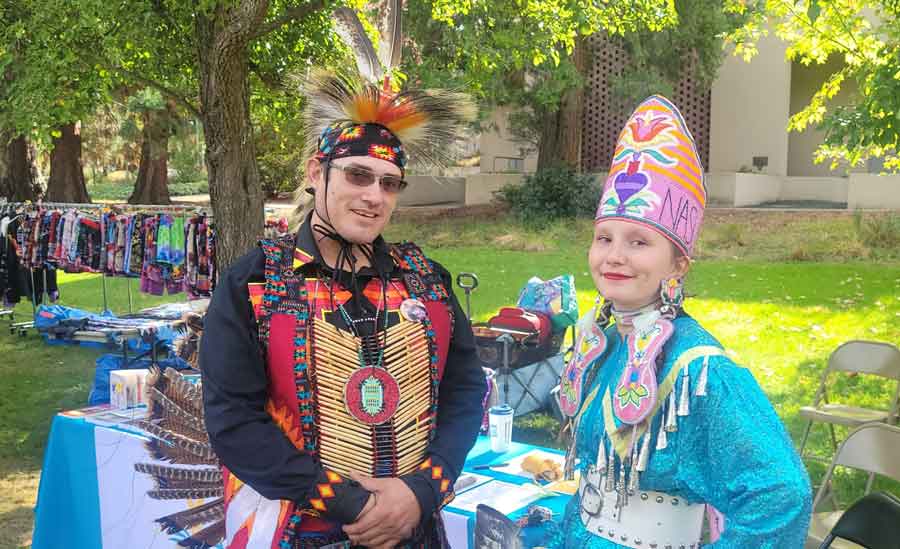
Amanda Pearce displayed a traditional costume designed for a royal appearance. She played a major role over the weekend events as the new Miss NASU (Native American Student Union) SOU. Her two-year tenure involves local and regional appearances.
“I go to different pow wows and different indigenous events in the area and make presentations to groups and classes. I was a student representative for Indian Education, so I reach out and help with kids programs a lot, I really like that,” she said.
Her father is also involved. Steven Pearce is an adopted Lakota Sioux who spent 13 years fighting fires as a crew boss in Northern and Southern Oregon and teaches at Conway School.
Pearce is now involved with teaching youth about their Indigenous culture. He said he’s found that the youth are actually teaching him in the end.
“Calling our groups a minority almost makes it seem like we’re weak, but when we stood up for our culture, it made us stronger. We’ve found that there is a lot of strength in the few,” Pearce said. “It’s because they see their life in such a pure way. I think it’s really important that our youth learn about our Indigenous culture because they see it in such a way that ends up as an example to the rest of us. A lot of times some students feel as if they’re a minority, but that changes.”
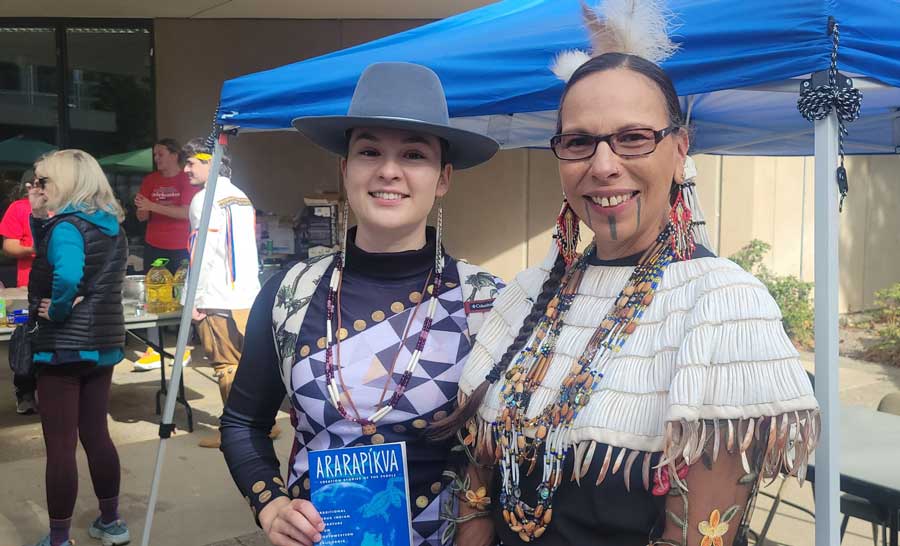
Tori McConnell is Miss Indian World 2023. She’s currently a Master’s student at Cal Poly Humboldt and has come to the celebration to share Karuk tribal stories. McConnell said she used her title as Miss Indian World to try to add mutual understanding in the controversy over the Klamath River dam controversy.
“I think there is still a lot of work to be done. They undammed the Klamath River recently and there are some people that don’t understand why it’s important for the river to run free,” she said.
McConnell’s views on ecology are in accord with earlier ideas expressed by Dan Wahpepah.
“Different people can’t understand why the ecosystem works that way that it does and how important it is. The river was managed for thousands of years. I think that’s a problem with education. Starting to introduce these concepts will help our society understand each other better and we can have a healthier earth if we do that,” McConnell said.
Hosts of SOU’s Indigenous Peoples Day celebration included the university, its Office of Equity, Diversity & Inclusion, the Native Raiders office and the Native American Student Union.
Art Van Kraft is an artist living in Ashland and a former broadcast journalist and news director of a Los Angeles-area National Public Radio affiliate. Email him at artukraft@msn.com.