Ashland state legislators Golden, Marsh preview upcoming session
By Herbert Rothschild
Short though it will be — only 35 calendar days starting Tuesday, Feb. 1 — the upcoming session may long be remembered as the moment when the contentious relationship between Oregon’s timber industry and environmentalists was finally laid to rest. There will be a bill to encode in law the provisions of the Private Forest Accord, which was negotiated at the urging of Governor Kate Brown and signed last October. It will overhaul management of 10 million acres of private forestlands.

“This is huge,” said state Rep. Pam Marsh, whose district includes Ashland and Talent. The Forest Practices Act will be amended to protect riverbanks and streamsides, improve forest roads, and allow for adaptive management of private forests.
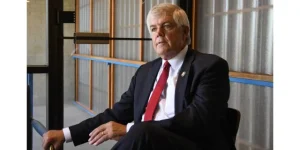
Jeff Golden, who represents Ashland and Talent in the state senate, chairs his chamber’s Natural Resources and Wildlife Committee, so the bill will come before him. “There’s a better than even chance that it won’t be hard to pass,” he said, citing the stature of those on both sides who worked out the accord. (For more on the accord, see the Jan. 18 KS Wild Side column in Ashland.news.)
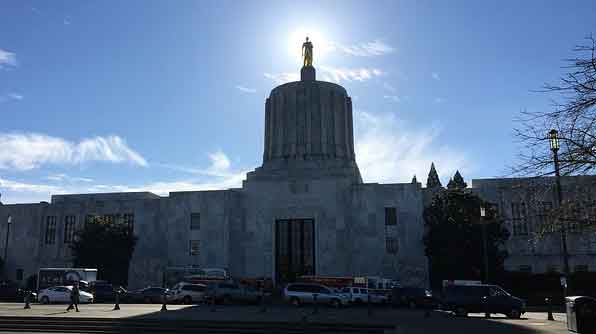
Originally, the “short session” every other year was devoted to adjustments to the biennial state budget, but its scope has expanded to address other pressing challenges. The sessions are the periods of time in which the state legislature is convened for purposes of lawmaking. Regular sessions convene each January and may last 160 days in odd-numbered years and 35 days in even-numbered years. To keep the number of bills manageable, each legislator is limited to filing two bills, and each committee and the governor are limited to filing three.
Marsh will use one of her bills to try to secure special funding for four school districts, Phoenix-Talent among them, that were hard hit by wildfires. Because so many residences were destroyed, the districts’ student enrollments dropped. And because state funding is based on student headcounts, so did their revenue. “If the public schools aren’t able to recover, people are less likely to return to the towns, so there will be a downward spiral,” Marsh said. The special funding would last from three to five years.
Marsh’s other bill intends to prepare Oregon for a big influx of federal funds to expand broadband capacity across the state. She thinks the infrastructure bill Congress passed late last year will provide at least $200 million to Oregon. The Oregon Broadband Office and the Oregon Broadband Advisory Council, both housed in the Oregon Business Development Department, will decide who gets how much of the money. Marsh’s bill would establish a grant review committee and set out rules for applying.

Golden will once again try to enact campaign finance reform. Despite overwhelming public support for reform — in 2020, ballot Measure 107 to remove state constitutional barriers to reform passed by an almost 4-to-1 ratio — the legislature couldn’t reach agreement on a bill last year. This year’s bill calls for state matching funds: it would match 6-to-1 the first $25 of every campaign donation of $200 or less from individuals. “This match would make small donors consequential,” Golden said. “More and more jurisdictions nationally are establishing public match programs.” Nationally, Republicans have opposed this kind of reform, arguing that it’s not a proper use of state funds, but Golden doesn’t expect a walkout of Senate Republicans this year to stymie passage of bills they oppose.
Golden’s other bill is one of several bills coordinated by the “HB3000 working group” that address problems in the cannabis industry, especially the intrusion by criminal organizations. When Oregon voters approved Measure 110 last fall to decriminalize possession of small amounts of all recreational drugs, revenues from the state marijuana tax were dedicated to programs to prevent and treat addiction.
“It slashed resources for regulating the cannabis industry,” Golden said. His bill is one response; it would require a moratorium on issuing licenses for hemp grows, a parallel to the current moratorium on pot grows. Slowing the proliferation of varieties of cannabis plants will help law enforcement identify and address illegal cultivation.
On the House side, Marsh is also interested in bills to help enforcement. These include finding a dedicated revenue source for it, plus giving new inspection powers to county watermasters, such as entry onto land under cultivation, without turning them into police officers.
Marsh wants to help mitigate the deadly effects of heat waves like the one Oregon experienced last summer. At least 63 people statewide died of heat-related causes. Most of the 45 who died in Multnomah County, which includes Portland, were found alone in residences without air conditioning or a fan. The first step would enable local governments to deploy air conditioners on an emergency basis during heat waves. The more permanent relief would be to help with the cost of installing heat pumps in low-income residences with inefficient heating and cooling systems.
As part of her continuing efforts to help house those who were burned out by the 2020 fires, Marsh is supporting approval of another round of turn-key projects, including converting under-used motels into emergency housing, plus promoting rule changes to further facilitate re-zoning of commercially zoned land for residential use.
Other bills that Golden hopes will succeed concern increased carbon sequestration on farm and forest lands, promotion of organic farming, facilitating creation of a state bank, and divestiture of state funds from fossil fuel companies. The bills call for modest steps toward each of those objectives.
More carbon sequestration was a recommendation in the latest biennial report of the Oregon Global Warming Commission, which was created by the legislature in 2007. The bill would lay the groundwork for programs that encourage farm and forestland owners to manage their resources to sequester more carbon dioxide. Organic farming would be promoted by adding five positions in the state’s Agricultural Extension Service specifically to assist growers, a response to a request by the Friends of Family Farmers.
The state bank bill would put on the November ballot an amendment to the state constitution to remove any perceived doubt that Oregon can establish a public bank in which to deposit governmental funds instead of enriching commercial banks.
A “Treasury Transparency” bill would require the state treasurer to list annually where the treasurer has invested funds under the treasurer’s control, principally PERS and local governments’ pooled funds. Access to this information would facilitate future consideration of proposals to reduce or eliminate investment of public dollars in fossil fuel-related companies.
Processing all the bills mentioned in this report is a lot to accomplish in 35 days, and there will be many more bills. Committee meetings will be held virtually, but all votes must be taken in person.
“If a bill isn’t pretty much in final form by the end of the first week, it won’t have much chance of passing,” Golden noted.
Email Ashland.news board member Herbert Rothschild at herbertrothschild6839@gmail.com.