Ashland needs to add lower-cost homes; getting them built hasn’t been easy
By Bob Kaplan
Ashland is a fabulous place to live — if you can afford it.
When you ask Ashlanders about our biggest issues, the cost of housing often rises to the top. When I ran for City Council in 2022, I was motivated to work on solutions to this crisis. Since then, I’ve learned how hard it is to solve this issue. A lot has been done, and groundwork has been laid for lots more. At the same time, I understand worries that nothing is happening.
I’ve also gotten a pretty clear picture of how many people and families are struggling, and it’s deepened my commitment to make a difference.
How bad is it?
It typically costs more to buy or rent a home in Ashland than in neighboring communities because of high demand and limited supply. Over the last decade, we’ve gained about 80 to 100 new housing units a year. We need many more. The city’s 2021 Housing Capacity Analysis says single-family detached dwellings account for about two-thirds of Ashland’s housing stock. The good news is that of the 680 homes built since 2018, two-thirds have been multifamily, mixed-use or ADUs.
Housing is considered “affordable” if the folks living there spend no more than 30% of their gross income on rent or mortgage payments, utilities, insurance and property taxes. Planners define “affordable housing” in relation to the area’s median family income. A household earning between 80% and 120% of the MFI is considered “middle income”; “low income” is 50%-80%; and “very low income” is less than 50%.
Many Ashlanders would benefit from lower-cost housing. Ashland’s 10,120 households are split almost evenly between owners and renters:
- Over a third are considered “very low income” — earning less than $36,600 a year for a family of four.
- Almost half are “cost-burdened,” meaning they pay more than 30% of their income on housing.
- About a quarter are severely cost burdened, meaning they pay more than 50% on housing.
Check out the chart below from the city’s 2023 Housing Production Strategy.
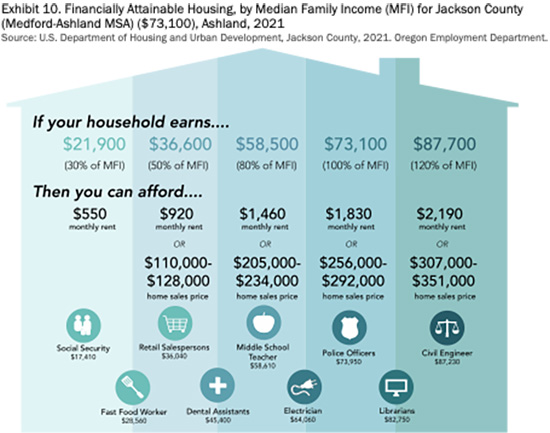
These numbers are from 2021, but even then it was hard to find housing at these prices. And today’s interest rates mean monthly mortgage payments are higher too.
The challenges:
Why can’t we do more, faster?
- High cost of land. We don’t have a lot of undeveloped land, and construction costs have skyrocketed. It’s hard to build affordable houses without hefty subsidies.
- Money: Public subsidies, grants, and/or tax incentives. The city provides some help but doesn’t have a lot to offer. Federal and state programs are very competitive — and complicated.
- Zoning. Our land use regulations used to favor single-family homes. That’s changed as the city relaxed height restrictions, allowed greater density and removed parking requirements. There’s room for in-fill, but most vacant lots are too small for large apartment complexes that might offer lower rents.
- Opposition. Neighbors worry about increased traffic and loss of open space, or that new developments will lower their property values. Sometimes these concerns can be satisfied, but in the meantime, projects are delayed — increasing the cost — or sometimes they just die.
What are we doing?
Ashland has pioneered many creative initiatives and continues looking for new strategies. Here are a few examples from the Housing Production Strategy:
- Accessory Dwelling Units (ADUs). Ashland began allowing ADUs in all residential zones in 1991. Today almost 300 ADUs dot the city, with 109 constructed in just the last seven years. They’re often the most affordable housing options. The city now offers preapproved architectural plans to simplify permitting.
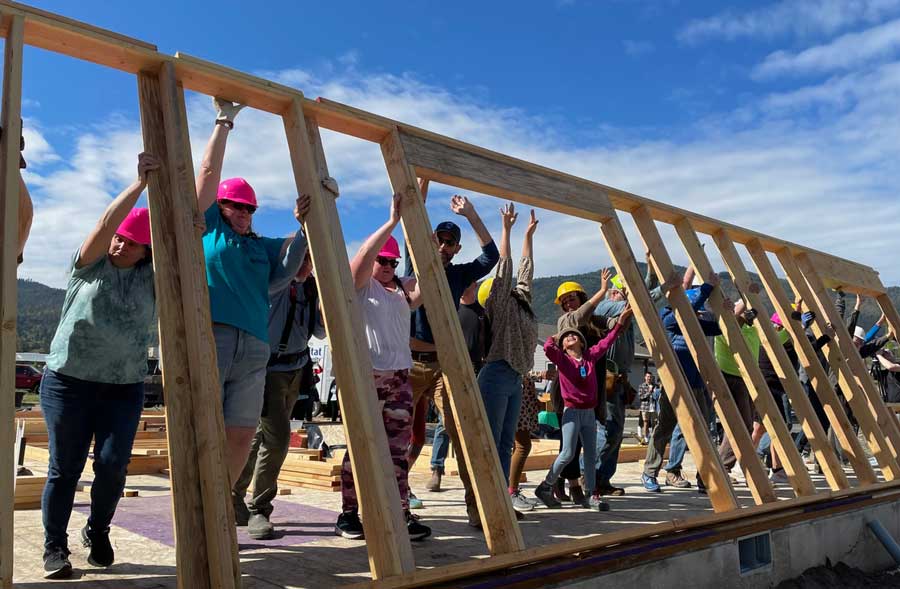
- Inclusionary zoning. When a developer applies to annex land into the city, Ashland requires 25% of new units to be affordable. The Beach Creek development on North Mountain includes eight deed-restricted houses, two under construction by Habitat for Humanity.
- Tax and fee waivers and incentives. Ashland waives various fees and charges for building new affordable units.
- The Affordable Housing Trust Fund. Ashland created an Affordable Housing Trust Fund in 2008, but it didn’t have a regular source of revenue until 2017 when we began feeding it with $100,000 a year from marijuana tax revenues. That’s not a lot, but it can leverage funding from other sources.
What else can the city do?
Ashland was the first city of its size to complete a state-mandated Housing Production Strategy (HPS). I was a member of the advisory committee in 2022, and the council approved the strategy last year.
The HPS commits the city to specific actions to increase availability of housing, with a focus on affordability and equity. Here’s what’s on deck over the next five years (pp 35-36, HPS). I’ve noted actions that are already underway:
| Priority action | Initiative (and primary or secondary focus) | |||
| Encourage new low- and moderate-income rental housing | Increase opportunities for affordable homeownership | Encourage new income-restricted affordable housing units | Preserve existing low- and moderate-income housing | |
| Evaluate land banking (underway) | Primary | Primary | Primary | |
| Evaluate community land trusts (underway) | Primary | Primary | ||
| Host education and outreach efforts (underway) | Secondary | Primary | Primary | Primary |
| Develop an Equitable Housing Plan (2025) | Secondary | Primary | Primary | Primary |
| Disallow single family dwellings in high density R-3 zones | Primary | Secondary | Secondary | |
| Evaluate increasing allowances for residences in commercial and employment zones (underway) | Primary | |||
| Support preservation of existing manufactured home parks (underway) | Secondary | Primary | Primary | |
| Increase development capacity for multifamily residences | Primary | Primary | ||
| Implement multiple-unit property tax exemption for multifamily or affordable housing | Primary | Secondary | ||
| Preserve and improve existing low-cost, unregulated rental housing | Primary | |||
| Support development of additional permanent supportive housing | Primary | |||
| Evaluate opportunities to improve energy efficiency (underway) | Primary | Primary | Secondary | |
| Establish a construction excise tax | Primary | Primary | Primary | Primary |
| Evaluate using urban renewal | Secondary | Secondary | Primary | Primary |
| Identify additional funding sources for the Affordable Housing Trust Fund | Primary | Primary | Primary | Primary |
Conclusion
Our housing problem may still feel intractable, and progress is slow, but we are focused on removing obstacles and creating opportunities that weren’t on the table five years ago and that could make a big difference over the coming years.
Email Ashland City Councilor Bob Kaplan at bob.kaplan@council.ashland.or.us. Email letters to the editor and Viewpoint submissions to news@ashland.news.