We are hardwired to regard global warming events as one-offs
By Chris Honoré
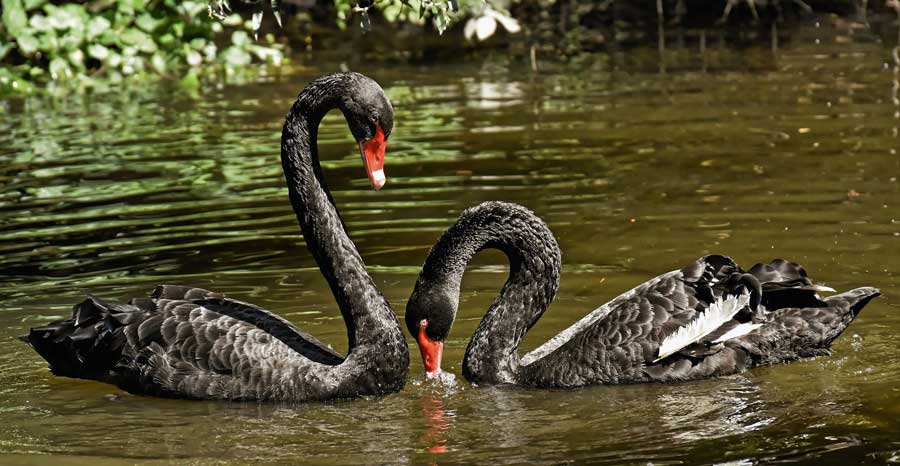
I’ve long been convinced that as a sentient species we are hardwired to regard catastrophic events — floods, earthquakes, hurricanes, tornados, fires that consume vast acreages of forests, to include homes and even towns — as “Black Swans.”

Black Swans (originally thought to be a bird that did not exist) are today used as a metaphor for occurrences that come as a surprise, have an impactful, even tragic effect, and are thought of as one-offs.
The term was created by risk analyst and mathematician Nassim Nicholas Taleb, and used to explain hard-to-predict phenomena that exceed the realm of normal expectations, magnitude and consequence.
Of course, history is replete with such events, and I assume that no life has ever been lived which did not include a Black Swan (likely countless), often explained in hindsight as if it should have been expected.
But here’s the rub: Thinking of extreme climate events (e.g. the recent, devastating Kentucky flood) as Black Swans offers us a rationalization wherein we can avoid recognizing what has become a pattern (referred to as global warming or climate change) which represents an existential threat to our planet and to all the species that inhabit this place we call home.
Recently, I came across an article in Time Magazine, dating back to July 2020, titled “One Last Chance: The Defining Year For The Planet,” written by correspondent Justin Norland. He wrote, “We’re standing at a climate crossroads. The world has already warmed 1.1 degrees Celsius since the Industrial Revolution. If we pass 2 degrees, we risk hitting one or more tipping points … To ensure that we don’t pass that threshold we need to cut emissions in half by 2030.” All things considered, that now seems beyond doable.
In a recent “code red” report (2022), released by the U.N.’s Intergovernmental Panel on Climate Change (IPCC), said report outlines the increasing risk that global warming poses to human health, infrastructure, the stability of food and water resources, and the biodiversity of the planet’s ecosystem. This assessment was produced by 270 scientists from 67 countries working on behalf of the IPCC, and warning the world community of the consequences of inaction. U.N. climatologist, Hans-Otto Portner states, “Any further delay in concerted global action will miss a brief and rapidly closing window to secure a viable future.”
If the planet exceeds that afore-mentioned 2 degrees Celsius, hundreds of millions of people will be driven into poverty, coral reefs will die, sea levels will rise, droughts will increase, and food and water insecurity will threaten those countries that are unable to adapt.
Of course, if we have the global/political will, there are countless things we can do. We can still think and invent ourselves out of what is now defined by scientists as an environmental emergency (e.g. wean the world off of fossil fuel; retrofit homes and buildings; buy back gas guzzling cars and turn to hybrids and electric; expand and modernize our electrical grid to include solar and wind instead of coal; and more). But the fulcrum upon which all of the above rests is the word “will,” and begs the question: Can we as a global community commit to what is massive change?
At the beginning of this piece I wrote that we are hardwired to regard global warming events as Black Swans; however, one could also think of our inability to respond to climate change as a form of reflexive denial. In other words, regardless of our exigent circumstances, we, meaning the global community, are simply incapable of solving what is a worldwide crisis.
At the risk of sounding hyperbolic, I believe that our planet is dying in slow motion. We know this. The evidence is incontrovertible as is our failure to act; therefore, I would predict that by the end of this century, the world that awaits our children’s children will have reached a catastrophic 3 degrees Celsius, which for us today is unimaginable.
Email Ashland resident Chris Honoré at honore307@gmail.com.