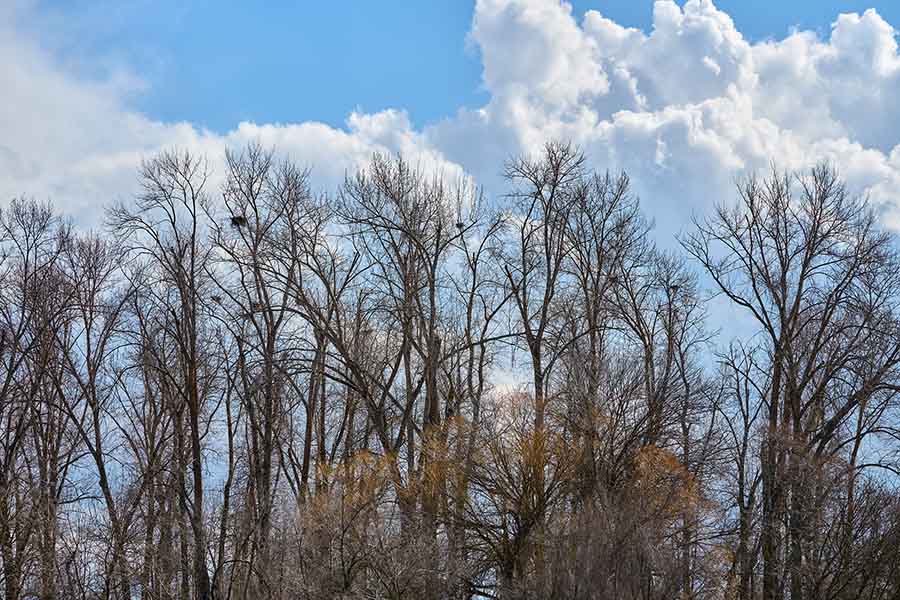
You may see their nests in tall trees along Rogue Valley waterways
By Elva Manquera-DeShields
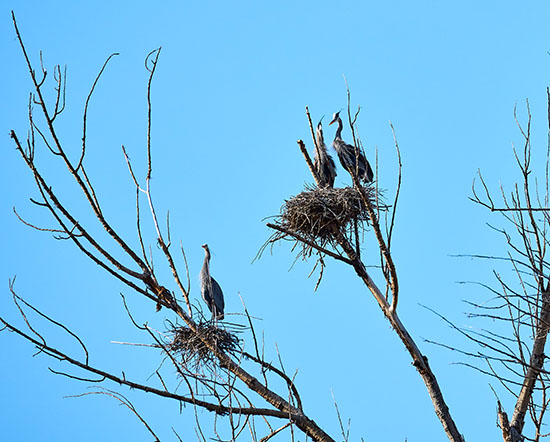
Driving along Interstate 5 in Southern Oregon, you will see several large nests high up in the trees along the Rogue River and Bear Creek. You may see tall figures standing in the nests in the early morning light. Once the new leaves arrive, the nests will be hidden, and their owners will have privacy again. These groups of large nests make up a great blue heron rookery. One can think of a heron rookery as a kind of time-share condominium complex.
Why do they nest in a rookery?
It might seem odd for such big birds to nest so closely together, but several benefits exist. By nesting in larger numbers, they help protect each other from predators. Rookeries give them multiple lines of defense, as they are so high up in the trees and have many eyes keeping watch. There is also a social aspect to nesting together. The herons can share nesting materials, and the young have more adults to observe and learn from.
Nesting behavior
Herons often return to the same nesting colony year after year and enlarge existing nests by adding sticks. Eggs are usually laid in March and hatch in April and May. By early April, nests become obscured by emerging leaves and are more difficult to see. Herons can be seen flying to and from the nest until their young fledge — between June and August.
Threats
As with many other species, habitat loss is the largest threat to heron populations. Herons are still common and have adapted well to human alteration of the environment. They are extremely sensitive to disturbance at nest sites, however, and seek out remote areas with little human activity. Protecting and restoring wetlands and riparian areas on public and private lands will help ensure the long-term survival of the species.
Protecting riparian habitat
Riparian habitat is important for birds big and small. Riparian (streamside) vegetation provides habitat for many breeding species, including migrating and overwintering songbirds. In the western United States, riparian zones make up less than 1% of the land area, yet they support diverse wildlife. Many of our historical riparian habitats have been lost or degraded due to human impacts. Their relative rarity and high biodiversity make riparian areas an important habitat for the conservation of birds and other wildlife.
What you can do?
Avoid vegetation removal or other restoration activities that disturb habitat during the songbird nesting season from April 15 to July 31. Plan to replace invasive blackberry or other shrubs you that are to be removed with native shrubs with similar structure, so that there is no net loss of bird habitat in the long term.
Elva Manquera-DeShields is science communication, outreach & DEI manager for Klamath Bird Observatory. Email her at ejm@klamathbird.org. The Klamath Bird Observatory is a nonprofit organization based in Ashland that advances bird and habitat conservation through science, education and partnerships. Working in the Pacific Northwest and throughout the ranges of migratory birds, KBO emphasizes high-caliber science and the role of birds as indicators to inform and improve natural resource management. KBO also nurtures an environmental ethic through community outreach and education.