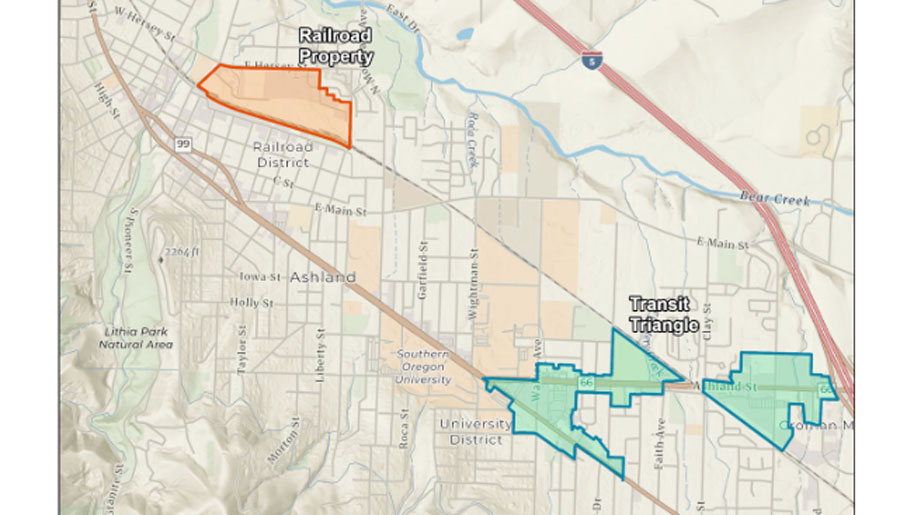
CFAs planned for the city’s transit triangle and railroad district will be designed to increase density and minimize reliance on driving; city code changes could make for greater density downtown as well
By Morgan Rothborne, Ashland.news
Ashland City Council unanimously voted to approve the first reading of ordinances to create code changes for state-mandated Climate Friendly Areas Tuesday, but only after a lengthy discussion of additional code changes inspired by CFAs for the downtown area to encourage more affordable housing.
CFAs will be created in the Transit Triangle and Railroad District areas of Ashland through changes to the city’s maps and codes, said Elizabeth Decker, a member of JET Planning, contracted by the city. The changes are intended to fulfill the goals of CFAs, developing urban areas with greater mixed residential and commercial spaces to encourage pedestrians, minimize reliance on vehicles and thereby reduce greenhouse gases, Decker said.
Increased building height allowances
The CFAs will include increases to building height allowances, maximum unit density dictated not by code but by, “building envelope,” and larger minimum unit densities, she said. For the downtown area, a formal CFA was not proposed but instead changes to the city’s code inspired by CFAs to accommodate greater density.
Councilor Eric Hansen asked why the downtown would not be made a CFA. Decker responded that her firm was recommending mimicking the CFA’s density incentives, such as higher building height allowances or less required parking, while maintaining the city’s design standards, which a formal CFA would supersede.
Councilor Bob Kaplan suggested increased building height allowances for developments that include affordable housing.
Possible affordable housing incentives
Community Development Director Brandon Goldman said the city could allow developers to build above a height of 50 feet if they included affordable housing. Councilor Dylan Bloom said lessening restrictions might make things “pencil in a little bit better” for developers, and he asked if an extra story could be allowed with 30% of affordable housing.
Kaplan responded in agreement to the suggestion of creating incentives to generate mixed affordable and “middle” housing within the two climate friendly areas and potentially more flexibility in the downtown area.
The remaining councilors reached an informal agreement after subsequent discussion of the downtown area. Mayor Tonya Graham attempted to move the discussion along and said that because of the city’s mixed zoning in the downtown area, the conversation was revolving around very little applicable land. Goldman responded that a third of an acre downtown would qualify for the suggested change.
Kaplan said that with changes in parking requirements, several areas now used for parking downtown could become developable and that was a “substantial opportunity.”
Council voted unanimously to approve the CFA changes with an amendment proposed by Kaplan to direct staff to return on the second reading of the ordinance with additional information on the affordable housing building height incentive for further council deliberation.
Council also unanimously passed the second reading of an ordinance to prohibit hazardous burning and after deliberation down to the last minute of available time, determined to approve a contract with Travel Ashland for destination marketing services at $450,000. A discussion on changes to the Enhanced Law Enforcement Area was deferred due to lack of time.
Public transit expansion
Councilors responded to a presentation from the Rogue Valley Transportation District by expressing interest in exploring how the city could support extended hours for buses.
Some businesses in Ashland such as the Food Co-op and some restaurants close at 9 p.m., after the last bus on the No. 10 line departs for Medford, Councilor Gina DuQuenne said.
Bloom asked if there was a known dollar amount to expand service even later, noting that some food service jobs are not done until after 10 p.m.
Representing RVTD, Kelly Madding said expansion of service to 10 p.m. is part of the district’s 2040 transit plan. Kaplan said the city should be “ambitious” in supporting expanded public transportation.
Councilor Jeff Dahle said he would like to see data collected from local business owners to learn how lack of transit is preventing them from attracting or maintaining employees.
Concerns for homelessness policy, management of shelter
During public comment, Echo Fields asked the council to consider homelessness issues, particularly with regard to what stakeholders are involved in making changes to police policy for the city’s night lawn camping area and the future of the 2200 Ashland St. property. Summer heat is coming fast amid uncertainty surrounding the city’s ability to stand up a severe weather shelter, she said.
Christopher Nader identified himself as someone who stays on the night lawn and has been homeless in the present and the past. Originally from New York, he said he was good friends with the police chief there and an expert on ethics who helped co-found the center for ethics at Columbia University. Nader listed off a number of other accomplishments and leadership positions in social services and expressed concern about Ashland’s police chief, Tighe O’Meara.
“I ask everyone to look into this man. The behavior I’ve seen out there is horrible and it should be looked into, it should be looked into,” he said.
Rich Rohde, speaking as a member of Southern Oregon Housing for All, said recent “police sweeps” on the night lawn were done with too little notice and without input from those volunteering to assist with those sleeping there.
“If you asked anyone in our group about Ashland’s policy for homelessness, they would describe it as incoherent,” he said.
Email Ashland.news reporter Morgan Rothborne at morganr@ashland.news.