Some of the logs cut in Ashland watershed used to help restore creek banks, enhancing habitat for birds, fish and animals
By Morgan Rothborne, Ashland.news
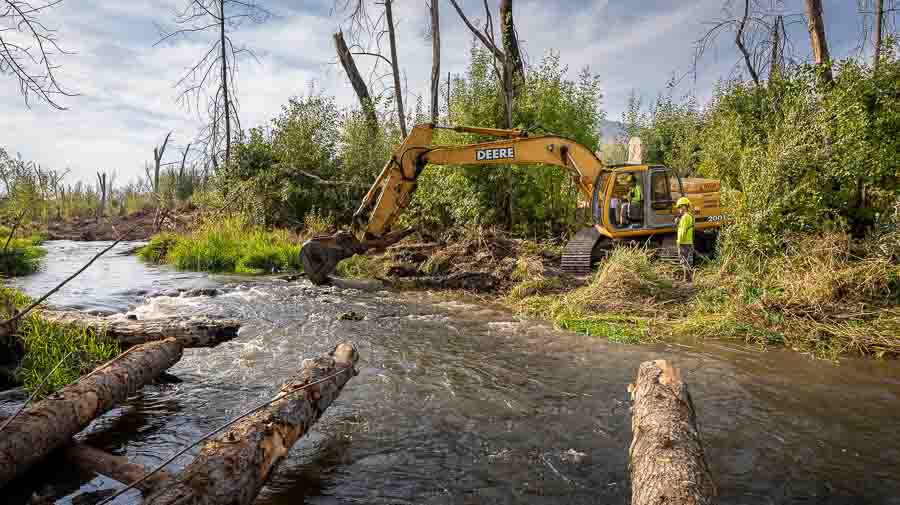
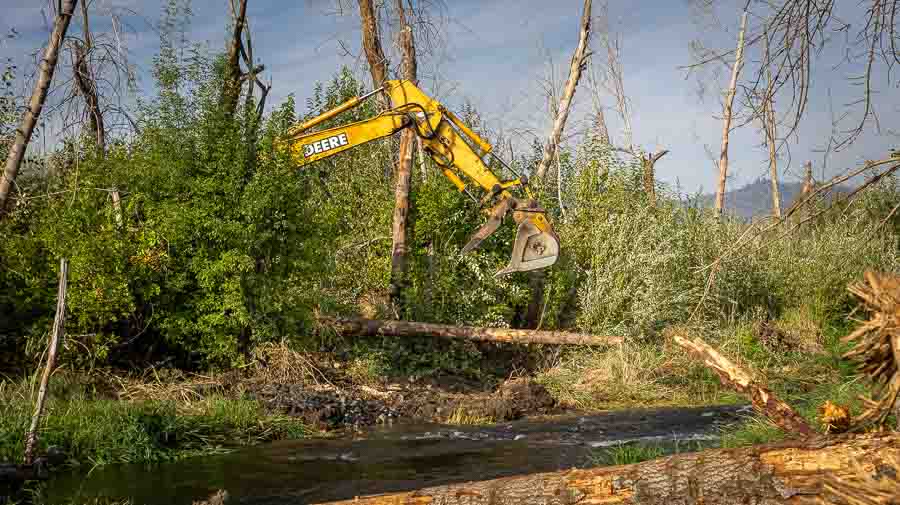
An excavator appeared to be ravaging the bank of Bear Creek in Lynn Newbry Park on the east side of Talent on a Friday morning in early September. On the opposite bank was a scene of apparent destruction, with a haphazard maze of logs jutting from the surface and woody debris scattered. Most vegetation immediately close to the creek on one side was gone.
The recently completed $750,000 Bear Creek River Mile 19 project wasn’t intended to have a strictly surface level effect, but to create a nuanced restoration of eight acres of wildland urban interface within the Almeda Fire scar.
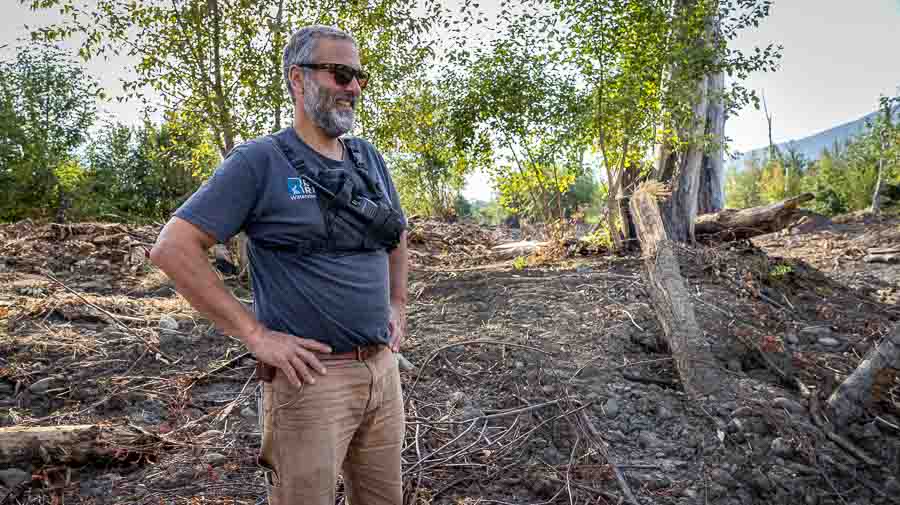
“Right now, he’s taking that boulder and trying to weigh that log down, that’s the ballast, the weight,” said John Speece, project manager with the Rogue River Watershed Council.
Using the claw-like end of its arm, the excavator made peculiarly human motions picking up a large boulder and carefully pressing it into the soft earth beside the water. In 32 locations throughout the project area, Speece said, structures of one to six logs have been methodically placed underground with bolts and ballasts, such as this boulder, to hold them in place through high or low flows of the creek. These log structures will help create the kind of topography that makes for a healthy ecosystem, clean drinking water and less likelihood of flooding.
“This project, for aquatic species, is targeting high winter flows so that in high flows these side channels will become active and juvenile fish can take refuge in there, rather than getting blown out,” Speece said.
He pointed to the creek where water flowed gently enough to create a mirror of the trees overhead, then transitioned suddenly into water rolling over itself and reflecting light in wavering lines, or a “riffle.”
“Look right there where it goes flat to riffle — before this project, this was all one, what’s called a glide. … It’s too simple. A complex habitat, it helps the geomorphic processes, provides little refuge spots,” he said.
Various fish call this creek home, species such as Chinook salmon, steelhead, coho salmon, pacific lamprey and some resident trout. During periodic “high flow events” or periods of higher faster water lines in the creek, juvenile fish need refuge areas of still enough, calm enough, water on the edges of the creek to survive and thrive. Invertebrates need rock surfaces to attach to. All forms of life seen and unseen in these waters have highly specialized habitat needs, said Beth Boos, community engagement project manager for the council.
Introducing complexity through embedded logs and slash will protect and improve the fish populations species higher up the food chain — from birds to otters, bears and beavers — will also see more habitat. The log structures had to be protected with wire cages in some places to protect them from the already healthy beaver populations.
All the messy elements of the project serve a purpose. The “slash” or woody debris along the surface of the ground will help improve soil health and foster the return of soon-to-be seeded native species. Willow stakes have already been included in the log structures and are “greening up,” rapidly, Speece said.
Improving the overall habitat and health of the creek also means better drinking water for the populations that sometimes source their water from this creek, Boos said.
A thick bundle of papers was visible hanging inside the excavator across the creek. Boos said the bundle contained a map and plans created through a contract with Cascade Stream Solutions.
The operator inside the machine continually referenced the plans throughout the project as he made choices of where to place boulders and where to add or remove material, Speece said. The plans themselves were created after painstaking work to analyze the flow of the creek and the habitat needs of the various aquatic species in play to determine what structure was needed in the creekbed.
Prior to adding any material, an estimated 300 dump trucks of material were first removed from the sides of the creek, Speece said. During the construction of Interstate 5 and Highway 99 decades ago, material was dumped pell-mell in the area. Using historical photos and the engineering plans, material was strategically removed to best redesign the creekbed.
“It’s like putting an ice cube in a glass of water — you don’t want that water to get to the top of the glass, as you take material out you can put material in,” Speece said.
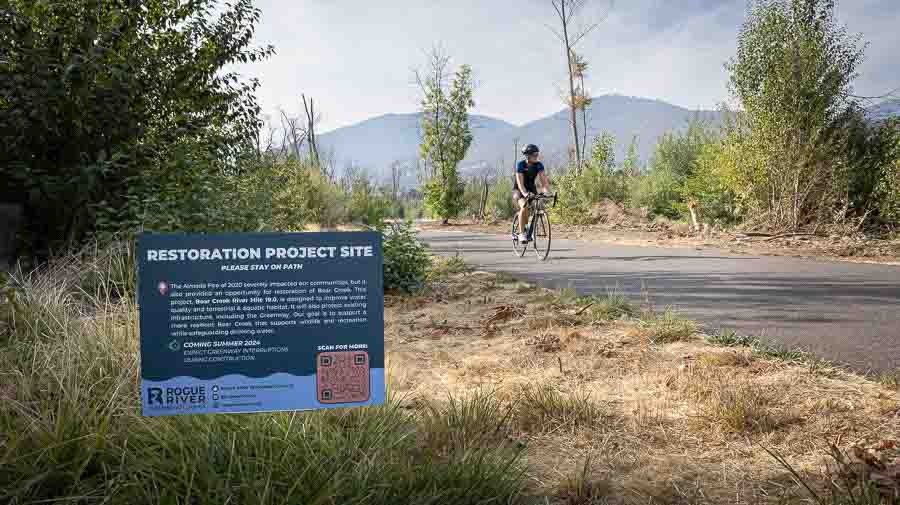
In addition to protecting habitat, the periodic high flow events of Bear Creek were ill-controlled by the creek bed as it was. Lacking the proper topography and vegetation on the banks to contain roughly every-five-years high flow events in winter, water sometimes led to severe erosion or lapped at the Greenway’s path.
“We lost 8 feet of bank in one location, 12 in another. Probably because there was no root stabilization since the fire,” Speece said.
The project was done with meticulous thought during the season when juvenile fish are not searching for refuge, outside nesting season for the nearby birds, and with state, county and federal permits, long-term planning and expansive work by the contracted engineers, Speece said.
The M&M excavating company has also worked with the council before and can contribute a little of their expertise and experience to the project.
Once the architecture of the creek was completed, the banks were also seeded with native species to catch the coming fall rain. Around January, the council will hold “staking events” for the public to assist in planting willows to further enhance the structural integrity of the banks, Boos said.
The Rogue River Watershed Council usually does projects on a larger scale — often 40 acres or more — and on different waterways, such as Little Butte and Elk creeks.
“In Bear Creek, this is unique. There hasn’t been anything like this within the last, like, 10 years,” Speece said.
When the Almeda Fire swept away poison hemlock, blackberries and other invasive species, it laid bare both a relative blank slate and an objective understanding of the need to restore the ecology along Bear Creek. Areas where restoration work had been done before the fire did not burn as hot and recovered faster.
“After the fire, we saw opportunities to come out here. … In hours, it did years and actually millions of dollars of work in removing that blackberry,” he said.
This summer’s-end project was possible through the confluence of more than one opportunity — a flow of grant funding for restoration related to the 2020 Labor Day fires and dead trees from the recently completed helicopter logging project in the city of Ashland’s watershed.
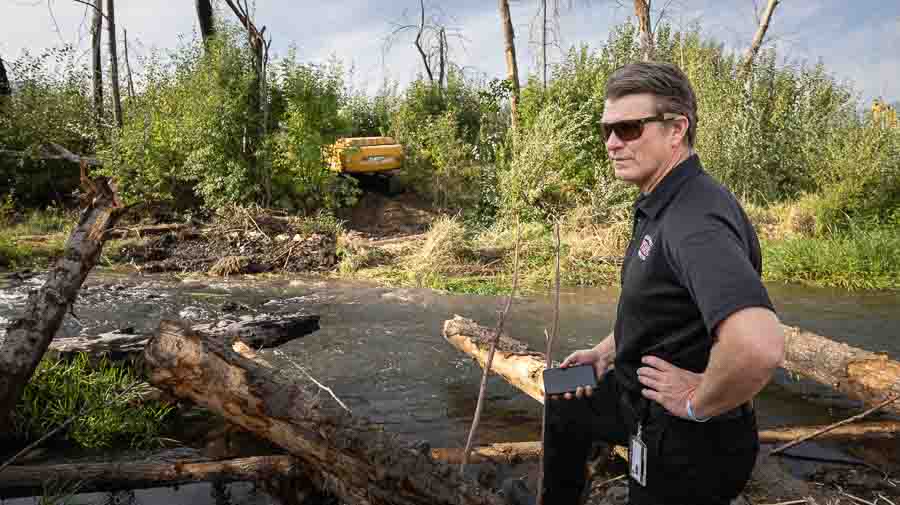
Standing on the banks watching the excavator, Ashland Fire & Rescue Wildfire Division Chief Chris Chambers said when he learned of the project it was an obvious dovetail for the city’s project. Dead trees surrounding Water Treatment Plant road were “sandwiched between the road and probably the city’s most important piece of infrastructure and a trail,” and could not remain there, Chambers said.
These trees filled three full loads of log trucks, with one partial load “too small to go to the mill,” were all removed by the council project’s staff and paid for from their budget, both saving the city some funds and adding an additional facet to the city’s project.
“From a fire perspective, to burn off that fuel and start over — what an opp to get something better to grow in. … This has enormous ecological value,” Chambers said.
To learn more about the project or participate in upcoming tours and staking events, follow the Rogue River Watershed Council on social media or visit its website.
Email Ashland.news reporter Morgan Rothborne at morganr@ashland.news.