If we wish to truly honor Dr. King, we should read his ‘Beyond Vietnam’ speech
By John Marciano
Over the years, I have attended the January celebrations of Dr. Martin Luther King Jr.’s birthday in Ithaca, New York, where I chaired the Human Rights Commission, and in Santa Monica, California, Medford, and Ashland.
I do not recall a featured guest speaker addressing the fundamental truths expressed by King’s April 1967 “Beyond Vietnam” oration that condemned the U.S. as “the greatest purveyor of violence in the world.” Many know and admire King’s magnificent “I Have a Dream” oration, but few Americans have read or heard his Riverside Church critique of that war. It has been erased from history.

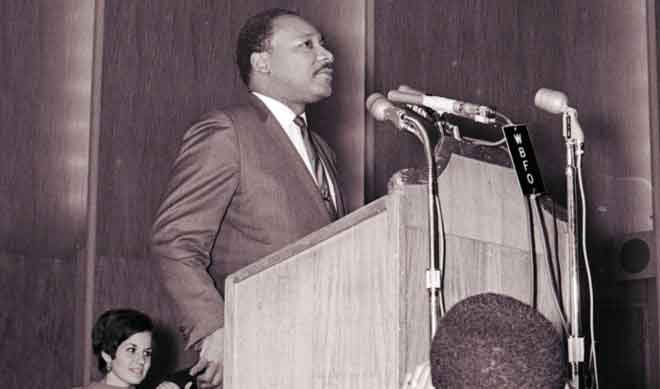
On Nov. 9, 1967, King gave the annual convocation address of the Graduate Student Association (GSA) at SUNY Buffalo. I co-organized the event and was his driver that evening — seven months after his historic “Beyond Vietnam” addressed that war. During our time together that evening, we discussed the harsh attacks he received for his opposition to the conflict. He explained that conscience demanded it.
“Beyond Vietnam” is arguably his greatest speech, although virtually unknown to most Americans compared with his “I Have a Dream” oration at the August 1963 March on Washington. Those who have heard or watched King’s magnificent oration that day are deeply moved, but many are unaware of the pre-march “apprehension (and) dread” of the corporate media and political establishment. President Kennedy ordered 4,000 troops to be stationed in the suburbs, with 15,000 men of the 82nd Airborne Division ready in North Carolina; his aide was ready to cut power to the public-address system if rally speeches became “incendiary.” Washington banned all alcohol sales for the first time since Prohibition. Hospitals prepared “for riot casualties.” The event was a huge success. It drew a crowd of some 250,000 people in a marvelous and peaceful show of interracial support for justice (Taylor Branch, “Pillar of Fire: America in the King Years 1954-63”).
Four years later, at New York’s Riverside Church, King articulated powerful truths about the war in Vietnam and this nation. He laid his firm opposition to the war squarely on the shoulders of the U.S. government — that had denied the Vietnamese their right to independence, aided brutal French colonialism there, created and supported Diem’s dictatorship in South Vietnam, and violated the 1954 Geneva Agreement — policies supported by Democrats and Republicans.
King denounced the war as “a symptom of a far deeper malady within the American spirit.” He asserted that “the evils of racism, economic exploitation and militarism are all tied together.” We could not “get rid of one without getting rid of the others (and) the whole structure of American life must be changed.”
He stated that the injustice of the conflict was inextricably linked to the African-American struggle for civil rights. The war was an enemy of poor people because it diverted money that could be used to mitigate the effects of poverty.
King’s speech elicited vicious attacks from the political and corporate media establishment, and from civil rights leaders. “Life Magazine stated that much of his speech “was a demagogic slander that sounded like a script for Radio Hanoi.” The New York Times called his effort to link civil rights and the war a “disservice to both. The moral issues in Vietnam are less clear-cut than he suggests.” It concluded that there were “no simple or easy answers to the war in Vietnam or to racial injustice in this country.” The Washington Post claimed that some of his assertions were “sheer inventions of unsupported fantasy,” and that King had “diminished his usefulness to his cause, to his country and to his people.” The corporate media and political attacks of King reflected public sentiment. A Harris poll taken in May 1967 revealed that 73% of Americans opposed his antiwar position, including 50 percent of African Americans.
If we wish to truly honor Dr. King on this January holiday, we should read (or reread) his “Beyond Vietnam” speech, and abandon the myths about him and the movement for justice and peace to which he dedicated his life. We do a grave injustice to his legacy and that struggle by revising the actual history of that era, and by failing to fully understand and confront the economic exploitation, militarism, and racism that he condemned — which continue to poison this nation and the world.
We have to stop ending his political life in this nation with his “I Have A Dream” oration of August 1963, and see what he had become by April 1967 with his radical critique of the War in Vietnam and American militarism.
John Marciano lives in Talent