Oregon students pay disproportionately high tuition, hindering enrollment and depriving the economy of trained professionals in key sectors
By Alex Baumhardt, Oregon Capital Chronicle
A new report shows that Oregon is “faced with many problems” when it comes to paying for the rising costs of higher education, ultimately hindering enrollment that has a spillover effect on the state’s economy.
The report on trends in state higher education enrollment and funding found that the Legislature’s overreliance on universities raising tuition to cover rising costs — rather than keeping up by making larger investments with state revenue — ends up hurting the economy. Unless tuition comes down and enrollment in post-secondary institutions goes up, the state will not have enough workers in fields such as health care and technology, and the state will struggle to compete for workers with other states, researchers found.
The report was presented to state lawmakers on Dec. 8 by Dennis Jones, president of the National Center for Higher Education Management Systems, a nonprofit think tank in Colorado.
Continuing to raise the price of tuition, Jones told members of the Senate Education Committee, affects college enrollment, completion and key sectors, such as technology.
Underinvestment
Compared with other states, the report found, Oregon under invests in its four-year public colleges and universities.
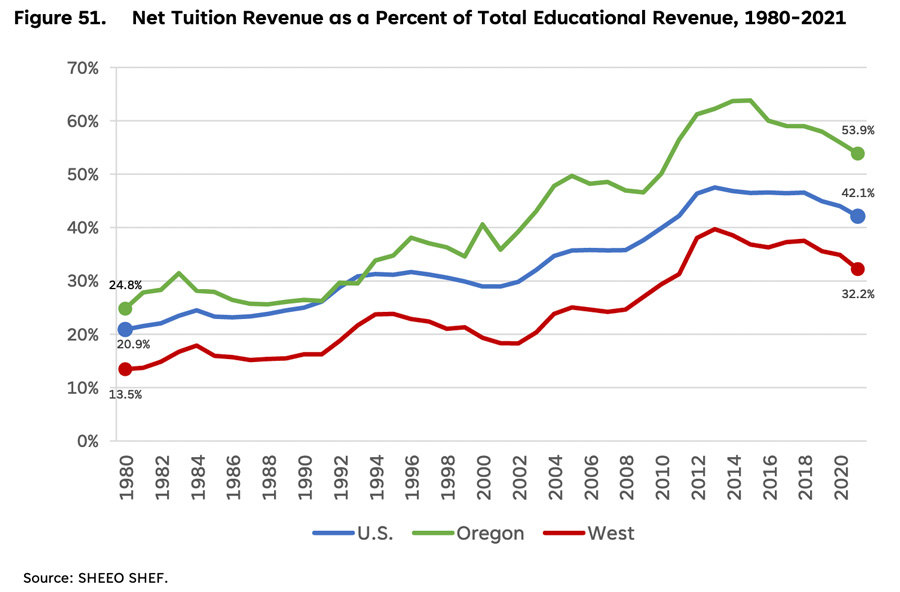
“Students in Oregon are paying a much higher share of the overall costs of universities than in most other states,” Jones told lawmakers. “The only states that are higher up there are states like Vermont and New Hampshire, that have essentially a private university view of how they fund higher education.”
Rising personnel costs have been pushed on to students, the report said.
About 25 years ago, the state paid for up to 75% of the cost of each full-time employee at a university. Now, it pays for about 50% or less, with tuition covering much of the rest, researchers found.
One major reason the cost of personnel has gone up so dramatically, researchers noted, is the rising cost of benefits under the state’s Public Employees Retirement System, or PERS.
During the 2018-19 school year, Portland State University and the University of Oregon faced budget shortfalls that led to tuition increases of 9% and nearly 11%, respectively. For both universities, a quarter of the deficits were due to increased PERS costs, according to reporting from the Statesman Journal.
To cover these costs, the state needs to step in, or universities will need to continue increasing tuition, enrollment or both, researchers wrote. The latter has been difficult and could become more difficult in the years ahead.
Enrollment challenges
Oregon faces several major challenges when it comes to boosting college enrollment and completion.
First, the state has some of the lowest four-year high school graduation rates in the nation, according to the National Center for Education Statistics. Among students who do graduate from high school, Oregon has some of the lowest college attendance rates in the nation, researchers found. Though the proportion of adults 25 and older living in Oregon who have an associate degree or higher is about on par with the national average, many did not earn those degrees in Oregon.
“Oregon is a net importer of college-educated talent,” the researchers wrote.
Universities will face major budget challenges as enrollment falls in the years ahead unless they can get more high school graduates to enroll and recruit older Oregonians who want to go back to a four-year institution to start or complete a degree, the report said.
The number of traditional college-age youth in the state is projected to decline. On top of that, the number of students enrolling in Oregon universities from out-of-state is expected to decline. California, where most of these students are from, is projected to have a much larger decrease in the number of high school graduates in the years ahead because of population declines in that age group. Washington and Utah are expected to have increased graduation rates but the report said students from those states are not likely to compensate for losses in California.
Recommendations
In the fields of science, technology, engineering and math, or STEM, researchers found that Oregon’s universities are not producing enough graduates to fill current and future labor needs. This means the state will need to entice nonresident workers to move to Oregon to fill these roles, competing with surrounding states.
Per capita wages for degree holders in Oregon are also below national averages, making competition difficult, researchers wrote.
The report’s authors said the state needs to increase its high school graduation rates. The researchers also recommended that state leaders and colleges agree on what Oregon’s future economy should look like and collaborate to work towards it. They said the state’s Higher Education Coordinating Commission, which is responsible for promoting post-secondary pathways for Oregonians, should do a better job of connecting universities and licensing boards so students are better prepared to enter the workforce after graduating.
State leaders must continue to focus on increasing college enrollment, especially among low-income students, students of color and nontraditional students who are older and working full-time, the researchers said.
To achieve this, the state will need to pick up a larger share of the cost of higher education, and universities must lower tuition.
Economic factors play a large role in why a higher proportion of Oregon high school graduates forgo going straight to college and instead enter the workforce. The report’s authors recommend that colleges do a better job offering alternatives for them, including programs that can be undertaken after work and on weekends, and programs that are accelerated and focus on developing job skills.
The state should also do more to help students who are at risk of dropping out due to financial or life circumstances, the researchers found.
For nontraditional students hoping to start or complete a degree, housing costs and a lack of affordable child care are the major barriers to enrollment or completion.
“It’s an old saw, but nevertheless a true one, that the individuals who are most reachable in any effort to increase enrollments are students who are already enrolled but need assistance of one kind or another to continue,” researchers wrote.
Alex Baumhardt has been a national radio producer focusing on education for American Public Media since 2017. She has reported from the Arctic to the Antarctic for national and international media, and from Minnesota and Oregon for The Washington Post.