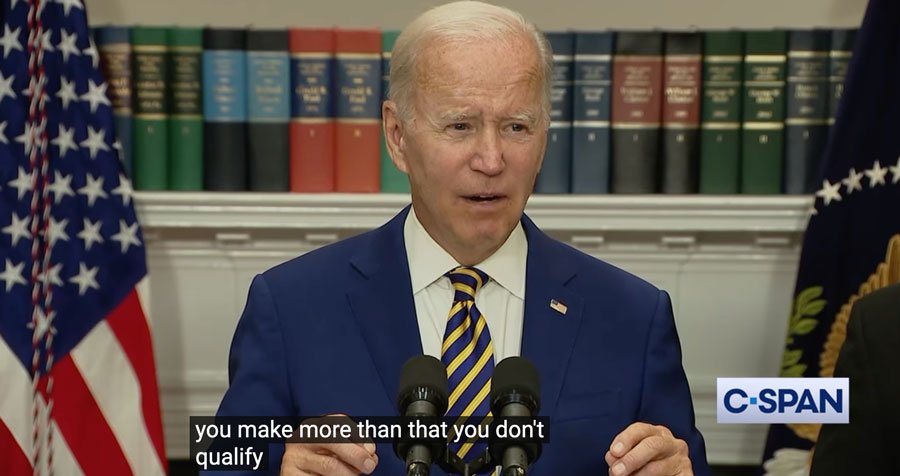
The Department of Education estimates nearly 90% of relief will go to those earning under $75K
By Herbert Rothschild
The student debt relief program President Biden enacted by executive order on August 24 immediately became contentious. Predictably, Republicans — who always become deficit hawks when Democrats are in power, never when they are — argued that it will add to the deficit. But another criticism, that the program is unfair, has not been only partisan. It’s that criticism which I want to think about with you.

The moderate version of this criticism is that the program helps people who don’t need it. The validity of that charge can be settled empirically.
Only recipients of Pell Grants are eligible for the $20,000 of debt forgiveness. Based on 2019-2020 data, 66% of this group were in households that earned under $30,000 annually and another 28% in households earning between $30,000 and $60,000. Pell Grants need not be repaid, but they have long ceased to cover the full cost of college attendance, so recipients have had to borrow as well. Biden’s plan also forgives $10,000 to other student debtors if their individual income doesn’t exceed $125,000 or their family income $250,000.
The Department of Education estimates that, among borrowers who are no longer in school, nearly 90% of relief dollars will go to those earning less than $75,000 a year. Researchers at the University of Pennsylvania broke the beneficiaries into income quintiles (20%). They concluded that 14% of benefits will go to those in the lowest quintile of earners, 24% to those in the next quintile, 36% to the middle quintile, and 20.5% to the fourth. Less than 5% will go to people more than just financially secure. Given how many federal programs benefit the rich and for so much more than $10,000, this 5% isn’t worth trying to rework the scheme to eliminate, even were it desirable to do so. You’ll see later that I don’t think it is.
The extreme version of the criticism that the Biden program is unfair holds that people who never took out student loans ought not be required to subsidize those who carry student debt. (There is an ancillary complaint that it’s not fair to those who have already paid off their student loans, but by that standard of fairness we could never institute any new government benefit program.) Obviously, the basis of this argument is not empirical but ideological, and it has implications far beyond this one public policy.
That’s easy to demonstrate. Families with no children could contend that they shouldn’t have to pay taxes to support the public schools. Their assumption would be that if a public program doesn’t benefit one individually and directly, one isn’t benefiting from it at all and therefore one shouldn’t have to pay for it. For most of our history, however, we rightly viewed an educated citizenry as a benefit of enormous value to everyone, so we funded public schools with public money.
Regrettably, state legislators became less and less committed to funding higher education, which led to the student debt crisis. We might regard Biden’s program as our belated and partial assumption at the federal level of a responsibility we have dodged at the state level for the last four decades.
Biden’s student loan forgiveness program is hardly the first. There are dozens of such federal programs, and each state has at least one (Oregon has two). All of them associate a public benefit with the forgiveness, mostly through work deemed to advance the general welfare, such as in the Indian Health Service or the military.
The Fact Sheet the administration released when Biden announced his program did not cite the public benefit of student loan forgiveness per se. I consider that a mistake, but it’s not hard to infer the public benefit from what the Fact Sheet says forgiveness will mean to the 43 million borrowers laboring under $1.6 trillion of debt.
“Middle-class borrowers struggle with high monthly payments and ballooning balances that make it harder for them to build wealth, like buying homes, putting away money for retirement, and starting small businesses. For the most vulnerable borrowers, the effects of debt are even more crushing. Nearly one-third of borrowers have debt but no degree … Many of these students could not complete their degree because the cost of attendance was too high. About 16% of borrowers are in default — including nearly a third of senior citizens with student debt.”
I want to conclude this inquiry by returning to the criticism that Biden’s program benefits people who don’t need help. Now I want to challenge, not its factual accuracy but its premise. I maintain that there should have been no income cap to qualify for the $10,000 benefit.
My authorizing precedent for so ostensibly extreme a position is that attendance at our public pre-Ks through high schools is free to everyone, and tuition at our public community colleges and universities is the same for everyone. This undifferentiation is true of other universal public benefits, such as entrance fees at our state and national parks.
Critics of the program are seeking fairness at the wrong point of participation in public life. The rich should pay more than others, not to benefit from public goods but to fund them. Our systems of taxation are where we should differentiate on the basis of means. For the most part, county property taxes, which fund K-12 schools, do that. As for state taxes, fairness varies greatly. Blue states like New York and Oregon rely heavily on the income tax. Most of the red states depend much more on flat taxes like sales and fees. As for federal taxes, the wealthy pay more, but not nearly what they should be paying.
Let’s focus our discussions of fairness there, not on student debt relief. Regarding the concern for deficits, largely they have grown not because federal spending has risen but because federal revenue has fallen. From 1981 through 2020, Washington was less and less inclined to tap the vast accumulations of wealth to fund desperately needed public goods. We’ve begun to do better.
Herbert Rothschild is an unpaid Ashland.news board member. Email him at herbertrothschild6839@gmail.com.