Why VE Day still matters in a time when few who helped to defeat Germany in World War II remain
By Paul R. Huard for Ashland.news
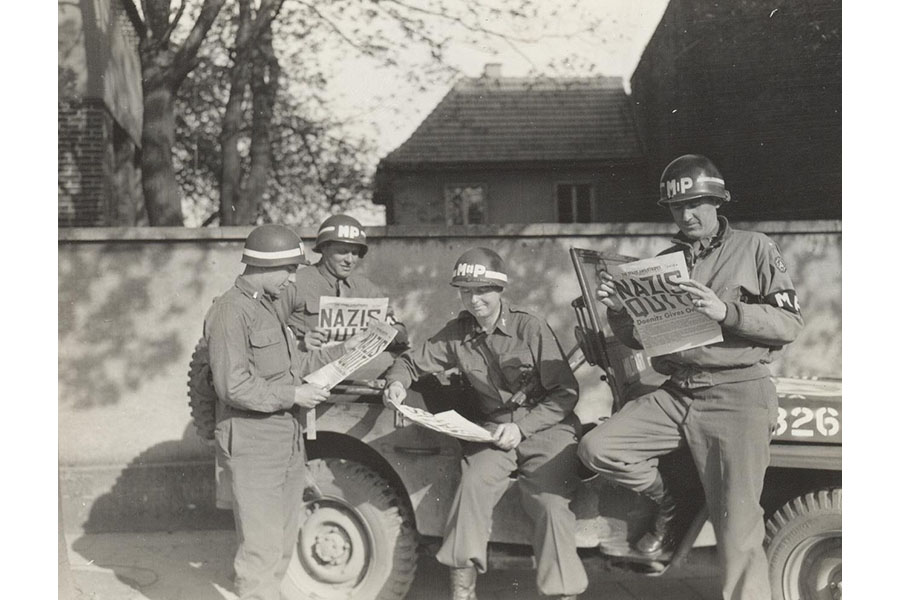
Thursday marks the 80th anniversary of the end of World War II in Europe, commonly called VE Day for “Victory in Europe.”
For 2,077 days, from Sept. 1, 1939, when Nazi Germany invaded Poland, until May 7, 1945, when the Nazis surrendered unconditionally to the Allies at a town in France, the worst war in human history transformed the European continent into one vast blood-soaked killing field. A human being died every three seconds because of combat and atrocities, whether they were a soldier or a civilian, man or woman, adult or child. Estimates of the death toll in Europe range from 15 million to 20 million people.
It even took two surrenders to stop the war officially — the Soviet Union demanded that Germany sign an additional “clarifying document” on May 8 — hence the decision to commemorate the European war’s end one day later. (The Russian Federation will mark the anniversary tomorrow because May 9 is the day when Joseph Stalin told the Soviet people of the victory.)
Even then, World War II was far from finished. It would grind on in the Pacific Theater of Operations for another three months, killing tens of thousands of American and Japanese soldiers a week and only ceasing after the use of two nuclear weapons.
A vanishing generation
Today, veterans of the war can be measured in mere thousands. The youngest participants are in their late 90s. There is even talk that this year will mark the last significant commemoration of VE Day because the World War II generation has nearly died off.
In recent years, one of them was my father, Donald Huard, a U.S. Army combat medic. The other was an uncle, Lloyd Lundy, who was the command pilot of a B-17 bomber in the U.S. Army’s Eighth Air Force. Both served in Europe and saw friends die horribly.
Considering the realities of the day, I will be the first to concede that it is becoming more and more difficult to explain to people why they should care about a war that is fast fading from the planet’s collective memory. We have enough problems of our own today — and I, too, feel the pressures of everyday life that our tumultuous decade has produced.
Yet, for more reasons than the fact that I teach history, I am compelled to ask you to consider two things that VE Day represents.
A multinational team
First, you need to know that the United States did not win the war in Europe — or the Pacific, for that matter — on its own. Despite the claims of the current U.S. president, other nations contributed mightily to the victory against fascism and cruelty that Allied victory achieved.
By 1945, 47 nations comprised the Allied Powers. Examples abound, but when it came to Europe the maritime convoys from North America to Great Britain during the five-year Battle of the North Atlantic paint a picture of shared hardship, shared danger, and shared sacrifice. Industrially produced war material from the United States was loaded onto British, Norwegian, Canadian, Greek, Belgian, Dutch and U.S. merchant vessels bound for Liverpool, England, and Murmansk, the Soviet Union. They were protected by warships from the Royal Canadian Navy, the British Royal Navy and the U.S. Navy.
Shared sacrifice
Nearly one-quarter of all the Allied vessels were sunk by German U-boats. More than 32,000 naval personnel died from the attacks; 36,000 merchant seamen lost their lives. That is more than all the U.S. personnel killed during the entirety of America’s involvement in the Vietnam War. It is the height of ignorance, arrogance or both to suggest that “victory was only accomplished because of us.”
Second, you need to remember the values that motivated the Allies in Europe.
Without a doubt, nations such as Great Britain and the United States were flawed actors. British colonialism caused widespread suffering. Jim Crow, segregation and race hatred were alive and well in the United States — including the segregation of U.S. Armed Forces during the war. We cannot deny or minimize the truth of our past.
But most people in the Allied nations knew that we needed to be on the right side of history. We knew that we were fighting for freedom and democracy — not as abstract political ideas, but as the means for our survival as a people. We would defeat fascism and dictatorship abroad so we could defeat racism and hatred at home.
A catalyst for change in the U.S.
It happened in the United States: Many historians argue that U.S. involvement in World War II was one of the greatest catalysts for social change our nation ever experienced. The Civil Rights Movement surged within a few years after the end of war. People in the United States began to change this nation so there would truly be liberty and justice for all — and the transformation was purchased in part with the blood of young men and women who died in Europe.
“War is a clinic in mass killing, yet there’s a miracle of singularity; each death is as unique as a snowflake or a fingerprint,” wrote the Pulitzer Prize-winning journalist and historian Rick Atkinson, whose books on World War II are considered some of the finest penned in this century. “The most critical lesson for every American is to understand, viscerally, that this vast host died one by one by one; to understand in your bones that they died for you.”
They died for you
On this day, which might be the last day during your life that anyone raises the importance of VE Day to you, remember that they died for you. They died so the United States — and the world — would be governed by the rule of law and the consent of the people, not by strongmen and oligarchs. If we fail them and their sacrifice, we throw away the precious gift of liberty that they bought us with their blood.
Paul R. Huard covered politics and the military for Gannett News Service-USA TODAY. He also is the writer of more than 20 magazine and journal articles on World War II and its legacy. Since 2004, he has taught American history courses at Ashland High School. Huard was among the first public school teachers selected as a teacher-ambassador for the National World War II Museum in New Orleans, Louisiana. He was twice selected as the Oregon Social Studies Teacher of the Year by the Veterans of Foreign Wars.