Threat? Or asset? Or some of each? Ideas — most from humans — abounded at first night of two-day confab
By Morgan Rothborne, Ashland.news
Four artists were asked if they could define at what line artificial intelligence could compromise human creativity. As they passed a microphone between each other, their conversation challenged the concept of a soul.
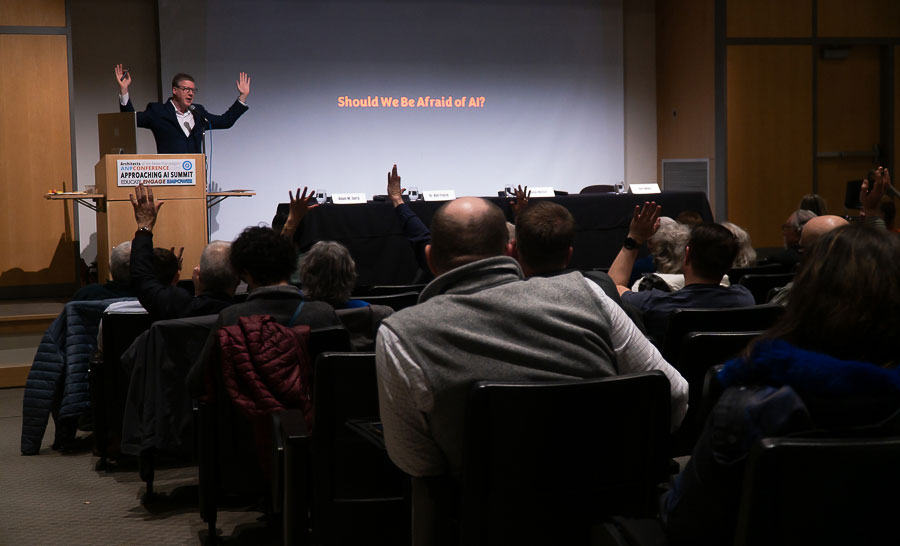
The deep existential dive came on the first night of the Approaching AI Summit, the second year of an artificial intelligence (AI) summit in Ashland. Friday night opened with two panels: “Creating with AI in commerce, industry & education: from answer engines to prediction engines: human innovation’s next leap,” and “Creating with AI in arts & media: redefining creativity — is AI a tool, a crutch, or a revolution?”
Panel moderator Paul Hynek asked the arts and media panelists if they could identify a Rubicon — a line that when crossed makes a consequential difference — for infringement on human creative power.
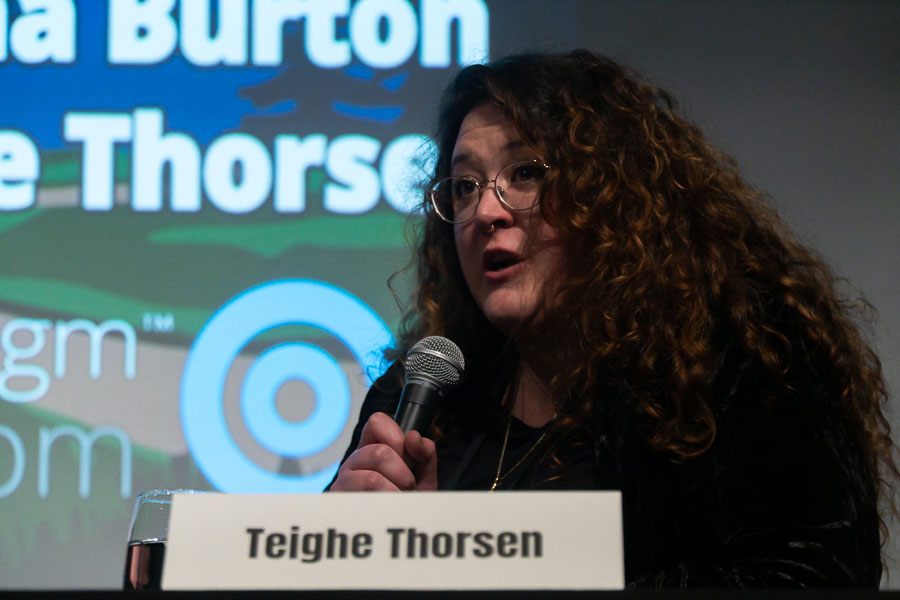
Teighe Thorsen, a media innovator and digital storyteller, equated the introduction of AI to Photoshop. Detractors felt it took away from those who had the skill to use a darkroom, while what it actually did was make photography a more accessible skill and trade. AI has enhanced her work by shortening research time from weeks of work to hours, keeping computer files more organized by automatically matching them to their associated projects and expanding productivity tracking.
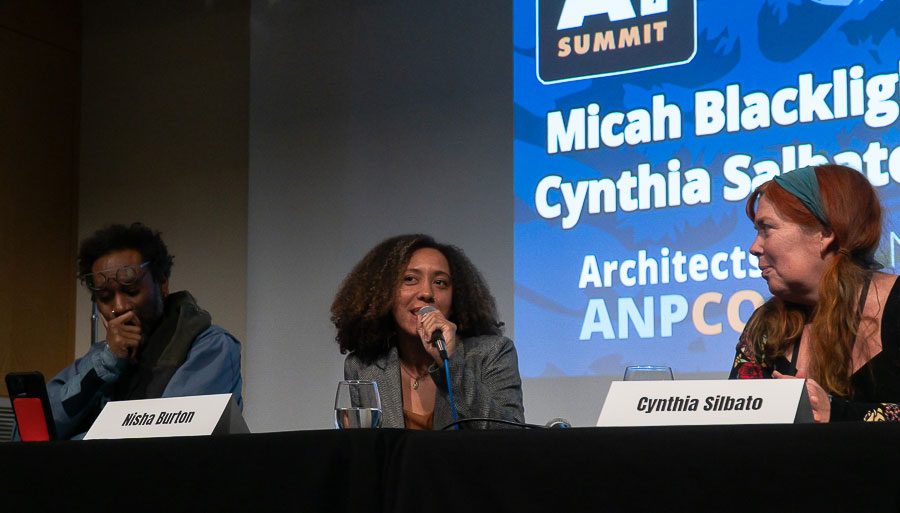
“Anyone can get a computer and try out one of the tools,” said Nisha Burton, a filmmaker and digital artist.
This new democratization of creative work could allow those who may not consider themselves creative — but who inherently are by virtue of being human — to make art when they otherwise may not have, she said.
“We are able to deconstruct some of the snobbery of art. … What has shifted is mastery.”
Artists might have spent years learning to hold a brush or work a camera and can now fill in those gaps with AI much faster, she said.
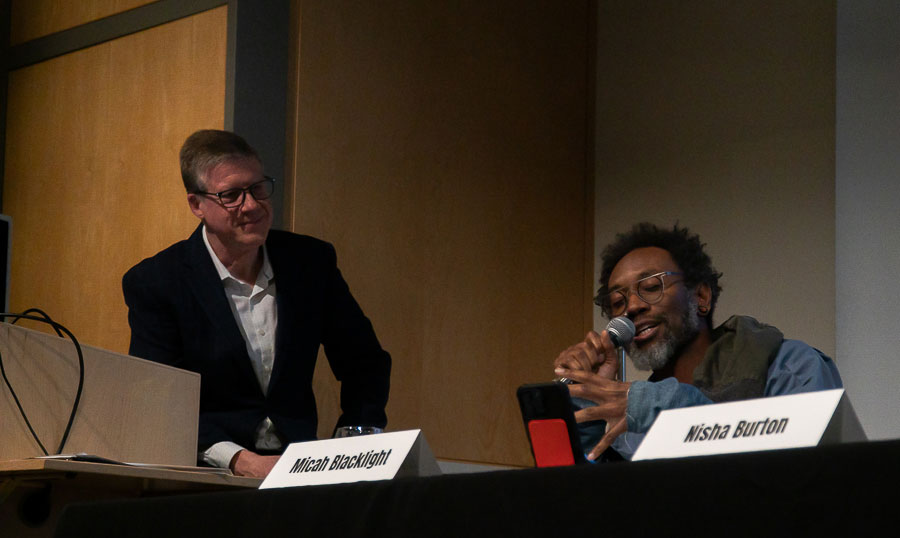
Micah Blacklight, a multi-media, multi-dimensional artist, said he agreed with his fellow panelists, but these points are a problem if AI is used without integrity, which not every human being exercises all the time.
When AI was created, artwork from throughout the internet was fed in without consent or compensation. Anyone can ask software to produce work akin to any artist and the software will do it.
“It messes with me on a fundamental level. I get really emotional about it but — the cat’s out of the bag, genie’s out of the bottle. … Artistic integrity, that’s for me the line,” he said.
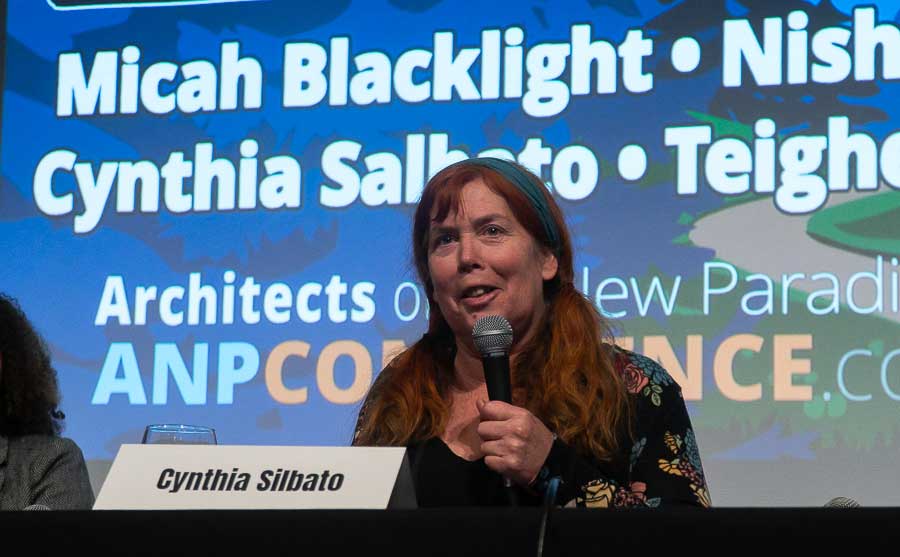
Cynthia Salbato, a storyteller and community builder, said she was easily the “Luddite of the group” — the last in her circle to get a cell phone and a rare and reluctant user of Facebook. But she found AI to be a way to gain the benefits of collaboration as a staunch introvert, or enjoy the collective knowledge of mankind to “create the beautiful wonderful world we all know is possible.”
Those who want to create that world should “steer the boat” rather than leave a vacuum for those of an exploitative mindset, Salbato said. The initial creation of AI wasn’t completely ethical, she said, but it could be viewed as a positive result.
“People say it’s ‘soulless,’ but I say it has parts of all the artist’s souls,” she said.
More info
Rogue Valley Metaphysical Library (RVML) produced the Approaching AI Summit at SOU March 21-22, 2025. Video recordings of all summit sessions are available online on RVML.org‘s YouTube channel (click here)
With a $20-a-month subscription to ChatGBT, anyone can develop a personalized chatbot which will learn the user. She cautioned the audience to consider that she would now hesitate to turn off the subscription.
BlackLight said he believes in a soul and a spirit. A soul as the “spark” of what it is to be alive, and a spirit as something that can distinguish pain from pleasure, “wrapped closer” to the human experience.
He referenced listening to someone who created AI software being asked the question if AI will gain consciousness. The software developer replied “no, but it will be able to fake it.” It’s possible to wonder, he said, if what we understand as divinity could be the escaped created intelligence of other life forms in the universe.
“Simulacrums are not authentically human and what they create is not,” BlackLight said. “It has no soul, but over time, there may be kind of a ghost in the machine. … At that point, you’ve got what amounts to a god. A little ‘g’ god, but a god nonetheless.”
Living with the technology will require a balance of opposites familiar to the rest of life — live like there’s no tomorrow and plan for tomorrow, he said. Partake in the possibilities while bracing for disruption.
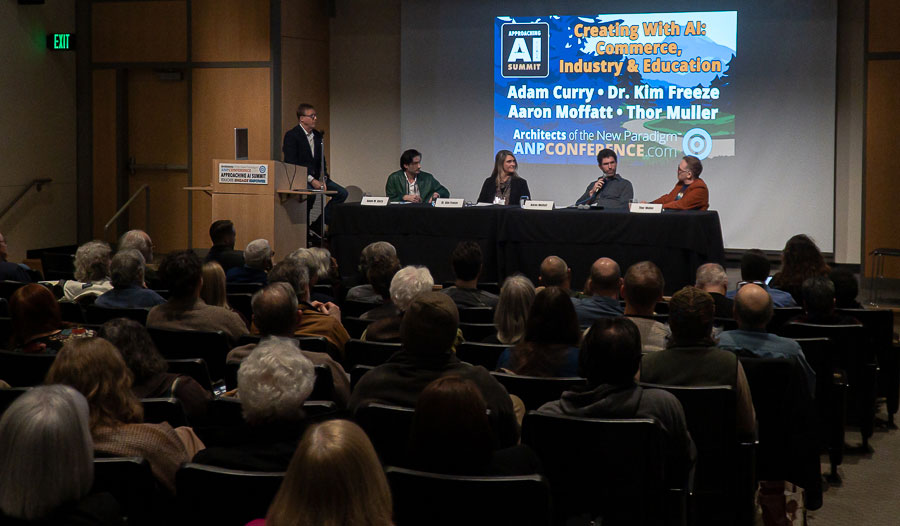
Commerce, industry and education panel
The thinkers of the commerce, industry and education panel discussed a tool with potential.
Adam Curry, an inventor and tech entrepreneur, said employers should be encouraging their employees to experiment, even challenging them to “disrupt their own jobs,” and rewarding those who create new ideas.
He offered a historical parallel for potential disruption of what is known.
In the antebellum argument over abolition, those who argued for slavery said, “Who’s going to pick the cotton?” If anyone could have explained that an invention would utilize a black substance of ancient biomass that, coerced into an explosion in the right machine, could move gears and levers and automate the harvest — “no one would have believed you.”
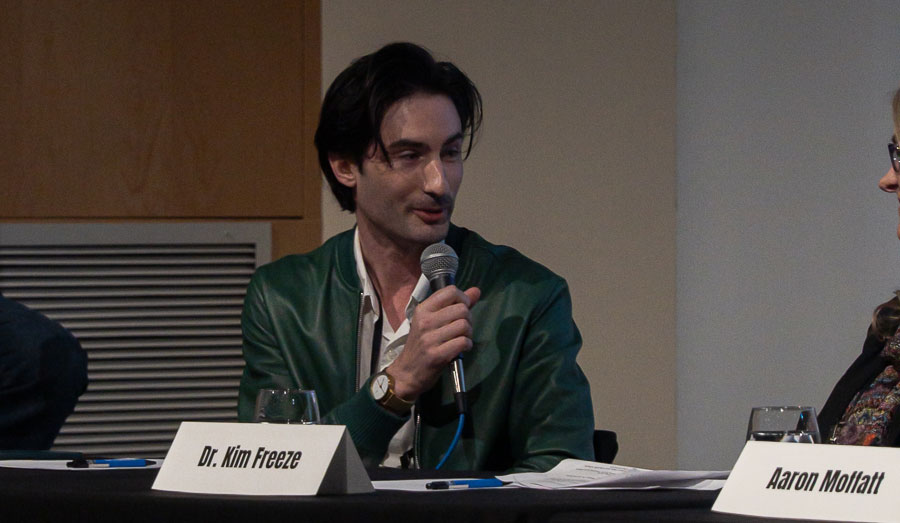
Dr. Kim Freeze, a serial entrepreneur, psychology professor, clinical psychologist and ecosystem builder, said in working with local entrepreneurs, many enjoy more time to be innovative by using AI to work out tedious tasks such as learning customer preferences or tracking information.
In working with those with neurodivergent minds, Freeze said she found many to be intensely creative, but sometimes with co-occurring communication challenges. Many of her students have benefited from AI.
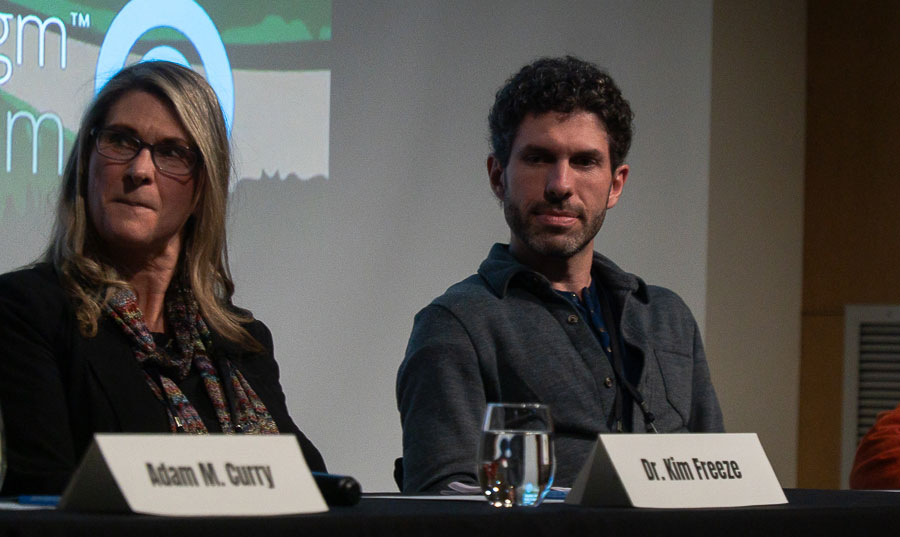
Aaron Moffat, a technology leader at the intersection of spatial visualization, AI, and cloud architecture, ventured that some might more easily raise funds to start a business by developing a prototype with AI rather than trying to explain their ideas. It may be easier to translate an idea from its creator to AI, rather than person-to-people.
Thor Muller, an AI strategist and entrepreneur, said AI could coexist with creative people the way gardening coexists with grocery stores. Creativity also isn’t restricted to artists, but used by scientists and researchers who with AI could develop new cures and breakthroughs.
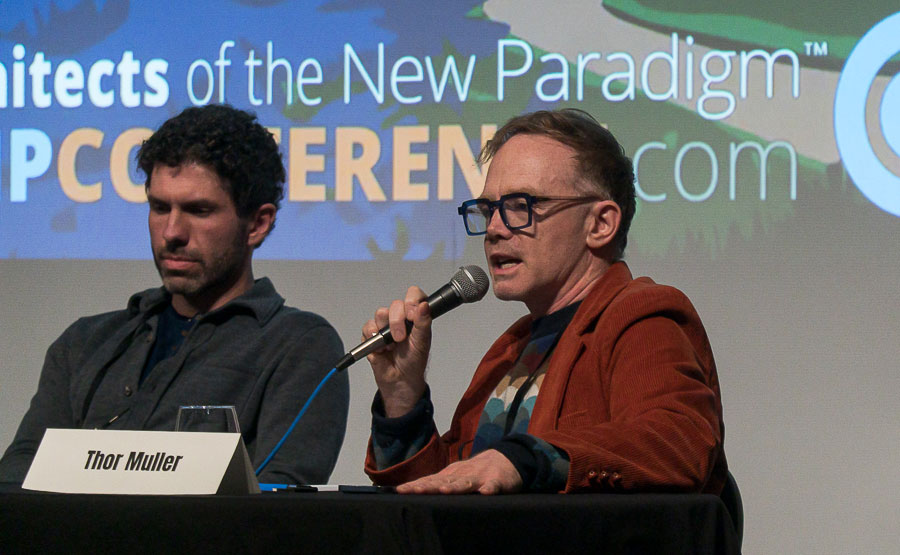
One way to embrace this new creative potential was the automation of tedious tasks such as writing a paper. Muller suggested using AI software in voice mode. By talking out an idea with the software, it can create a paper based on its user’s ideas and speech patterns.
“We can solve problems today we wouldn’t solve before; this is a huge opportunity,” Moffat said.
Freeze said she’s still learning what AI can and can’t do, but it is now her “favorite thing in the morning to have coffee and hang out with ChatGBT.”
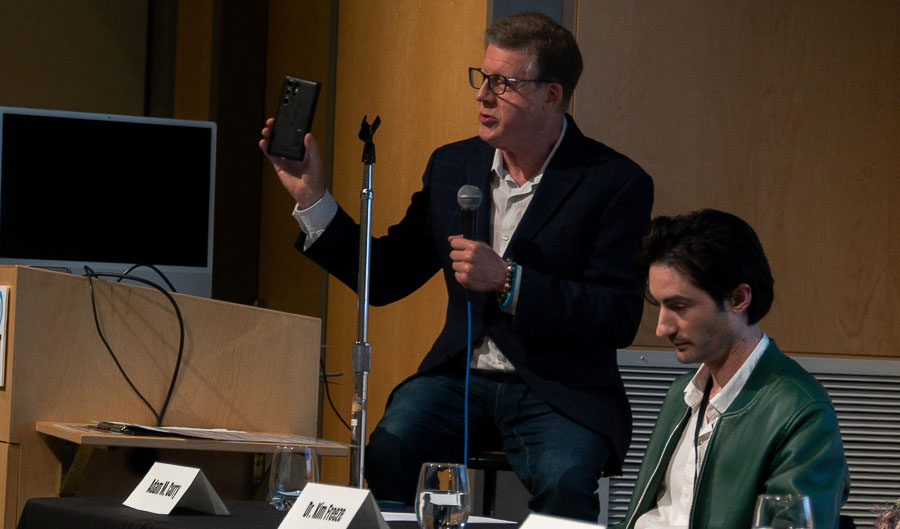
Hynek closed the evening by reminding the audience that they can learn AI by asking AI for help. He pulled out his phone, opened a program and, using the voice feature, asked for an explanation of a concept first, in a Valley Girl accent, then in French. It complied.
“If you just develop the habit, you can have this companion that can be with you all the time,” Hynek said.
An attempt to transfer the conversation back to the panelists was interrupted. The program still open on the phone in Hynek’s hand said, in its Valley Girl accent, “That’s a good idea.”
Email Ashland.news reporter Morgan Rothborne at morganr@ashland.news.
March 25 and 26: Corrected spelling of Paul Hynek’s name in body of article and in photo caption.