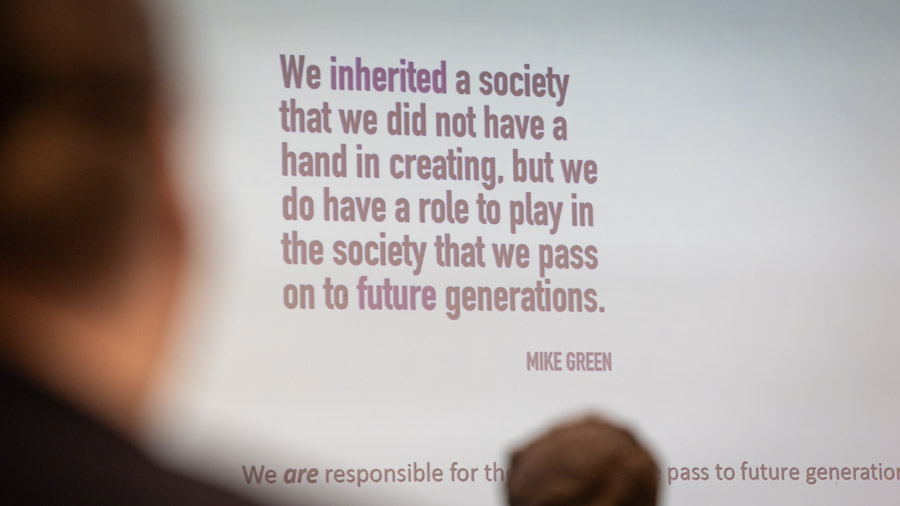
Mike Green: ‘We inherited a society we did not have a hand in creating, but we do have a role to play in the society that we pass on to future generations’
By Meg Wade for Ashland.news
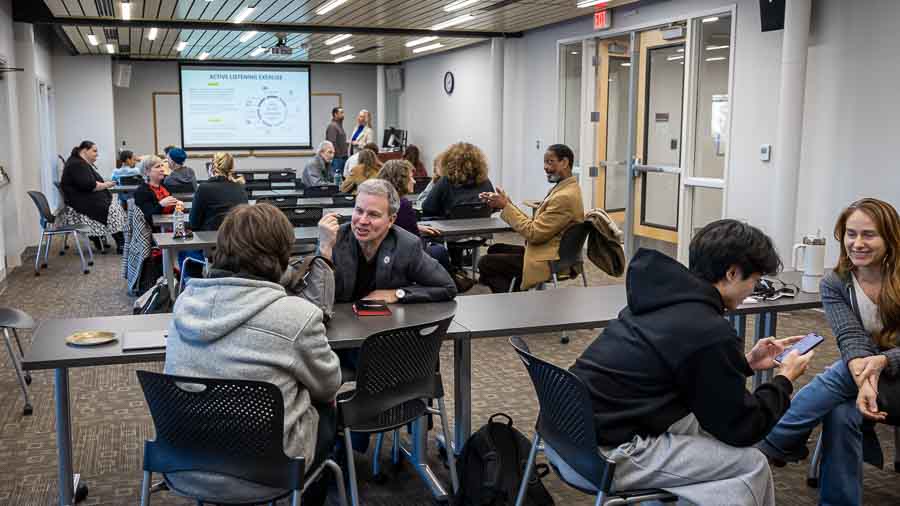
How to collectively think about big problems and discuss them across lines of difference — a lot to learn in 50 minutes, but that’s what students, faculty, and staff at Southern Oregon University, along with Ashland community members, did Wednesday afternoon.
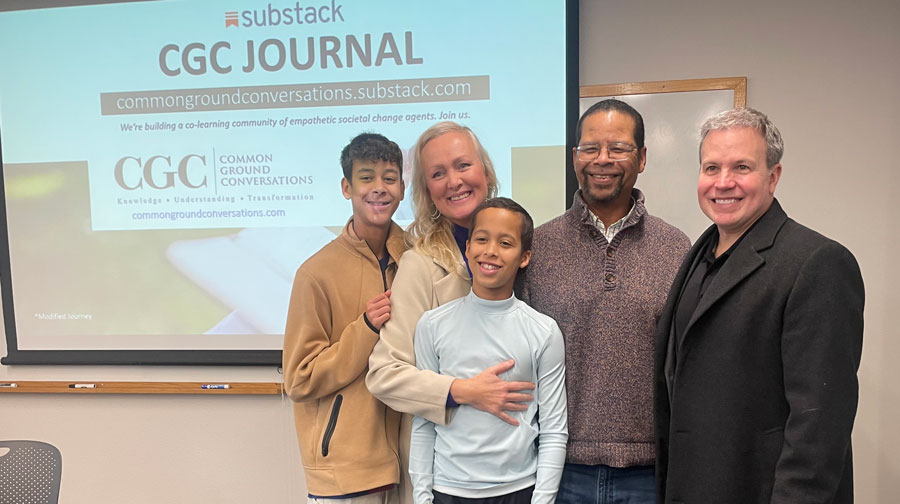
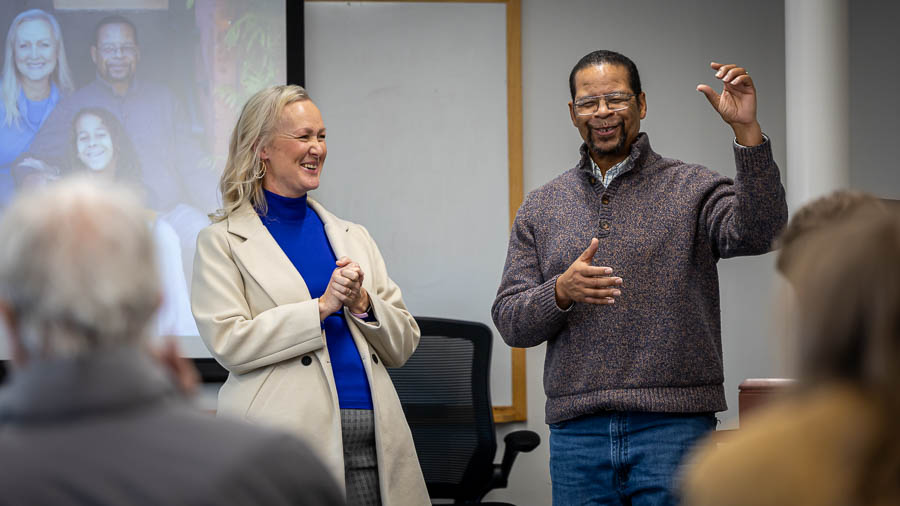
“Working Toward Building and Sustaining Our Southern Oregon Cultures & Communities,” the second in the “Level Up” series sponsored by SOU’s Communication, Cinema, and Media program, featured Mike and Emily Green of Common Ground Conversations who offered a condensed version of their “conversation journey” tools, including practices for establishing common frames of reference with others and dialoguing through active listening.
The Greens engaged the audience of 15 to think about the systems shaping the past, present, and future conditions of the many communities of which they play a part.
“If we don’t know the history and the current conditions, then we will maintain the status quo and pass on the same problems,” Mike Green said. “We inherited a society we did not have a hand in creating, but we do have a role to play in the society that we pass on to future generations.”
Attendees paired off to practice describing the communities of which they are a part and their respective challenges, and then sharing back what they heard from their partners. Themes were varied; in the back of the room, an international student shared the support they had received from other students in the athletic community on campus, along with their decision to leave to pursue a more competitive team. Across from him, a public school teacher shared about the challenges of teaching history in a politically charged year, and in a school system facing budget shortfalls.
In the brief Q&A, audience questions focused on how to make change in systems that feel “too big” or “overwhelming.” Mike Green argued that incremental and smaller moments of change at any level in the system can reach further up, noting that the federalist system of government in the United States might even help make this possible.
After the talk, when asked to share more of how those who feel anxious or overwhelmed can approach the current moment, the Greens demonstrated their own practice of the tools they teach, listening and sharing different perspectives. While Mike suggested that “increasing awareness of one’s conditions” was key to feeling less overwhelmed and more empowered — “people don’t feel empowered when they feel they don’t have enough information” — Emily disagreed, opting to distinguish between ‘awareness’ and ‘understanding.'”
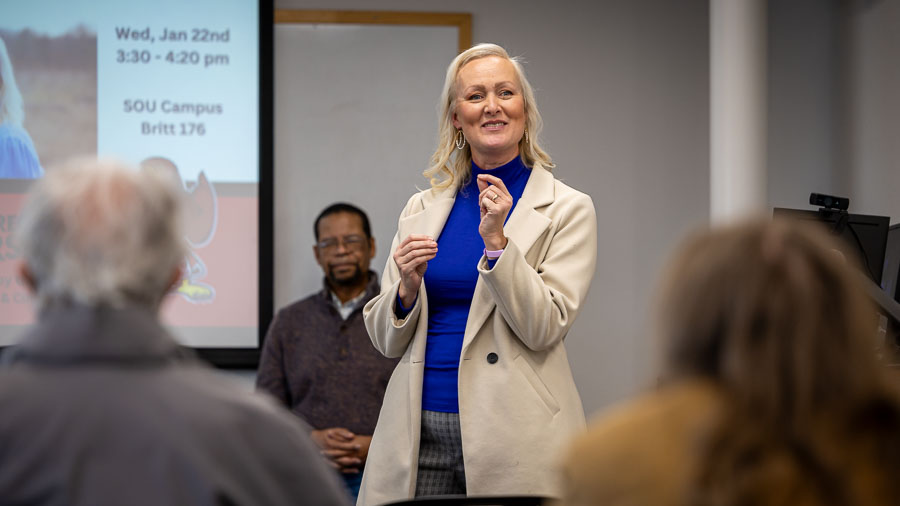
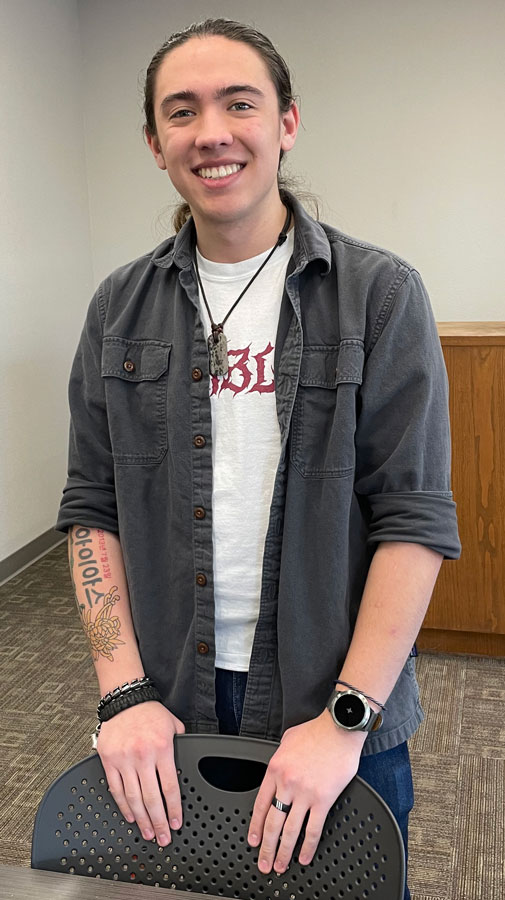
“I think that awareness doesn’t always ameliorate fear, and so we can have a lot of awareness and still feel fearful,” she said, but that “as we deepen our understanding, we learn things that allow us to know some steps that we might be able to take to both engage and create change.”
Through understanding, she continued, “we don’t feel so much powerlessness, and we do feel a sense of where is our place of insertion and engagement? And where can I step into and speak and create some change?”
Both were in agreement that collective learning, like what they offered through the day’s program, was an important step, and that simply taking in information on one’s own was often not enough to effect change. Another way they are trying to create communal space for learning, they said, is through group discussions on their Substack, the Common Ground Conversations Journal.
A desire to create a space for shared learning that bridges the distance between students and other Ashland residents is part of what motivated Precious Yamaguchi, Program Chair and Professor of Communication, to launch the Level Up series.
“One of the things that I have always heard, having been here for 11 years now, is that there’s always this gap between our community, which could be, you know, retired people or artists, a mix of all kinds of people, and SOU. And sometimes we’ll hear from the community, like, oh, this doesn’t feel like a college town.”
“I think both the community and the university, they want to come together, they just don’t know how to find each other’s events,” Yamaguchi said, explaining that “generational and socioeconomic gaps” can limit students’ involvement to the campus. “It’s not like a lot of them have a lot of money to go out to the bars all the time or go shopping and all of that stuff.” The Level Up programming “is a bit more intentional and trying to bring those conversations together.”
SOU President Rick Bailey was in attendance and noted the importance of the series: “We have students, faculty, and staff with a wild diversity of viewpoints and we celebrate that here. And I think what Professor Yamaguchi was really setting up with the series of community dialogues is, what are the things that are beyond politics? What are the things that are, no matter what your perspective, what are some things that we can all agree on. And kindness, respect, love, compassion, those are things that I think are universal, and I wanted to show my support for that.”
The Level Up series is held quarterly. Announcements about future talks in the series will be made to the SOU Communication, Cinema, and Media program Facebook page.
Ashland resident and freelance journalist Meg Wade’s byline has appeared in Mother Earth News and other publications. Email Ashland.news at news@ashland.news.