Oregon’s requirement that a percentage of semis sold be EVs has prompted Portland-based Daimler to stop selling trucks in the state
By Nigel Jaquiss, Oregon Journalism Project
On Dec. 20, Daimler Trucks North America issued a stunning statement: It would stop selling large diesel trucks in Oregon.
“Effective immediately, DTNA is pausing all orders for new internal combustion vehicles intended for registration in Oregon,” wrote Daimler’s general manager of product strategy and market development, Mary C. Aufdemberg, in a message to Oregon truck dealers.
The statement hasn’t been reported previously. It’s significant for a few reasons.
First, Daimler, through its Freightliner and Western Star brands, is the leading producer of large trucks in the U.S., accounting for 40% of all new Class 8 trucks (tractor-trailers) sold in 2023, according to American Truck Dealers, part of the National Automobile Dealers Association. Paccar Inc., the second-largest heavy truck maker, declined to comment on its sales plans.
Portland-based company
More pointedly, Daimler Trucks’ North American headquarters is in Portland. The company is one of the state’s largest manufacturers and employs 3,000 people here.
But for now, the company that builds diesel trucks in Oregon has stopped selling them in the state.
The reason for that halt, the Oregon Journalism Project has learned: a new rule issued by the Oregon Department of Environmental Quality that took effect Jan. 1.
Here’s how DEQ’s Advanced Clean Trucks rule works: Out of every 100 new Class 8 heavy trucks a manufacturer sells in Oregon in 2025, seven must be electric. That percentage of electric trucks will increase every year, reaching 40% of all heavy trucks sold in 2032. (In 2023, according to DEQ, Oregon dealers sold 1,708 new heavy trucks. Nine were electric.)
The Oregon Environmental Quality Commission, which is appointed by the governor and sets policy for DEQ, first adopted the Advanced Clean Trucks rule in 2021, mirroring California’s policy. Colorado, Washington and other blue states have since adopted the same rules, but Daimler hasn’t stopped selling trucks in those states.
Daimler cites ‘ambiguity’
The company said that’s because there is “ambiguity” in how Oregon accounts for electric truck sales. Daimler fears it might fail to meet Oregon’s quota, triggering penalties. The company said that’s an unacceptable risk.
DEQ spokeswoman Susan Mills said her agency immediately contacted Daimler after the Dec. 20 announcement.
Mills said DEQ sought to resolve what she terms an “inaccurate” communication from the agency about when manufacturers would get credit for an electric truck sale.
Gov. Tina Kotek is aware of Daimler’s decision but wants to stay the course. “Gov. Kotek believes that Advanced Clean Truck requirements are critical to reaching our greenhouse gas emissions reduction targets and ensuring healthy air quality,” spokeswoman Anca Matica said.
Environmental groups, including Climate Solutions, Verde and Neighbors for Clean Air, urged DEQ in November to proceed with the new rules in 2025. “Adopting these rules was the promise from Oregon to address the public health crisis caused by persistent diesel pollution,” Mary Peveto, executive director of Neighbors for Clean Air, said then.
Others pushed for delay. State Rep. Shelly Boshart Davis (R-Albany), whose family owns a trucking company, said the mandate will disproportionately affect rural Oregon. “The rules will harm farmers who feed our families,” Boshart Davis wrote in a Nov. 14 letter to DEQ.
Regardless of where one stands on the merits of the new rules, Daimler’s decision speaks to the complexity of implementing them.
Following California’s example
As with many environmental regulations, Oregon followed California’s lead on reducing the use of diesel fuel, adopting standards developed by the California Air Resources Board.
Transportation fuels are the biggest single source of carbon emissions in Oregon. Heavy trucks comprise about 4% of vehicles but produce about 23% of harmful emissions, according to DEQ. That is why the state wants to electrify them as part of a broader policy to reduce carbon emissions 80% below 1990 levels by 2050.
But Jana Jarvis, CEO of the Oregon Trucking Associations, said there are key differences between California and Oregon.
One semitruck charging station
First, California built charging stations for electric semitractor-trailers. Oregon has only one public charging station, located on Swan Island in Portland.
Second, the nature of California’s geography and of its massive ports in Los Angeles, Long Beach and Oakland means that a large share of trips in California are big trucks making relatively short hauls, which make charging simpler.
“Our routes tend to be long haul,” Jarvis said. Diesel trucks can travel more than 1,000 miles between fill-ups, she adds, while electric trucks might go 200 — and carry less freight because their batteries are big and heavy.
Given those differences and the fact that electric trucks cost twice as much as diesel trucks, Jarvis said that manufacturers will struggle to sell heavy trucks in Oregon.
“You can’t make an electric truck work in Oregon yet,” Jarvis said. “The technology isn’t there. I have been trying to get DEQ and the governor’s office to understand the implications of this, but I’m not making progress.”
Electrification is proceeding well for passenger vehicles, but even in ideal situations, Jarvis said, it doesn’t yet make sense for rigs carrying heavy loads.
Roger Davis is general manager of TP Trucking & Logistics in Central Point, just north of Medford. In November, Davis saw an opportunity to test an electric truck on a run his company regularly makes, moving loads of veneer between a mill that TP owns in Yreka, California, and mills in Medford and Grants Pass.
It’s only 56 miles from Yreka to Medford and 79 miles from Yreka to Grants Pass, so Davis thought the short trips between mills might be ideal for electric trucks.
“We knew the new rules were coming and we needed to figure them out,” Davis said.
A test run
In mid-November, a TP employee drove the truck — without a trailer attached — to Yreka to see how it would fare. The trip consumed about half the battery’s charge. That seemed OK, Davis said, because the trip back to Medford, included steep downhill grades, which would allow the vehicle to recharge.
“The routing from our terminal in Yreka has a series of mountain passes exceeding 6% (grade) for a duration of over 6 miles,” Davis said.
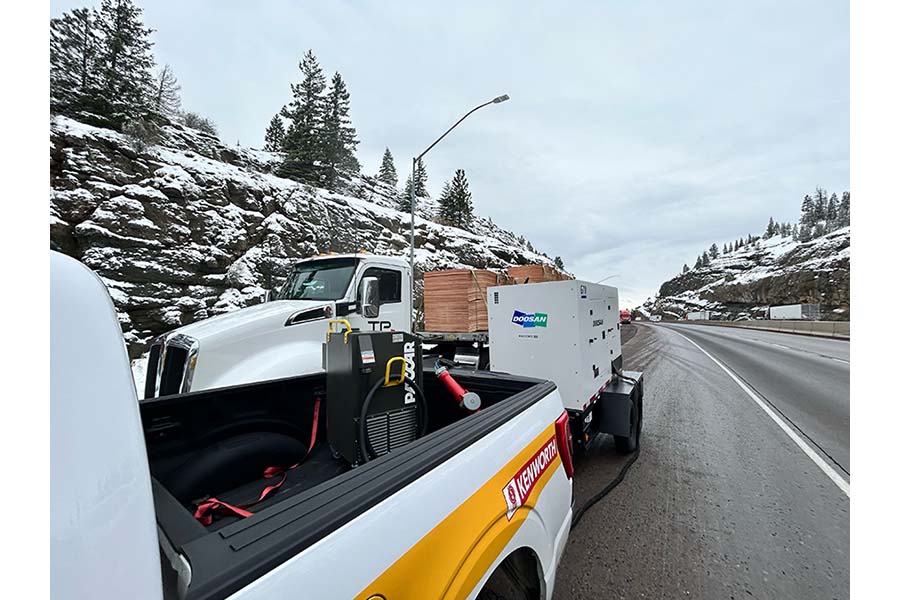
But on the second day of testing, pulling the full load of veneer, the electric truck died on Interstate 5 halfway to Medford on the Siskiyou Summit.
It sat for three hours, getting a charge from, ironically, a mobile diesel generator. TP dispatched a diesel truck to haul the veneer to Medford.
“In the minds of the people who wrote these rules, we operate in a perfect world,” Davis said. “But when we tried one (electric truck), it ran out of charge on the Siskiyou Summit.”
Davis told his employer that the electric truck was of no use to TP: “This trip would be made three times per day by a diesel truck in our fleet. Unfortunately, we failed to get one trip completed by the electric vehicle.” He shared his experience with DEQ.
Mills, the DEQ spokeswoman, said the agency knows there will be challenges in electrifying Oregon’s fleet.
“We hear the manufacturers’ and fleet owners’ concerns, and we recognize zero-emission vehicles won’t work for every fleet or application right now,” Mills said. “That is why the Advanced Clean Trucks rule is designed with many flexibilities, including an additional three years for manufacturers to achieve the first-year sales targets.”
More charging stations planned
Mills said that between legislative and federal appropriations, there are tens of millions of dollars coming to build out charging stations. She also said there are some uses for which electric trucks already work.
“Many medium- and heavy-duty vehicle applications, such as delivery vans, drayage trucks and transit and school buses drive less than 100 miles per day and are or can be electrified with private depot charging,” she said.
But for now, Daimler still said DEQ’s rules are untenable. That means it’s holding new diesel trucks, which produce far less emissions than older trucks, off the market.
Critics, including the National Resources Defense Council and the Union of Concerned Scientists, say truck manufacturers are undermining decarbonization. Daimler, however, is investing $40 million in Portland on research into zero-emission vehicles.
The company said the ball is now in DEQ’s court.
“They are implementing key provisions of the Advanced Clean Trucks rule differently than California,” Daimler spokeswoman Anja Weinert told the Oregon Journalism Project on Jan. 6. “(That) risks our compliance in the state. We are confident we can work with the Oregon DEQ to resolve this issue. But until we have clarity on the matter, we are regretfully unable to process any orders for combustion-powered vehicles for the state.”
Nigel Jaquiss is a graduate of Dartmouth College and the Columbia School of Journalism is the winner of the 2005 Pulitzer Prize for Investigative Reporting for his work at Willamette Week. Ashland.news is a partner publication with the Oregon Journalism Project, a new, nonprofit investigative journalism newsroom for the state of Oregon. The project produces regular stories on matters of real interest to Oregonians, while shining a light on those institutions whose proper functioning is central to our quality of life. State and local government — along with the federal government’s impact on Oregon — is its main beat.