The military-industrial complex needs them, but do we?
By Herbert Rothschild
Imagine if someone in a foreign policy think tank proposed that the U.S. should conduct our international relations as if no other country was our enemy. She would acknowledge that currently we do have enemies, but we could try to change those relationships, and we might succeed were we to acknowledge that our own actions are partly responsible for the hostilities.

It’s unlikely that such a proposal would get a hearing. The most influential think tanks are heavily funded by the military and military contractors, and they exist to conduct hostilities. More generally, “good guy vs. bad guy” is the most appealing way to view life’s challenges. It feeds our habit of self-justification and validates the violence deeply embedded in the American psyche.
Nevertheless, let’s you and I conduct a gedankenexperiment (thought experiment), a kind of thinking that Albert Einstein said he employed to find his way to the theories of special and general relativity. It requires stepping out of the frames of reference within which everyone supposedly must function and observing whether things still behave in the ways we assume they must.
Let’s start with an easy case — Cuba. Our relationship has been hostile since 1960. To break the control over the Cuban economy of U.S. corporations, Castro nationalized their holdings, hiked taxes on imports from the U.S., and established trade relations with the U.S.S.R. Eisenhower then slashed the import quota for Cuban sugar, froze Cuban assets in the U.S., imposed a trade embargo, and severed diplomatic relations. The following year the CIA facilitated the disastrous Bay of Pigs invasion and later kept trying to assassinate Castro.
Just how easy it would be to put this relationship on a different footing was demonstrated by President Obama’s initiatives, mediated through Pope Francis. He couldn’t undo the trade embargo, which Congress had codified in the Helms-Burton Act, but embassies were reopened, travel was restored, and the terrorist state designation from the Reagan era was removed. Trump undid all these changes except the restored diplomatic relations, but another president could reverse course again, and U.S. businesses would be happy if Congress repealed the embargo. It’s up to us.
A harder case is Iran. When the Pahlavi family ruled it, we were fast friends. We might identify 1953 as the beginning of our enmity. That year, the U.S. and Great Britain arranged for the ouster of Mohammad Mossadegh, who had become prime minister in 1951 and was hugely popular for his stand against the British-owned Anglo-Iranian Oil Company, which never paid Iran more than 16% of its huge profits. Mossadegh’s plans to nationalize Iran’s oil industry led to our intervention.
After our coup, the CIA and Israel’s Mossad helped the Shah organize SAVAK, his dreaded intelligence service, which used arbitrary arrest, torture and murder to suppress popular opposition until the 1979 revolution ended Pahlavi rule. When Iraq seized that opportunity to invade Iran, we wholeheartedly supported its war of aggression, which took hundreds of thousands of lives. Iran’s offense was occupying our embassy on Nov. 4, 1979, and holding 52 Americans hostage for 444 days because the U.S. refused to hand over the Shah to stand trial in Iran. As for Iran’s troublemaking in the Middle East, it does no more than Saudi Arabia and Israel and less than we, who don’t belong there.
A precondition of our ending hostilities with Iran would be to openly own this history. But countries rarely acknowledge and apologize for their past crimes, and Iran might not accept our apology even if we made it. That’s what makes this a hard case. Nevertheless, it would be worth a try.
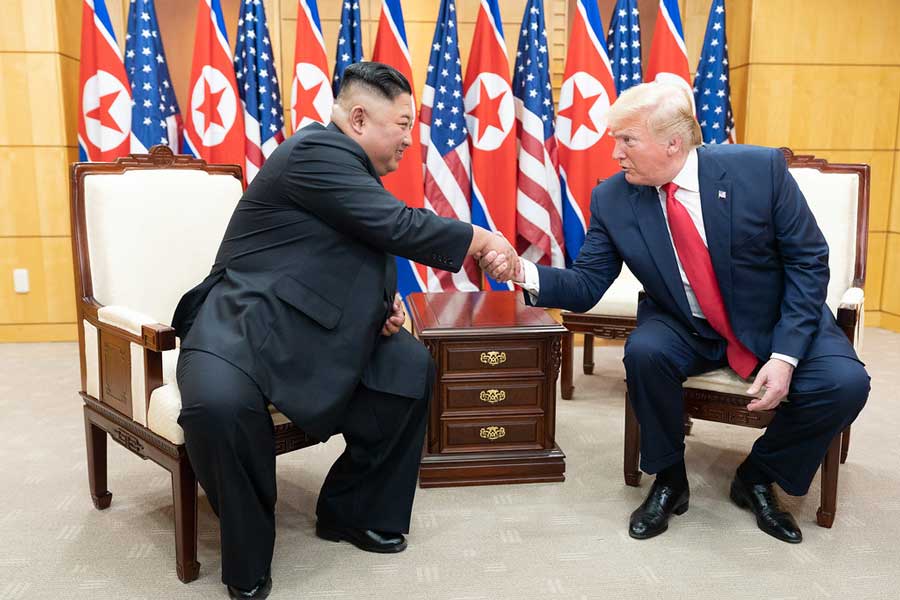
North Korea is an even harder case, but it was Trump who showed that there is a path forward if we’re willing to walk it. We think of North Korea’s 1950 invasion of South Korea as the cause of our hostility, but it’s actually a relic of the Cold War. Before 1945, there was one Korea. When imperial Japan, which had occupied the peninsula since 1910, was defeated, the victorious U.S. and U.S.S.R. agreed to two occupation zones divided by the 38th parallel. Dictatorships were established north and south, but neither government accepted a permanent division of the country. There were provocations by both sides prior to the invasion.
Unconstrained by foreign policy orthodoxy, Trump decided to change our relationship with North Korea. His three personal meetings with Kim Jung Un — Trump stepped into North Korea at the last — in tandem with wider-ranging diplomacy between the two Korean governments, promised to end the Korean War. Regrettably, Trump seemed only interested in winning a Nobel Prize for getting a pledge from North Korea to dismantle its nuclear arsenal, and when this unrealistic expectation was dashed, he had no understanding of, or patience for, sustained diplomacy. Nonetheless, what happened suggests that a similarly unconstrained but less egotistical and erratic President might make significant headway.
I don’t wish to speak of our relationship with Russia, because now there appears to be no opportunity to transform it. During the Gorbachev era, however, the hostility did end, and in 1991 there was an excellent chance that it would end permanently. Far more accomplished historians than I have maintained that we bear a heavy responsibility for passing up that chance. It might come again if we wished it to.
I conclude with U.S.-China, which is likely to be the most significant international relationship of the 21st century. It isn’t yet entirely antagonistic, and though we’re rapidly heading down that road, our foreign policy establishment hasn’t coalesced around hostility. Other possibilities exist.
A gedankenexperiment isn’t an assertion of what is or what must be, but neither is it wishful thinking. It’s a meaningful intellectual exercise that sometimes inaugurates a world-changing paradigm.
Herbert Rothschild is an unpaid Ashland.news board member. Email him at herbertrothschild6839@gmail.com.