Keeping the story alive to prevent history from repeating: Ashland Together hosted encore presentation of Mitzi Asai Loftus’ book Monday night
By Emma Coke, Ashland.news
“It can happen again. It can happen to somebody else. It’s all on us to prevent it from happening again.”
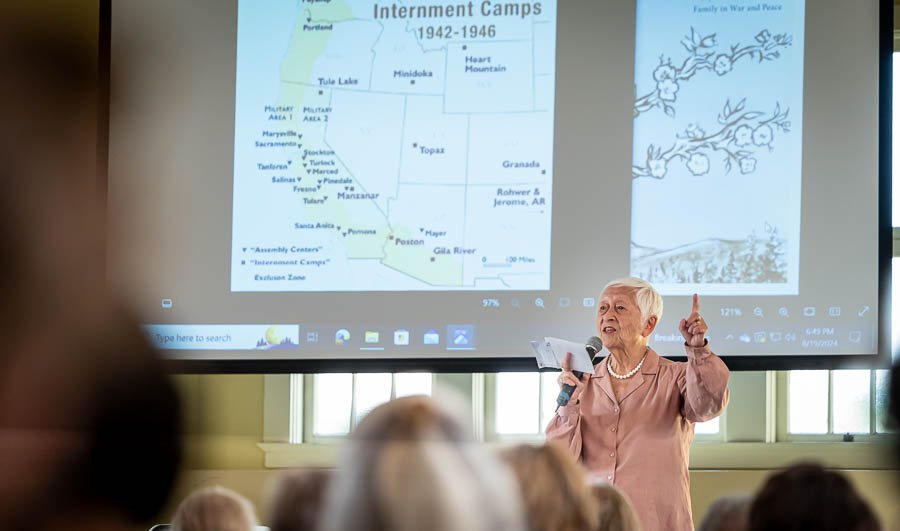
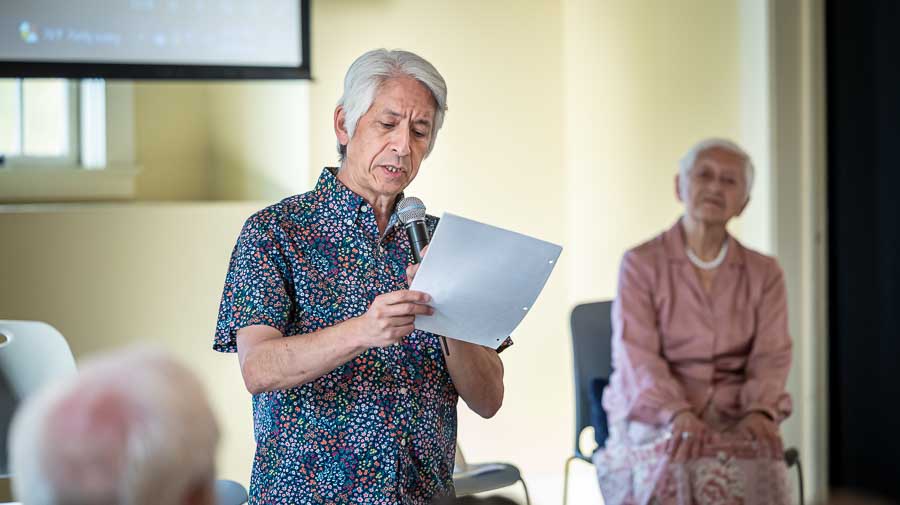
That’s what David Loftus, son of Mitzi Asai Loftus, said of the prison camps hastily built to imprison Japanese Americans in World War II during Ashland Together’s encore presentation Monday night of Mitzi’s book, “From Thorns to Blossoms: A Japanese American Family in War and Peace.”
The talk is the second Mitzi, an Ashland resident, and David have done with Ashland Together about their book, which recounts her three years spent in the government prison camps, the discrimination she faced following WWII and later, and her work as a teacher. Back in April, Mitzi spoke to a standing-room only crowd at Bloomsbury Books.
Executive Order 9066 was issued in 1942 after Japan bombed Pearl Harbor and resulted in the imprisonment of 120,000 Japanese Americans, including Mitzi’s family, over “security threats” due to their ancestry.
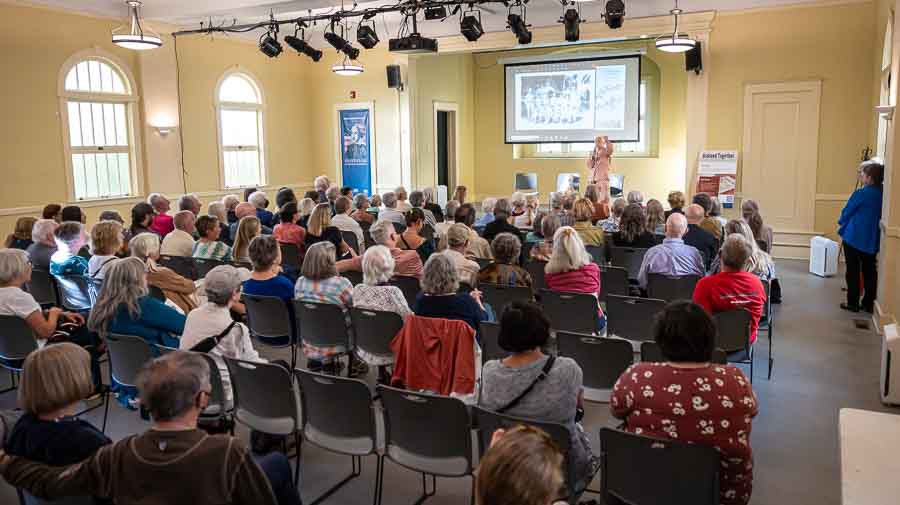
“My mother’s story serves as a reminder of the evil and the goodness that ordinary citizens commit,” David said. “The heart and suffering they can offer to others by going along and remaining silent when they witness injustice, or by choosing to speak out when they see their country violate its own ideals.”
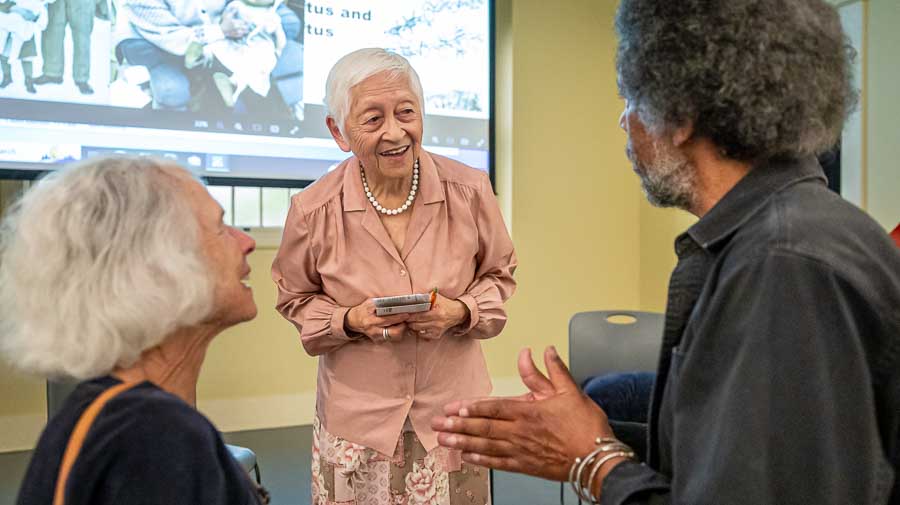
Mitzi had the audience lead her discussion. She answered questions about life in the camps, her family, the discrimination she faced, the orchard she grew up on and how she dealt with any bitterness she felt over what happened to her.
“To this day, I know that my family number is 16331. And I also know that I was sent to camp on May 13, 1942,” Mitzi said. “I also know that I returned home to my home in Hood River on April 20, 1945, and it was snowing.”
She was only 10 when her family was sent to the prison camp, and she didn’t fully understand what was happening.
“I was so excited it was going to be my first train ride,” Mitzi said. “When I got down to the station, I thought, ‘I wonder if my friends are going to come say goodbye?’”
Her friends didn’t show up — they didn’t even know her family was leaving. Nobody knew.
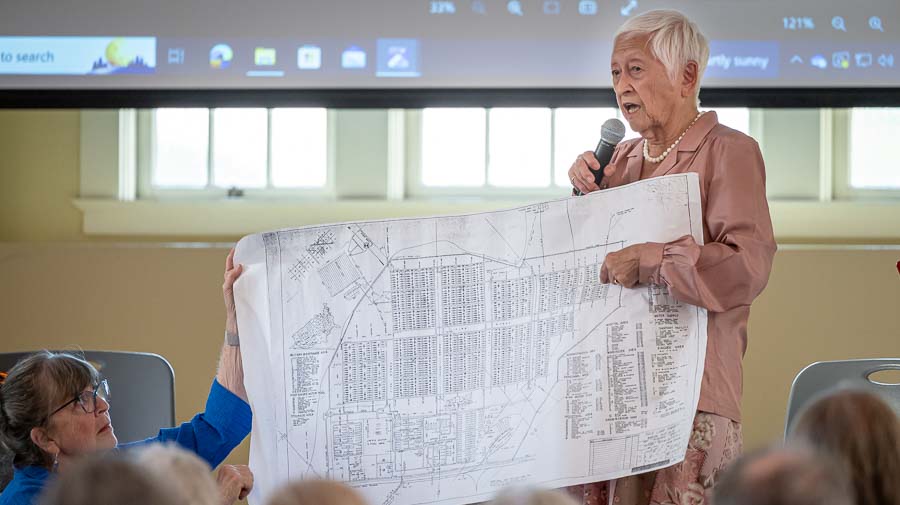
Her family was first sent to an “assembly center” in Fresno, California, where they lived for months until the more permanent “relocation centers” were built. Mitzi was then sent to the relocation center in Tule Lake, about 20 miles south of Klamath Falls.
Around 18,000 people lived in Tule Lake in barracks that were divided into four to six rooms, with one family to a room. The barracks were poorly insulated, making it very hot in summer and very cold in winter, Mitzi said. They had no real ceilings, just open rafters, and the walls were made of two-by-fours.
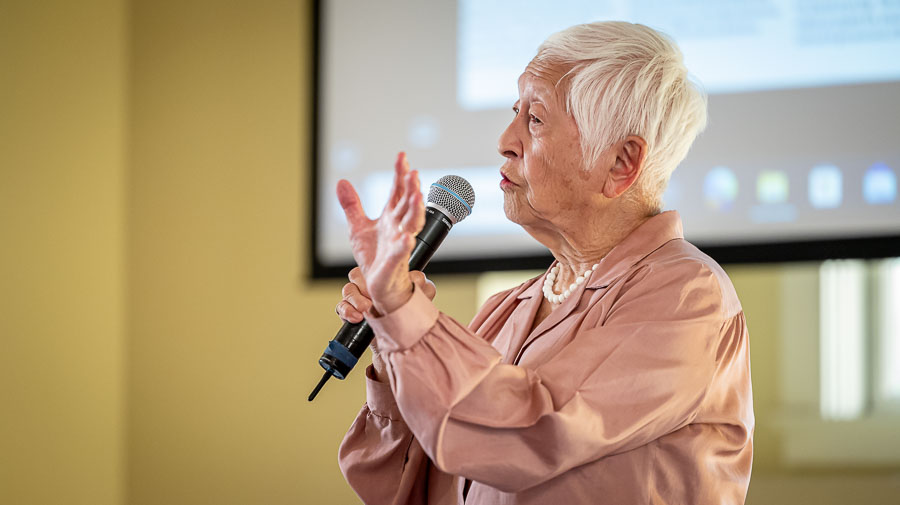
Mitzi’s experiences in the camp and the discrimination she faced upon her return home left a negative impact on her.
“I myself had sadness and loneliness being totally isolated by my peers when I was 12, 13, 14 years old,” Mitzi said. “No dates, couldn’t go to high school dances because nobody would dance with me.”
Mitzi even changed her name from her birth name, Mitsuko, to Mitzi when she started junior high school to become “1 or 2 percent American.”
“I didn’t realize that that was an act of unconsciously running away from my heritage,” Mitzi said. “I carried that monkey on my back.”
It wasn’t until a Fullbright Grant sent her to Japan that she understood that. There, she reconnected with her heritage.
“That year in Japan was very, very important in my life because that’s where I really discovered I had this monkey on my back that I had been carrying for all those years,” Mitzi said. “I threw it off and I took back my heritage with pride.”
Shortly after Mitzi married, she went to see Tule Lake, and the camp in Heart Mountain, Wyoming, where she was later sent.
“It left me with such an empty feeling in my stomach,” Mitzi said. “It was this field of grass, dirty. Nothing else. But I could see the mountain on each side so I knew I was in the right place. I thought, ‘I’m never coming back here again.’”
But today she doesn’t harbor much bitterness about what happened to her, something she attributes to her Zen Buddhist father — “I was the heir of that (teaching),” Mitzi said.
“Without speaking, our father taught us that to harbor any negative emotions was a mistake,” Mitzi said. “It will grow inside of you and it will kill you.”
She also recognizes the importance of telling the story of what her family went through.
“When I’m gone, the first-person stories are going to be gone,” Mitzi said. “I hear people in the third and fourth generation telling the story, trying to keep the story alive. They don’t always get the story quite right because they didn’t live it.”
Email Ashland.news reporter intern Emma Coke at emmasuecoke@gmail.com.
Related stories:
Mitzi Loftus is a positive force, even at 92 (Aug. 16, 2024)
Ashland resident recalls being imprisoned for her heritage (March 13, 2024)