Lomakatsi works with federal, state, community and other nonprofit groups in effort to bring landscape into balance
By Morgan Rothborne, Ashland.news
As thunderstorms rolled in over red flag conditions Monday afternoon, Lomakatsi Restoration Project Executive Director Marko Bey said he and others at the nonprofit’s office watched the sky for clouds for lightning and the landscape for smoke.
“This is the time of year. We’re thinking about fire. … Fire shaped this landscape. Everything, all the hills you see around us were shaped by fire,” Bey said.
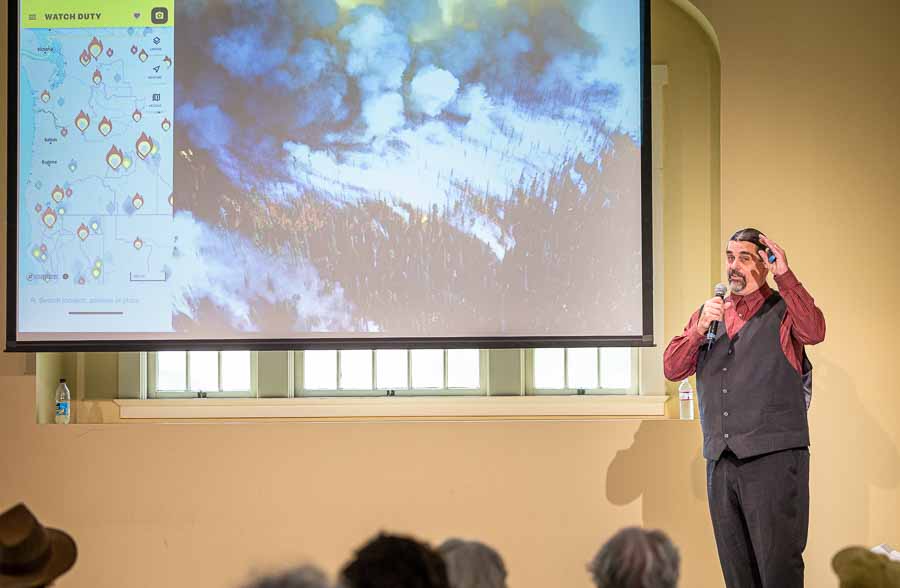
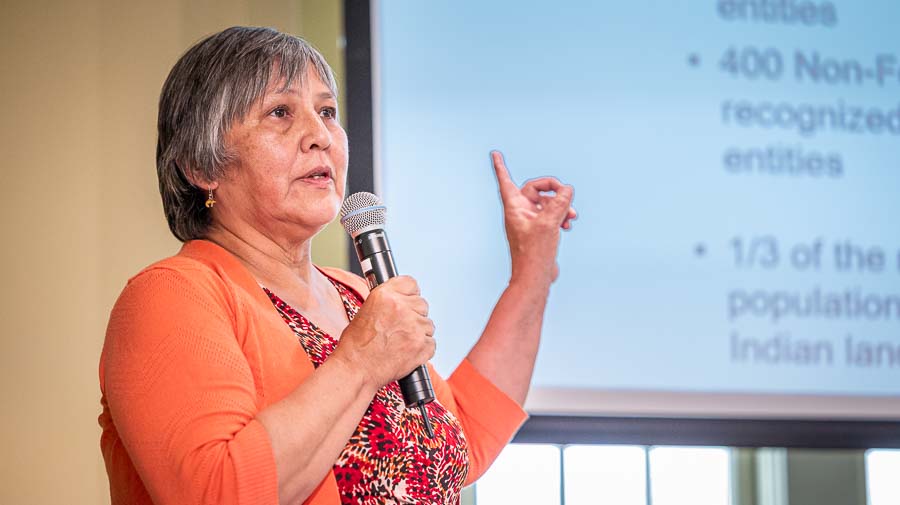
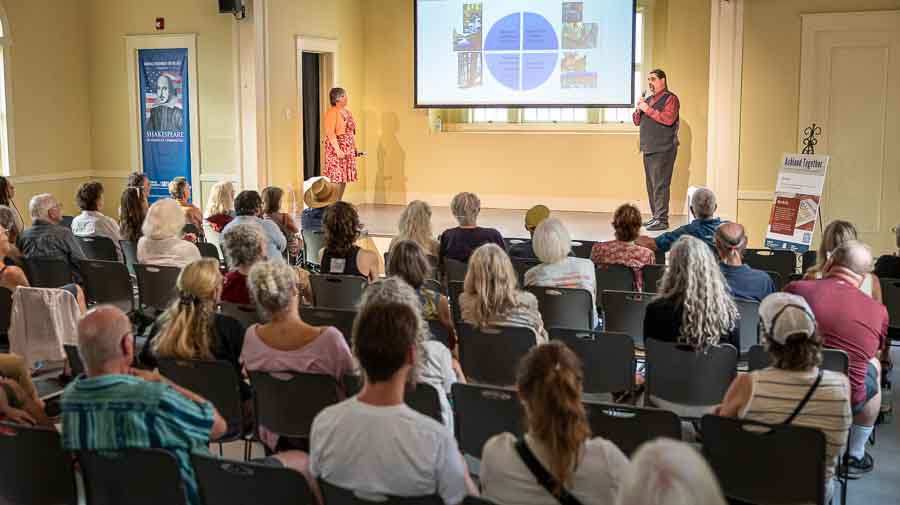
Monday evening nearly every chair in Carpenter Hall was full as Bey shared the stage with Lomakatsi’s Tribal Partnerships Director Belinda Brown. The pair were headline speakers at an event organized through the collective effort of Ashland.news, the Oregon Shakespeare Festival and Ashland Together to showcase Lomakatsi’s efforts to answer the promise of wildfire with collaborative partnerships between federal, state, local and tribal governments and other organizations to create resilient forests and communities.
Jackson and Josephine counties are the highest fire risk areas in the state. While fire is endemic to Oregon, both climate and forests managed for fire suppression and timber harvests created forests primed for destructive wildfires with resources such as Ashland’s water supply or species like the spotted owl to protect, Bey said. Old growth trees that are more resilient to fire were replaced by stands of young trees planted close and harvested young, Bey said. These forests have proved susceptible to disease and insect attacks further exacerbated by drought and heat.
“Our forests have grown kind of dense from the lack of fire. We did a pretty good job putting out fires. Smokey was successful. So now we want to reverse that trend,” he said.
Bey pointed to an aerial image of the aftermath of the Bootleg Fire of 2021 in a section of U.S. Forest Service land that had been treated in part by Lomakatsi in a collaboration with the Klamath Tribes. The photo showed delineated lines of color as stark as an untouched pint of Neapolitan ice cream.
One stripe of the forest was black with no discernable life. Another was mottled brown and green, while the remaining section was alive and verdant.
“That’s the green island that survived. Low intensity fire, we were actually able to be in that forest while it was burning,” he said.
The green island was treated with both strategic ecological thinning and understory burning or the ancient Native practice of “good fire.” The section with significant brown was only treated with thinning, while the black section was untreated.
Settlers’ diaries from Oregon’s early history record Native women rolling burning pine cones down the hillsides where Jackson Wellsprings now stands, Bey said. But indigenous fire was banned for a time with a preference for industrial logging and fire suppression.
“We’re still here. Still the first and best stewards of the land, still ready, able, willing to care for the land. Fire has been a missing ingredient, fire is medicine for the landscape,” Brown said.
Using Indigenous knowledge of how the forests should be, strategic thinning is first applied to eliminate unhealthy density. Once forests are healthier, understory burning can take place to bring the landscape into a position of resilience, all monitored with Western science, Bey said.
When he founded it in 1995, Bey used “lomakatsi,” the Hopi term for “life in balance,” for its name and guiding principle.
In partnerships with the city of Ashland, the U.S. Forest Service, the Nature Conservancy, tribal governments and other partners, Lomaktatsi has systematically worked on predominantly public land throughout Oregon and Northern California. In the case of projects such as the West Bear All Lands project, private landowners have been included.
Partnerships with tribal governments and other agencies have led to programs such as the Indian Youth Service Corps. First created through Federal Legislation in 2019, Lomakatsi now has the first multi-racial Indian Youth Service Corps agreement with forest service and a master participation agreement with the National Parks Service, allowing the corps to work in national parks across the country, Brown said.
Lomakatsi also has its longstanding Youth Ecological Training and Employment Program. The organization will hold a graduation for its 12th year of the program on Friday, July 19, Bey said. Through this program, young people can earn certifications and gain experience they can leverage for careers in wildfire or forest management.
“We’re building a restoration economy,” he said.
Wildfire is creating other financial pressures necessitating collaborative action, said state Sen. Jeff Golden, taking the stage to explain ongoing work at the state level. He said he plans to bring forward a bill for the third time to create a statewide network of neighborhood protective cooperatives akin to Firewise USA models. Not only would swaths of fire-adapted communities protect homes, it could preserve the ability of Oregon homeowners to obtain insurance.
Some insurance companies are no longer offering coverage in California, he said. California caps the cost of premiums while Oregon does not, leaving Oregon homeowners insured, but often at debilitating rates.
A conversation is ongoing between insurance agencies and state and local lawmakers, Golden said. There is a hope to lower premiums through some form of certification of fire adapted neighborhoods. Fires such as the Almeda Fire have proven hardening one home is not enough.
“You yourself are not able to reduce the risk enough to secure a reasonable premium. … We are in a historic predicament, we don’t know how this is going to play out. But the conversation continues,” Golden said.
At the close of the presentation, an audience member asked if residents should answer to the high fire risk with “guerilla activism,” or taking personal action rather than the tedious work of going through the proper channels. Bey advocated continuing conversations, education, volunteer work with established organizations and an expectation of continuous work.
“This isn’t a one-shot deal, that we just do a restoration action and walk away, it’s perpetual, ongoing stewardship,” he said. “We think about upholding our infrastructure, our homes — the ecosystem is the same. It needs people. People need to be reintroduced back into the ecosystem as a keystone species.”
Email Ashland.news reporter Morgan Rothborne at morganr@ashland.news.