The ratio of U.S. workers to retirees, 2.8 to 1, is too low; without immigration, our pension and health care systems would soon collapse
By Herbert Rothschild
I had to write this column before last night’s debate between Joe Biden and Donald Trump, so I couldn’t know what they would say about immigration. I’m sure it figured largely in the debate. I’m almost as sure that neither candidate spoke thoughtfully about it.

For Trump, treating immigration as an existential threat has paid big electoral dividends, so I can expect nothing truthful, much less useful, from him. I don’t expect too much more from Biden. Over the last three years he’s tacked this way and that, trying without success to seem both tough and humane.
Some specific policies related to immigration are obviously proper, and Biden has supported many of them — citizenship for DACA kids, an easier path to legal status for undocumented spouses and children of citizens, and more resources to expedite asylum requests. Another reasonable policy would be a second iteration of the Immigration Reform and Control Act of 1986 (Simpson-Mazzoli), which, among other provisions, legalized most undocumented immigrants who had arrived before Jan. 1, 1984. Simpson-Mazzoli was the last comprehensive immigration bill Congress passed.
In February 2022, when a flood of refugees from Haiti reached Del Rio, Texas, I wrote a column about how our imperial interference in the affairs of Latin American and Caribbean countries continually exacerbates the poverty and tyranny that people flee. So, if we want to reduce the flow of immigrants to our southern border, we must change our own behavior.
It’s not clear, though, that the flow of immigrants should be reduced, or by how much. What we haven’t heard in the public forum is informed discussion about whether immigration is desirable. We need that discussion to counter the vilification of immigrants on the one hand and mere altruism on the other. Neither of these attitudes generates wise political policies.
The U.S. sorely needs immigrants. Just how many we need and how many we can accommodate without undue stress are questions needing answers. Although precision will elude us, we have useful data on which to draw.
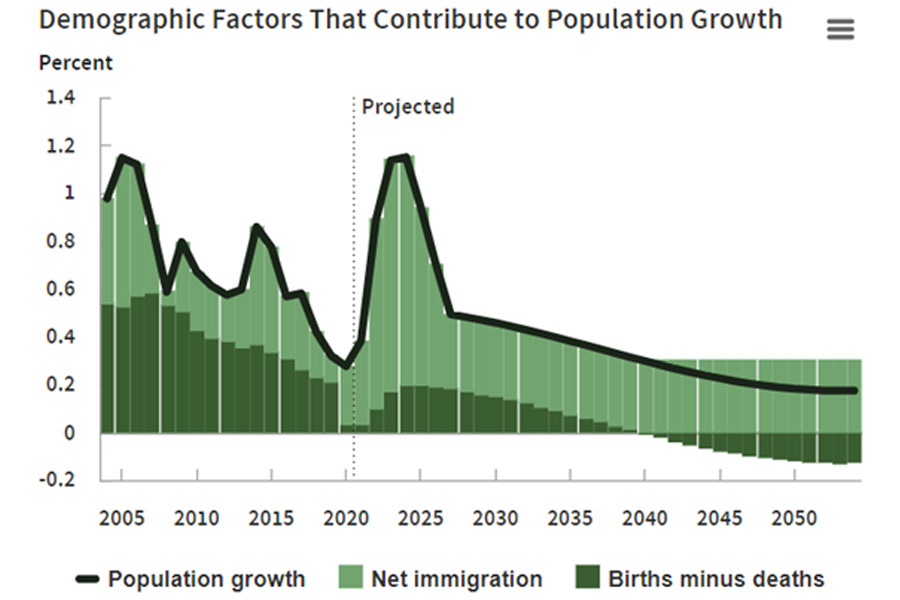
First, there is the demographic forecast. The fertility rate for a generation to replace itself is 2.1 births per woman. For the 20 years before the 2007-09 recession, the U.S. fertility rate was slightly under that. Since then, the rate has fallen. In 2020, the rate equaled 1.64 births per woman, then it rose to 1.67 in 2022. The Congressional Budget Office (CBO) projects that by 2034 our fertility rate will settle at 1.70.
Only because more of us will live longer, the CBO projects that U.S. births will exceed deaths until 2040, after which our population will decline absent immigration. And even now, because the retired population is growing relative to the working population, absent immigration the burden of sustaining the older cohort would be heavier than it is, with fewer people to shoulder it either as taxpayers or caregivers.
The U.S. Social Security system was designed for a much higher ratio of workers to retirees than exists today. In 1960, there were more than 5 workers for every beneficiary. Now it’s 2.8 to 1. The Social Security Administration predicts that the ratio will dwindle to 2.3 to 1 by 2035. And that’s with immigration. Without immigration, our pension and health care systems would soon collapse even if technology made some workers more productive.
So, one way to calculate with reasonable accuracy how many immigrants per year the U.S. needs is to decide a desirable minimum ratio of workers to retirees — taking into account that many immigrants arrive with children. The current ratio of 2.8 to 1 is too low, and the shortfall is exacerbated by keeping undocumented workers in the economic shadows, where their pay is low and untaxed. We should raise the ratio to at least 3 to 1 and maintain it there.
People responsible for tracking economic performance keep telling us how dependent we already are on immigrant workers. Last week, Jerome Powell, chair of the Federal Reserve System, said, “We’ve seen labor force supply come up quite a bit through immigration and through recovering participation. That’s ongoing, mostly now through the immigration channel.” Financial analysts like Elsie Peng and David Mericle of Goldman Sachs and Mark Zandi from Moody’s credit the post-pandemic surge in immigrants with stabilizing wages and cooling inflation.
And immigrants aren’t taking jobs from citizens. According to U.S. Bureau of Labor Statistics data, in May the number of job openings was 8.1 million while the number of unemployed looking for work was 6.1 million. Actually, immigrants create more jobs than they take. That’s the finding of an academic study titled “Immigration and Entrepreneurship in the United States.” Immigrants are 80% more likely than longtime residents to become entrepreneurs. First- and second-generation immigrants are launching businesses across the spectrum, from small sandwich shops with one or two employees to major tech firms with thousands of workers. Elon Musk is an immigrant.
Regarding the future impact immigrants will have on the economy, on June 18 the CBO released An Update to the Budget and Economic Outlook: 2024 to 2034. It predicts that increased immigration to the U.S. is expected to drive higher economic growth, grow federal revenues and shrink deficits. Regrettably, most of this increase will be immigrants without work permits. Nonetheless, they will add almost $9 trillion to our gross domestic product over the next decade.
Immigration has its costs, although very little to the criminal justice system. Even undocumented immigrants can access health care and their children can attend school. Most significant is their added strain on an already-inadequate housing stock. The question of how many immigrants we can accommodate without undue stress hinges upon other policy decisions we make, especially the funding of state governments, controlling health care costs and addressing our woeful housing shortage. In social systems as in natural ones, the parts are interrelated.
OK. How much of what you just read did you hear last night?
Herbert Rothschild’s columns appear on Friday in Ashland.news. Email Rothschild at herbertrothschild6839@gmail.com.