City of Ashland hosts workshops to help homeowners ahead of fire season; Zoom session coming up Wednesday
By Morgan Rothborne, Ashland.news
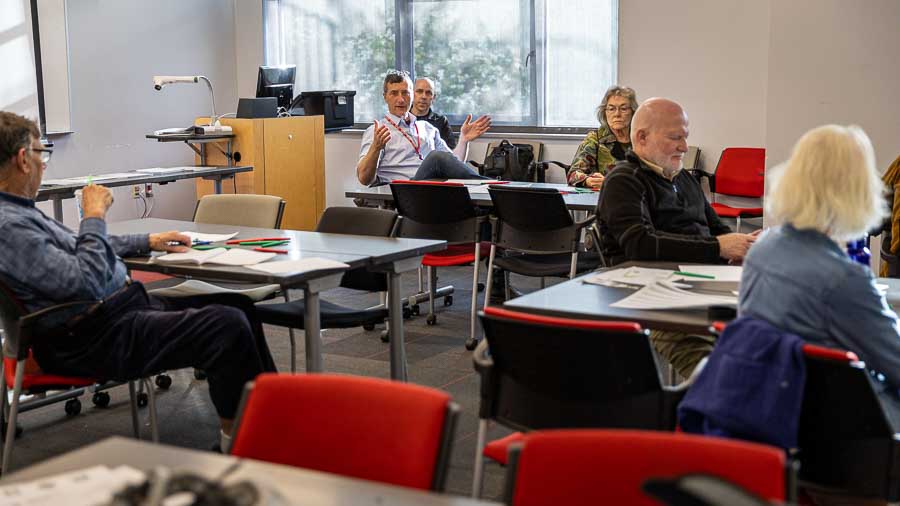
What’s the worst that could happen? Embers driven by gusting winds could fly onto your property and ignite, say, a cypress plant by your home, setting it on fire and destroying it. Thinking about very real scenarios now to keep them from becoming reality later was on the table in a basement room of the Lithia Motors Pavilion last Wednesday evening, where a researcher from Boise State University led Ashland residents in the first of two workshops focused on learning how to protect themselves and their homes as fire season approaches.
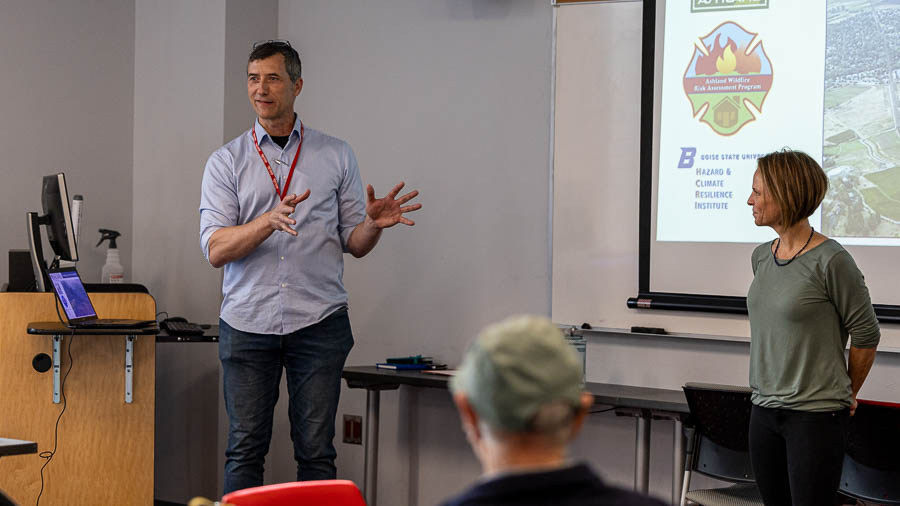
A small audience of around 25 Ashland residents were led through a series of thought exercises by Brittany Brand, a professor at Boise State University and Director for the Boise State Hazard and Climate Resilience Institute.
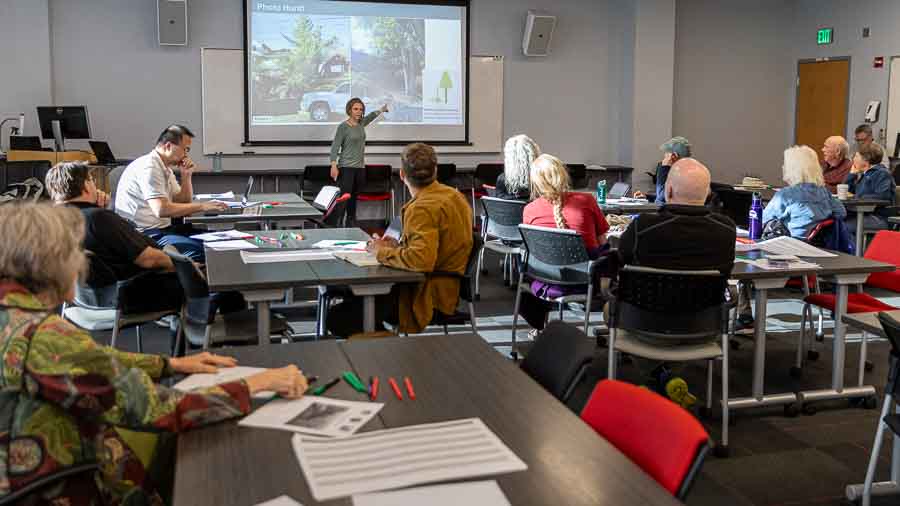
As soon as event attendees sat down, they were invited to draw a sketch of their homes and yards with pens and paper available. Brand then moved through a series of photos — labeled a “photo hunt” — akin to a Where’s Waldo for what ignition risks could be lying unseen in ordinary home landscaping. Attendees were encouraged to use red or green pens provided to color code their home map for risks discussed throughout the workshop.
“Is there anything in this photo that would put this home at risk of a fire starting?” Brand asked, pointing at a projector screen with two photos of landscaping and homes.
Piles of wood near homes in the first photos were obvious to the audience as a wildfire risk. In the following photos however, the potential risks of lavender, rosemary and cypress were less overt.
“If it’s fragrant, it’s flammable,” Brand said.
Fragrant plants contain more oils, making them more combustible, she said. Arbor vitae bushes, old wooden fences, mulch near a home or leaves under a deck, and gutters left without guards or regular cleaning were all also presented as possible wildfire vulnerabilities around a home.
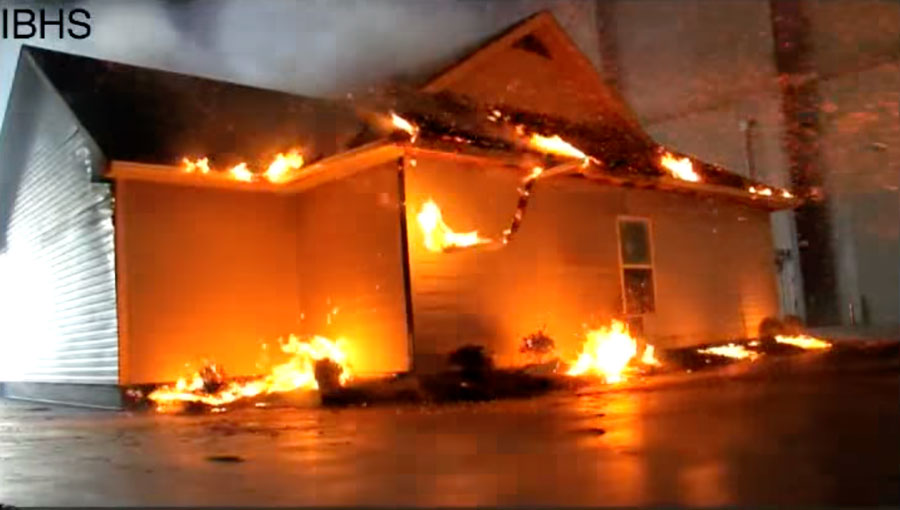
After the photo hunt, the audience was shown a short video of researchers in a lab showcasing how ember showers driven by wind from the active flames of wildfires can easily ignite homes, potentially miles away. Within minutes of being subjected to the ember shower, debris in gutters and mulch surrounding the model home were fully involved, with the plastic gutters melting and dripping, consumed by orange flames.
Embers can travel between 2 and 5 miles — depending on wind conditions — from a wildfire, Brand said. Leaving easily ignitable materials within 5 feet of a home presents a risk, she said. Fragrant vegetation such as lavender should be spaced out to prevent creating an easy line of food for fire, and spaced at least 5 feet from a home. Potential “ladder” fuels, or branches and bushes too intertwined should also be limited.
Within the “photo hunt” Brand included photos of her own home, such as flammable bushes and dead grasses she has since removed. One photo showed an old wooden fence she said was “on her list.” She encouraged the audience to see home hardening as a series of actionable steps and to encourage their neighbors by setting an example.
Brand turned to event organizer Ashland Emergency Manager Kelly Burns for a concrete example of what landscape choices can mean in a wildfire. Burns recalled within the first 15 minutes of the Almeda Fire watching a thick stand of manzanita between two homes in the Quiet Village neighborhood becoming fully involved in flames from wind driven embers. If a fire truck had not been in the area and available at that moment the homes could have been lost, he said.
Audience members were also pressed to consider the true meaning of the three tiered orders that will come in the event of an evacuation.
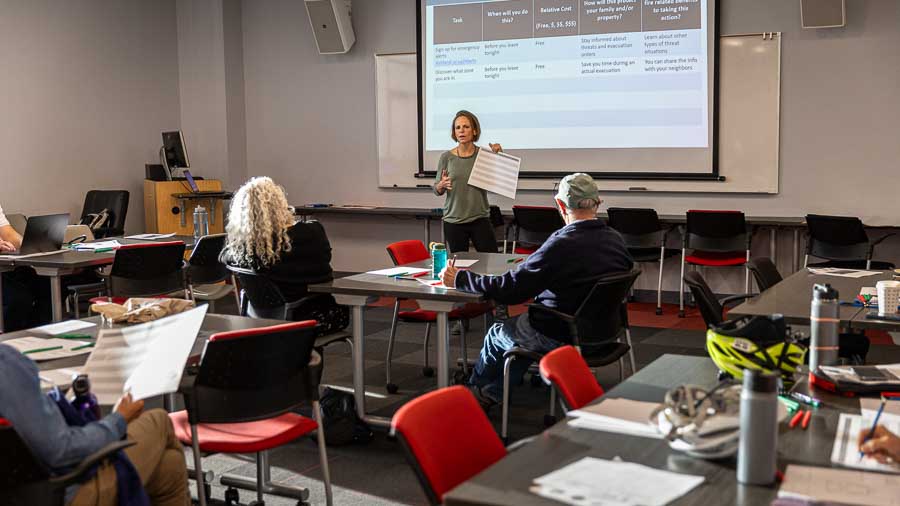
Level 1 “get ready,” means getting one’s valuables — including medication, pet food, documents and sentimental treasures — packed and ready by the door.
Level 2 “be set” means turning on lights in the home for first responders and taking photos or videos of the interior for potential insurance claims should the worst happen, Brand said.
Level 3 “go” means go now. It may be the only chance to escape a wildfire, she said.
The workshop was the first of two. To attend the second workshop — which will be held via zoom Wednesday, May 15 — registration is required and can be completed online. The city of Ashland has also provided a guide to firewise landscaping available online. Brand prompted the audience to explore additional resources on wildfirerisk.org. Brand said she could be available to host additional presentations for neighborhoods seeking to work together to become more firewise.
Email Ashland.news reporter Morgan Rothborne at morganr@ashland.news.
May 13 update: Evacuation level numbers corrected.