Study of organizational culture finds issues with with trust in leadership, sexism and communication
By Morgan Rothborne, Ashland.news
The Diversity, Equity, and Inclusion assessment the city of Ashland commissioned last year describes an organizational culture struggling with trust in leadership, sexism and communication even as overall dedication and direct coworker relationships remained strong.
In its brightest side, the city of Ashland’s assessment showed a strong culture of accountability, personal responsibility, and a motivation to serve others.
“The tie that binds organizational culture in Ashland government is pride in work, service to the
community, and a genuine interest in ensuring that all employees are treated respectfully,” according to Finding 1 of the 56-page report.
The vast majority of city employees responded they felt a personal expectation to ensure a good work environment — 89% of Ashland city employees responded affirmative to the statement, “I believe I am personally responsible for supporting a fair environment where different perspectives are valued and people are respected.”
But when the statement was altered to shift responsibility to the city rather than employees, 50% of respondents agreed. Survey participants also noted the city often employs a “blanket approach” to individual instances of inappropriate behavior with the result that guilty parties do not receive individualized guidance to improve while others feel penalized for circumstances they were not involved in.
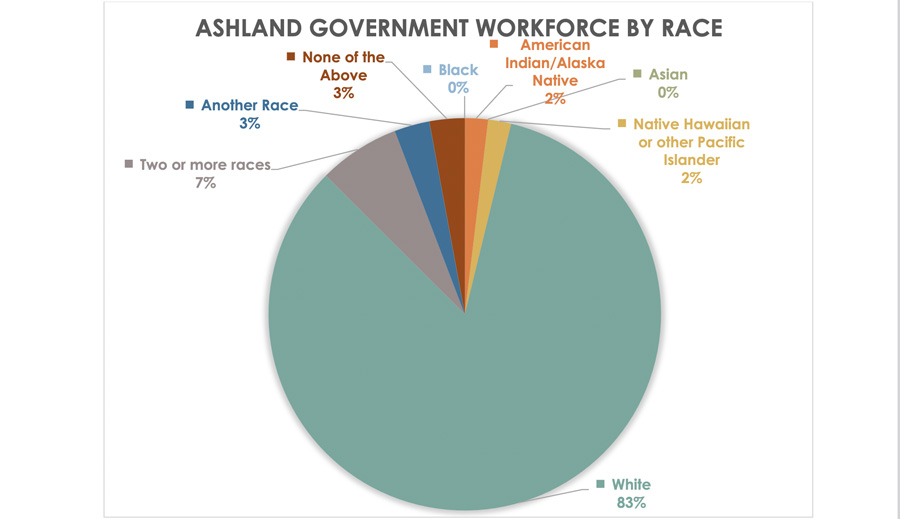
The report also highlighted a high level of sexual inequity and some racial inequity.
White men predominate the workforce and are overrepresented by 4.4% compared to census data of Ashland’s population. City staff also has 1.3% more Black employees than census data reports in the city’s population.
Women were underrepresented by -30.9% compared to population data, according to the report.
“One employee shared, ‘Sometimes I think the culture in my department, because there are so few women, we don’t understand the needs and potential benefits different gender perspectives can bring,’” according to the report. Microaggressions were also reported “to a lesser extent,” by staff identifying as LGBTQIA+ (lesbian, gay, bisexual, transgender, queer and/or questioning, intersex, asexual, plus other sexual and gender minorities).
In surveys and focus groups, employees related opposing and conflicting gender issues. Some female employees described being spoken to “like a kid,” regardless of seniority or qualifications, while others bemoaned favoritism for women in higher positions.
“Ironically, there’s a double-edged sword in Ashland. First there’s a perception that employees who identify as female are subject to microaggressions throughout the organization. Second, there’s a perception of favoritism in appointing women to higher level positions in City
government in a way that excludes other qualified candidates,” the report said.
The report also highlighted a higher than normal level of organization mistrust.
“Some staff expressed concerns over mental health related to past conflict with the previous City Council,” according to Part 2 of the report.
Concerns included feeling of job instability and a perception that city employees are not valued by elected leaders.
Employees did express strong levels of trust for their colleagues and coworkers and trust in the city of Ashland to value and pursue DEI for the organization as a whole. Communication throughout the city organization was also perceived to be lacking in transparency, inconsistent or generally disorganized. Human resources was cited as an example of poor communication, underlining the long period the Human Resources Director position went unfilled.
“The current HR Director is working to resolve some of the issues with lack of policy structure and transparency, but from the employee perspective, change cannot happen fast enough,” the report said.
There was also an emphasis on lack of communication between those making decisions and “people who are hands-on within the job,” the report said. The city lacks an “upstream,” mode of communication between staff members and city leadership positions where decisions are made.
When asked about trust in the city manager — at the time of the survey, Joe Lessard — and other city leadership, only 30% answered in the absolute affirmative. Around 20% of employees responded they had little to no trust in the top city leadership.
In one on one interviews, city employees stressed trust in the then-deputy city manager, now interim city manager, and their respective department heads, according to the report. When asked about respect, 87% reported respect for their direct supervisor while 58% reported respect for city leadership.
“We believe the source of organizational distrust primarily lies within the ranks of City executive leadership. … It is also worth noting that during our site visit, the City Manager at the time vacated his position, which contributed to further unrest among the employees which may have impacted later responses to the survey,” the report said.
Around 140 employees participated in the assessment with an average of 10 years employed by the city. The survey involved focus groups, one-on-one interviews from Oct. 23-25, 2023, and a feedback survey circulated from mid-November to mid-December 2023, according to the report. The majority of participants were staff — 65% — as opposed to supervisors and, while all city departments were represented, Fire & Rescue, Public Works, Police, and Parks & Recreation department were the majority participants overall.
Email Ashland.news reporter Morgan Rothborne at morganr@ashland.news.
Related story: Council, Parks & Rec commissioners dive into report on city staff’s workplace culture