Integrating transit, equity, housing and climate solutions
By Lorrie Kaplan
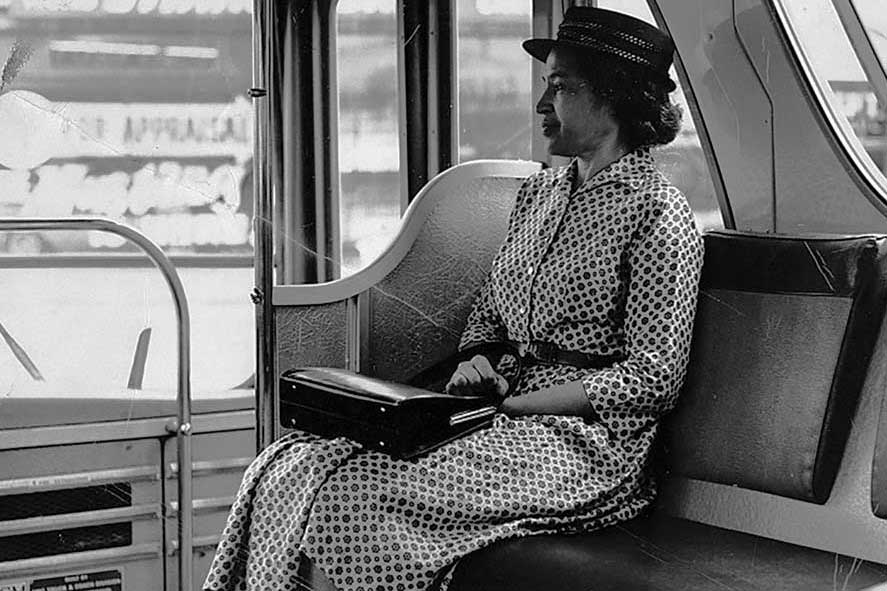
In one of the most iconic and inspirational moments in U.S. history, Rosa Parks protested segregation by refusing to give up her seat on a Montgomery, Alabama bus in December 1955.
Parks’ arrest triggered a massive year-long boycott of the Montgomery bus system in which an estimated 40,000 residents participated. The U.S. Supreme Court finally ruled that the city’s segregation laws were unconstitutional, bringing an end to both the boycott and the deep wound of legalized segregation.

More than 65 years later, the campaign for equity continues in transportation, housing and virtually every aspect of society. To highlight this intersection, Rosa Parks’s birthday, Feb. 4, has been designated Transit Equity Day across the U.S.
In recognition, an image of Rosa Parks is riding in the front seats of all Rogue Valley Transportation District buses for the next week.
“RVTD is committed to providing an equitable and accessible transit system for all members of our community,” said RVTD General Manager Julie Brown. “It’s an honor to recognize and commemorate the bravery of Rosa Parks and all who fought for freedom and equality.”
In the squeeze
America’s automobile-centered culture has profoundly shaped our cities and landscapes. Americans drive more miles each year, which essentially cancels out the gains in fuel efficiency. People without cars often struggle to carry out basic activities such as getting to work, school, health services, and shopping. Those who depend on transit often ride fossil-fueled buses with high greenhouse gas emissions. And while the negative effects of climate change affect everyone, they fall disproportionately on the most disadvantaged among us.
The confluence of transit, equity and housing challenges is putting the squeeze on local workers — and businesses, says Andrew Card, owner of Masala Bistro & Bar and Oberon’s Restaurant and Bar.
“It’s been challenging to hire in Ashland, and the Almeda Fire exacerbated the situation,” says Card. “The lack of affordable inventory is putting upward pressure on rent, preventing many workers, and even business owners, from living in Ashland. Even in Talent, where many workers have traditionally rented, it is difficult to find affordable housing. The cost of living in Ashland and Talent is outpacing the significant wage increases we’ve seen within the service sector.”
“We need more multifamily units in Ashland, Talent, and Phoenix to make it viable to work in Ashland,” Card added. “We also need to make Ashland more accessible from Medford, Central Point and Phoenix with better public transport.”
An untenable trajectory
Our current system centers on increasing vehicle capacity, which is neither equitable nor sustainable, says Oregon Environmental Council Transportation Program Director Sara Wright. “You only get the full functionality of the system if you bring your own resources to the table,” Wright points out. “You have to be physically and legally able to drive. You have to have money to pay for a car, gas, and repairs. If you don’t have those resources, you don’t have the full freedom of the system.”
While policymakers balk at the cost of public transit, and of upgrading to electric, Wright sees this as faulty logic. “We can’t afford the current system,” she asserts. “We’re perpetuating a system conceived in the 1950s. It’s incredibly wasteful of time, money, and space.” Transportation for America estimates that it costs $24,000 a year on average to maintain a lane-mile of highway — a significant bill that keeps coming due, well into the future.
“A lot of people cannot afford to own a car,” says Ashland Transportation Commission Chair Linda Peterson Adams. “Spending an equivalent amount to expand bus service instead would make it possible for more people to affordably access jobs.”
“Adding electric buses or rail provides even greater benefit by also reducing emissions,” Adams adds. “Adding more riders who would otherwise drive their own cars multiplies the benefits even further.”
Our transit systems need to move to center stage as we ramp up our response to climate change. “Municipalities and transit agencies need to work together,” Wright asserts. “Transit agencies can’t do that planning on their own. We need to re-center how we look at transportation. What will have the best outcomes for climate and equity?”
Over the next year, Ashland will be updating its Transportation System Plan for the first time in nearly a decade. The plan is the best opportunity we’ll have in the coming years to align our transportation system with our values and climate reality.
Lorrie Kaplan is chair of the Ashland Climate Action Project of Southern Oregon Climate Action Now. She is also an unpaid board member of Ashland.news. She can be reached at lorrie@socan.eco.