Measure 110, homelessness, affordable housing and wildfires dominate town hall discussion
By Damian Mann for Ashland.news
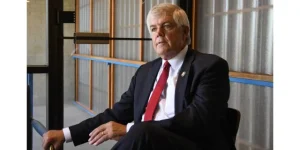
Ashland residents Wednesday night got a taste of the challenges Sen. Jeff Golden will face in the upcoming short Oregon legislative session.
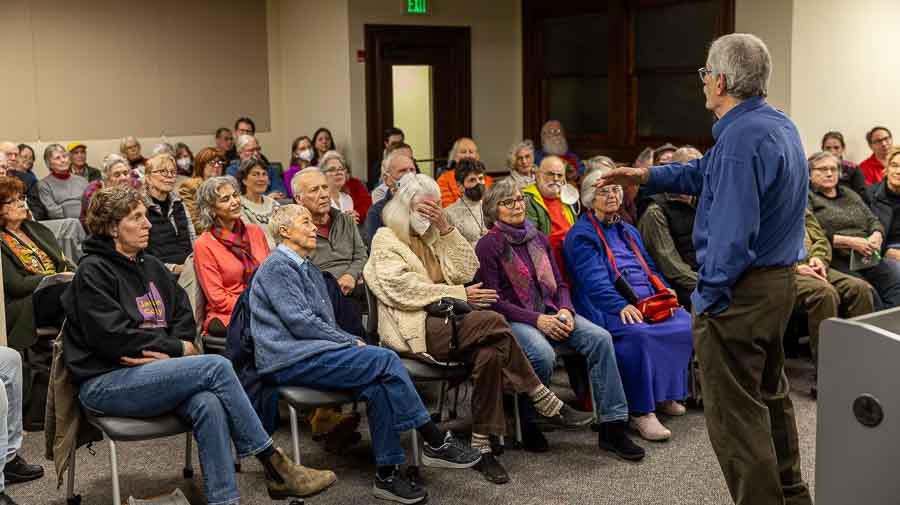
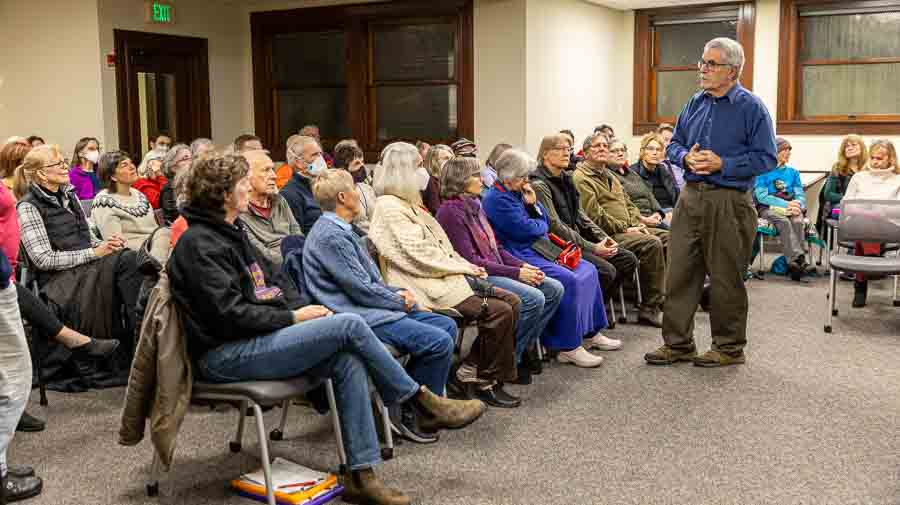
More than 60 people showed up for the town hall on Wednesday, held in the Gresham Room of the Ashland library. Golden held another town hall Tuesday night in Medford with about 40 people attending.
Dominating the discussion both nights was repealing or modifying a drug decriminalization law, homelessness, affordable housing and the issue that remains front and center for Ashland residents: the lack of state funding to help this community deal with wildfires.
“Far and away, I’m getting the most email about Measure 110,” Golden said. “It’s not going to be repealed, and it’s not going to be left alone.”
Measure 110, approved by voters in 2020, is often cited as the culprit as many communities in Oregon confront issues around homelessness, disorder on the street and public consumption of drugs. The law was designed to treat drug addiction as a health problem rather than as a crime.
Golden said Measure 110 was based on a drug decriminalization law in Portugal, which has relatively low rates of drug abuse.
But Portugal is a high-tax country that allows extensive resources to deal with the problem.
“They provide enough treatment to the people who are addicted, and we haven’t done that,” Golden said.
Going back to the days when drug addicts were thrown in jail is not the solution, he said. “It essentially criminalizes poverty.”
But the state will likely look at penalties for public drug use, but Golden said he’d also like to see more community-based peer treatment programs.
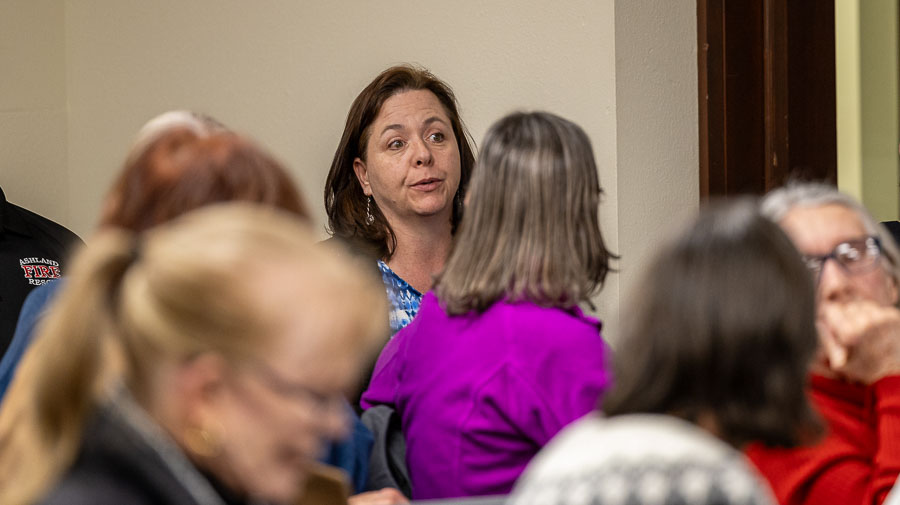
Ashland resident Helga Motley asked Golden if the potential penalties for public drug use would apply to marijuana.
Golden responded that the penalties would only apply to drugs decriminalized under Measure 110. Marijuana, he said, was legalized prior to 110.
This legislative session, Golden will offer bills that seek to address one of the critical reasons why healthcare treatment to address addiction faces a major hurdle: the shortage of behavioral health workers.
But the short session — five weeks, 35 days — that begins Feb. 5 is also a difficult session to get bills passed because of its duration, or lack of it.
Golden will propose a collaboration among Southern Oregon University, Portland State University, the Oregon Institute of Technology, and Eastern and Western Oregon Universities.
Under his proposed bill the schools would train students in counseling and other skills to help develop a statewide treatment system.
On the threat of wildfires, Golden said Ashland is a statewide leader in fuels reduction and other programs to prevent a catastrophic wildfire overrunning the city.
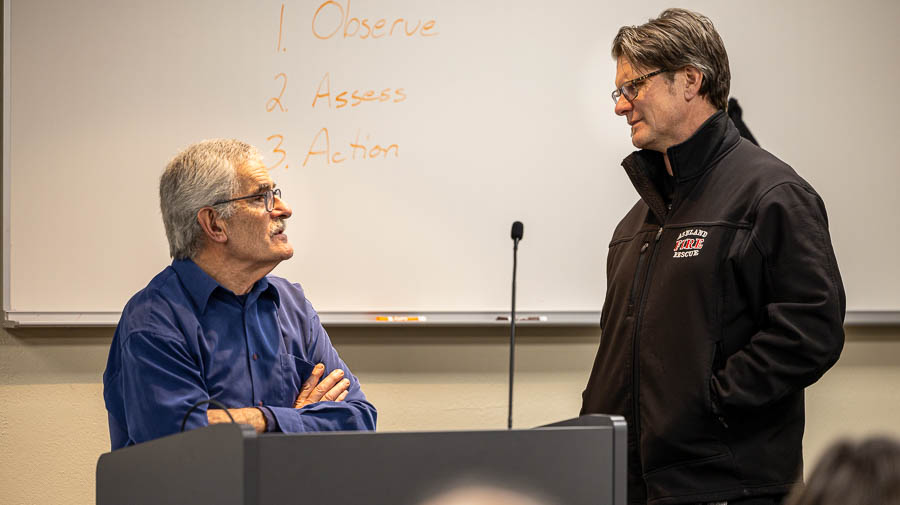
He called out Ashland Mayor Tonya Graham and Chris Chambers, Ashland fire division chief, as two leaders who have spearheaded Ashland’s ongoing efforts to help protect the city.
After the devastating 2020 fire season, which included southern Oregon’s Almeda fire, Senate Bill 762 allocated $220 million for mitigation efforts to prepare for wildfires, with $35 million of it earmarked to help communities and homes.
In 2023, the Legislature approved $87 million for wildfire efforts, with only only $3 million set aside to harden communities. Golden said there is strong disagreement about how to adequately fund wildfire suppression, though he thought the timber industry should shoulder some of the costs since they have an economic benefit.
He said he would support a November ballot measure with a graduated tax on the timber industry.
Mayor Graham said there are a lot of issues around wildfire suppression, and there is so much more that communities can do to protect themselves.
“What can the city of Ashland and its people do to further that,” she asked.
Golden said he applauded the efforts the city has already done to raise awareness to the issue, and he recommended continuing to keep that awareness in front of legislators.
He said communities such as Ashland have worked with residents to protect their homes and neighborhoods.
Getting insurance companies involved with a certification process to potentially lower rates would be a step in the right direction, he said.
A wildfire bill proposed a $10 fee on every property owner to help pay for wildfire protection.
Alan Journet with Southern Oregon Climate Action Now asked Golden what he thought of a recent article in Capital Chronicle about the timber industry ties to the bill.
“The article suggested the bill was written by Weyerhaeuser,” he said.
Golden demurred in his response: “I’d like to see if we can consolidate ourselves to a bill without bashing each other over the head.”
He said he would prefer to see the timber industry step up and before any effort is made to seek a fee from property owners.
Reach freelance writer Damian Mann at dmannnews@gmail.com.