The public is asked to comment on the draft plan by Jan. 7
By Shaun Hall, Rogue Valley Times
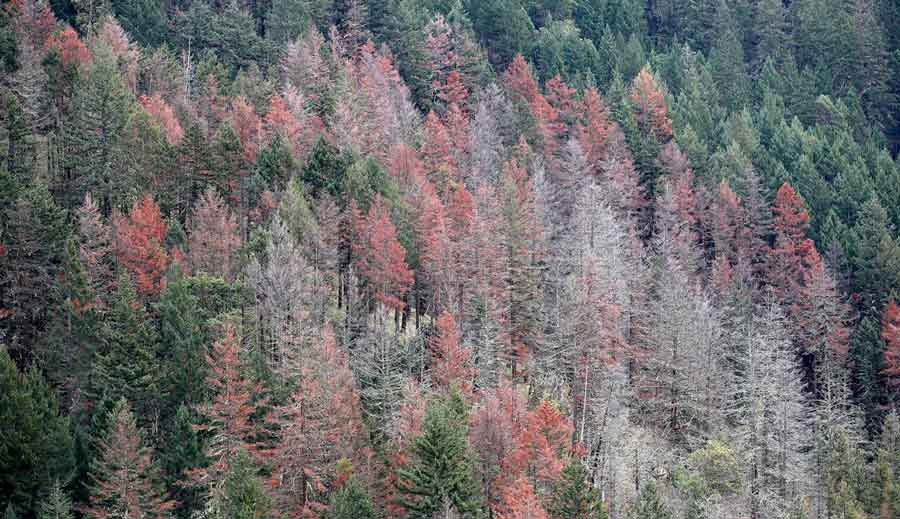
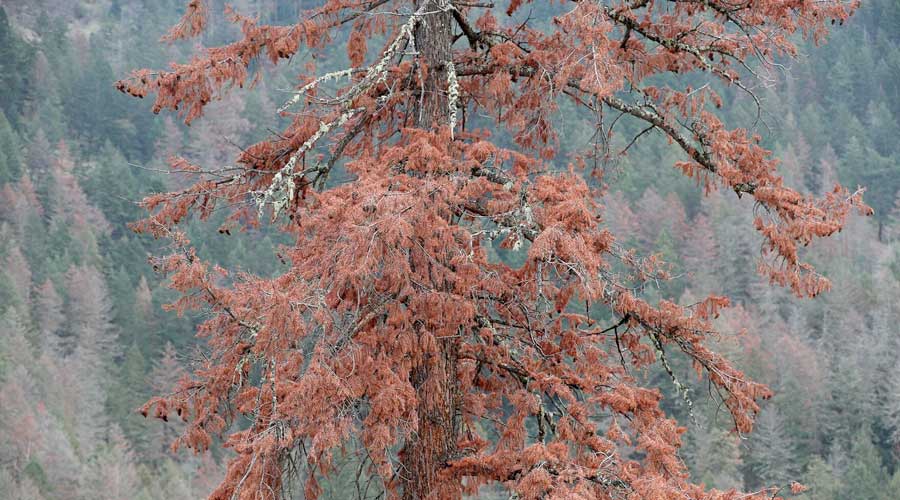
On a cold, windswept ridge above the Applegate Valley near Ruch last week, a group of specialists with the U.S. Bureau of Land Management and the U.S. Forest Service looked across a forested landscape showing patches of red-colored Douglas fir trees, the victims of drought and beetle infestation.
The group of six, which met with journalists and a local resident, warned about the threat posed by the dead and dying trees, which can fuel a severe wildfire.
“It’s shocking what we’re seeing,” said Lisa Meredith, a BLM silviculturist. “We’re being pretty loud about it. It’s scary.”
Nearby was a mountainside gully showing about 40% of its trees dead or dying. About a mile from the base of the gully stood the community of Ruch, with dozens of homes.
Mike Vanderberg, a supervisory forester with the BLM, predicted that within two years as much as 80% of the trees in that gully would be dead or dying.
“This is a call to action,” he said.
The widespread death and pending death of Douglas fir trees in areas around Grants Pass, Medford and nearby, including the Applegate Valley, has created a hazard to residents, firefighters and forests that prompted the BLM to propose a plan to quickly log those trees. Other trees, including fire-resistant pines and oaks are also threatened, but to a lesser extent.
In response, the agency has created a draft plan to log dead and dying trees across 5,000 acres of its properties within 1 mile of communities, within 500 feet of prominent roads or within 500 feet of the boundaries of certain roads, ridges, waterways or other natural features that can be used as fire breaks to control wildfire.
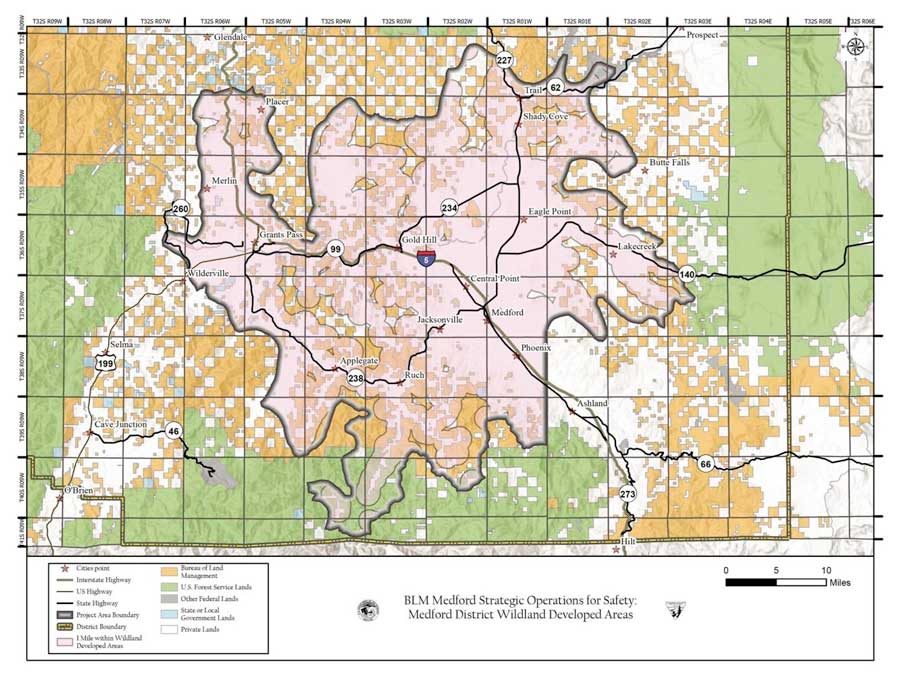
The public is being asked to comment on the draft plan through Jan. 7. A more detailed plan would follow, as would a public field trip.
The group met on Woodrat Mountain, about 6 miles southwest of Jacksonville, at a mid-level launch site for paragliders and hang gliders. The Applegate River flowed by about 2 miles to the west.
Meredith said that if the trees are logged quickly, before they deteriorate, they can be sold, helping to offset logging costs.
“Once they turn red, there’s less than a year to get them to the mill,” she said. “They can pay their way out of the woods, or at least partially. We’re trying to be pretty timely here.”
Dead trees are a fall hazard and can block access for emergency personnel as well as local residents. Chris Glode, a fire manager with the BLM, said an aim of the project was to “get to work quicker and safer.”
“Public safety is the driver behind this,” he said.
Among the group was local resident Gary Custance, who lives up nearby Bishop Creek Road where trees are dying.
“There’s so many dead trees,” he said. “It’s really alarming, almost overwhelming.”
Laura Lowrey, a forest entomologist working for the Forest Service, said drought has stressed the trees, leaving them open to beetle infestations that can hasten death. Climate change is now adding to the drier conditions and heat.
“They’re weakened from all this chronic drought,” Lowrey said.
The affected trees targeted by the project are found in areas with less than 35 inches of annual precipitation.
Kyle Sullivan, a communications specialist with the BLM, said BLM’s motives have been questioned at times, but that a priority of people working there is protection of the forest for generations to come. The agency has a history of logging its properties.
“We get accused of fear-mongering,” Sullivan said. “We have a bunch of people who care deeply about the environment.”
When contacted for comment, George Sexton, conservation director for the environmental organization Klamath-Siskiyou Wildlands Center of Ashland, gave a qualified endorsement of BLM’s plan.
“In general, KS Wild is supportive of addressing the small-diameter low-elevation Douglas fir mortality crisis,” Sexton wrote in an emailed response. “We’d like to see those areas managed as oak woodlands that might do better in the face of drought and climate change.
“I’m not sure that the timber industry or the BLM are going to be OK with converting low-elevation timber plantations into oak woodlands,” Sexton continued. “Plus, it’s way past time to start addressing the climate crisis or we’re going to see more problems ahead. And lastly, this has got to be a wake-up call to the BLM to stop creating dense young Douglas-fir plantations across Southern Oregon.”
The BLM is in the “scoping” phase of the project, known as “Strategic Operations for Safety – Salvage and Removal of Dead and Dying Conifers Project.” In particular, the agency is asking residents to identify prominent roads in their communities where trees are showing signs of tree die-off or to comment on notable areas of tree die-off.
For more information, contact Meredith at 541-618- 2333 or go online to BLM’s planning website at bit.ly/48nZxym.
Reach Rogue Valley Times outdoors and environmental reporter Shaun Hall at 458-225-7179 or shall@rv-times.com. This story first appeared in the Rogue Valley Times.
Related stories:
Study: 20% of Douglas fir trees in city-owned areas of the Ashland watershed are dead or dying
Expect helicopter logging this winter to lessen forest fire fuel load