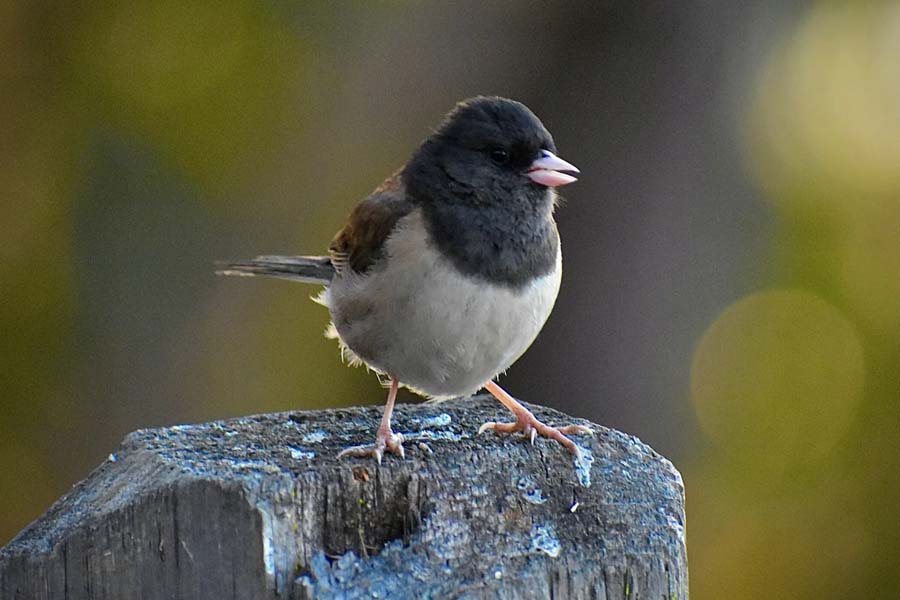
The junco is a familiar winter visitor in the West but it’s also something of a canary in the coalmine
By Pepper Trail
No, this isn’t about those folks who spend their winters in Arizona or Florida. The snowbird behind this warning is an actual bird, the dark-eyed junco, a small creature you probably know if you have a bird feeder and maybe even if you don’t.
Trim, gray sparrows that flash white tail feathers as they take flight, juncos are called snowbirds because they arrive in our towns with the coming of snow. Come spring, they head back up into the mountains or north to Canada and Alaska for nesting.
Juncos are among the West’s most familiar birds, reliable companions on summer hikes and winter days. The total population of the species is estimated to be around 200 million. Juncos are in no danger of extinction, so, what warning could they be giving us?
Juncos may be abundant but they are also in sharp decline. According to the Breeding Bird Survey, a decades-long monitoring study of the nation’s birds, junco populations are down by 42% since the surveys began in the late 1960s.
But here is the peculiar part: There is no obvious reason for this loss of millions of birds. Juncos are adaptable, not requiring some disappearing habitat. They don’t make long-distance migrations to the tropics. Poisons or toxins don’t seem to pose a special threat to them.
What seems to be killing juncos is simply … everything.
Based on numerous studies, the leading human-related cause of death among birds is predation by cats: over 2 billion (yes, billion) birds killed per year in North America.
This is followed by collisions: windows, 600 million birds; vehicles, 200 million; power lines and communication towers, 43 million.
Then there are pesticides and toxics, 72 million, lead poisoning, 12 million, and oil and wastewater pits, 1 million. That adds up to well over 3 billion dead birds per year.
Nothing on this list is a deliberate effort to get rid of juncos or other birds. They’re just byproducts of the way we conduct ourselves in the world.
These dangers, of course, are not faced just by juncos. A review of North American bird populations documents that we have lost almost one-third of our birds since 1970. The researchers summarized their findings in no uncertain terms: “This loss of bird abundance signals an urgent need to address threats to avert future avifaunal collapse and associated loss of ecosystem integrity, function and services.”
It’s not just bird populations that are collapsing. Insect populations are crashing as well. Studies from the United States, Europe and Asia over the last 10 years document shocking declines in insect populations, as much as 50% to 75%.
If you’re plagued by swarms of mosquitoes in the summer, you might think that’s not such a bad thing. But insects are crucial to the functioning of just about every ecosystem on Earth, serving as pollinators, decomposers and as food for countless species of critters higher up the food chain.
Is there an exception to this relentless litany of population declines? Why, yes. It’s us. Since 1970, the human population of the United States has grown by more than 60%, while bird populations have fallen by a third. That doesn’t seem like a coincidence.
Everyone has heard of the canary in the coal mine: the bird that miners brought underground to alert them to dangerous gases such as carbon monoxide. With its small size and fast metabolism, the canary would collapse before the gas reached levels fatal to humans, giving the miners just enough time to escape.
We need to see the humble snowbird for what it is: Our “canary in the world.” When even the commonest wild species are suffering drastic declines, do we really believe that a world inhospitable to our fellow creatures will continue to be hospitable to us? As one species after another dwindles away, the structure of the ecosystems that sustain life on Earth is weakening.
The familiar flash of a junco’s white tail feathers as I hike along a mountain trail always brings a smile to my face. It’s a reminder that keeping common species common is essential to keeping this beautiful planet livable. And for that, I say thank you, little snowbird.
Pepper Trail is a contributor to Writers on the Range, writersontherange.org, a nonprofit dedicated to spurring lively conversation about the West. He is a biologist and writer based in Ashland.
Related: