Suddenness of Ashland Street property purchase, lack of notice to neighbors draws protests
By Morgan Rothborne, Ashland.news
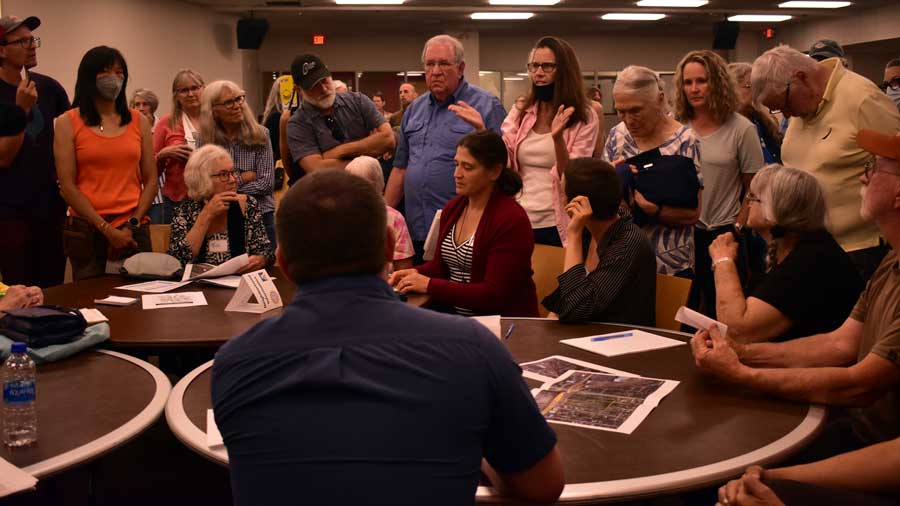
A community meeting Thursday for neighbors of Ashland’s proposed emergency shelter attracted a crowd of residents brimming with questions, fears and, for a few, hopes.
In the basement of the student union at Southern Oregon University, members of Ashland City Council, including Mayor Tonya Graham, and senior city staff sat at tables where residents were invited to share concerns about the emergency shelter soon to be operating in the 3,097-square-foot building at 2200 Ashland St.
Ashland residents first learned of the planned shelter site when purchase of the property was included in the agenda posted a few days before the Aug. 15 council meeting. Thursday’s community meeting was scheduled after neighbors voiced opposition during that meeting.
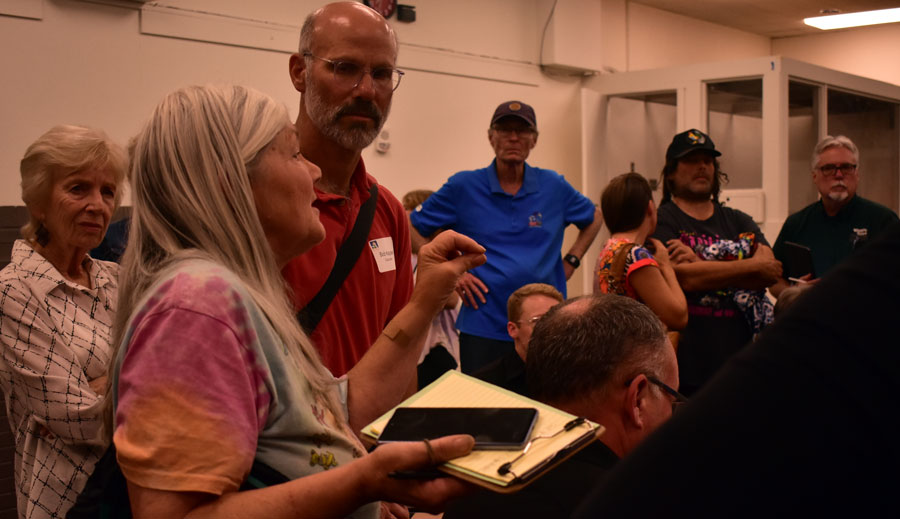
City Manager Joe Lessard opened the meeting Thursday evening with a series of statistics and explanations.
The state of Oregon has 18,000 homeless people at any given time and that number is up 63% over the past five years. Ashland, as part of Jackson County, has seen a 132% increase, he said. Governor Tina Kotek declared a state of emergency for homelessness to last from Jan. 10, 2023 to Jan. 10, 2024, leading to a flow of grant funding from the state — millions of dollars with restrictions and relatively precise objectives, Lessard said.
Ashland received a $1.58 million grant from the state for the operation of a shelter during the emergency declaration time frame. The search for a building started long before the emergency declaration, Lessard said. The city decided last year to find a new location for its emergency weather shelter and a site for “catastrophic events.”
“Quite frankly, this was not an easy thing to solve,” he said. “If you look at how Ashland is laid out, it’s sort of a longitudinal city and it’s primarily residential. We were trying as best we could to find an existing building, primarily in a commercial area, that was near transit, that could accommodate the usage.”
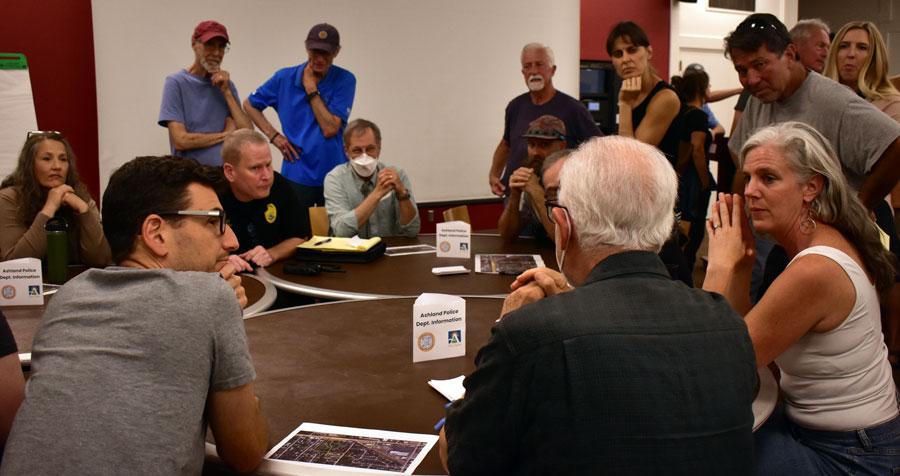
Almost all available chairs in the room were taken with some standing around the walls and others silently filing in as Lessard spoke. City staff waited at tables labeled for topics of conversation such as “neighborhood concerns,” “facilities,” and “police department information.” Attendees waited quietly for the discussion portion of the meeting until Lessard offered a statement of what the shelter is and what it is not.
“It is not a drop-in center,” he said. “It is not a case where you come and go as you please. … What it is is a state-funded operation of at least 30 beds with application and screening process required, screening individuals for past court cases, for violent cases and the sex offender registry.”
When he stated anyone who breaks the rules of the shelter will be expelled, several attendees called out:
“Where you going to send’em?”
“Send’em to your house!”
Lessard responded by saying it was a good question. After brief remarks from Graham and Cass Sinclair, executive director of OHRA (Options for Helping Residents of Ashland) — the nonprofit that will operate the shelter for the city — attendees were invited to choose a table and begin the discussion. Graham stated she would ring a bell every 15 minutes to keep attendees moving between tables. The bell never rang.
The majority of attendees crowded around the neighborhood concerns table, overwhelming the available chairs and standing two and three deep from it. Some talked over each other and the majority remained there throughout the two-hour meeting.
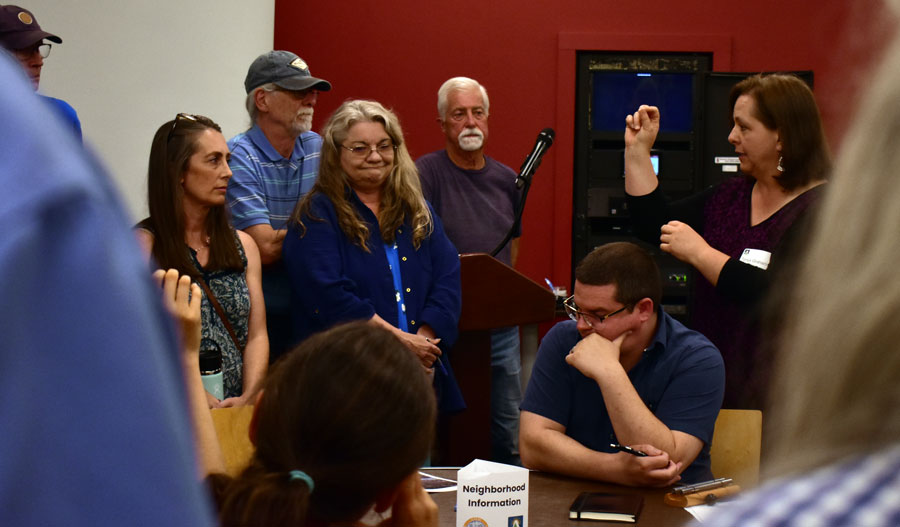
“Is this table about reconsidering the decision?”
“You’re 600 feet from an elementary school.”
“I’ve got a 14-year-old daughter, she isn’t comfortable walking to school.”
“You set this up in our neighborhood without asking.”
Standing at the table, Graham addressed her own neighbors.
“I understand that frustration, I absolutely completely understand it. I live on the other side of Clay Street park, I got my own letter in the mail. We are dealing with problems in this neighborhood. We are all dealing with them. This was a fall down, a complete fall down. It was not intentional. What we are trying to do right now is to make sure the way it started is not the way it carries on,” she said.
On her left was Councilor Bob Kaplan, on her right Councilor Dylan Bloom. When shelter neighbor Lisa Good challenged Bloom with her concerns about safety and property values, he responded with a description of his dual investment in the shelter — as a native of the neighborhood he has seen it “deteriorate,” he said, but he still walks with his 2-year-old child in Clay Street park. As a councilor, he described the shelter as an attempt to help.
“When government sees that there is a problem and we have an opportunity to try to address that problem, who are we to not attempt? This is our attempt. … We’re saying, ‘give us a chance to try something.’ If it doesn’t work, you come back and you yell at us, you vote us out of office,” Bloom said.
The crowd largely obeyed Graham’s request to raise their hands and wait their turn to speak, apart from intermittent outbursts. Some applauded one another’s accusations or concerns. Others turned to each other and quietly traded how many decades they had lived in the neighborhood and how it has changed.
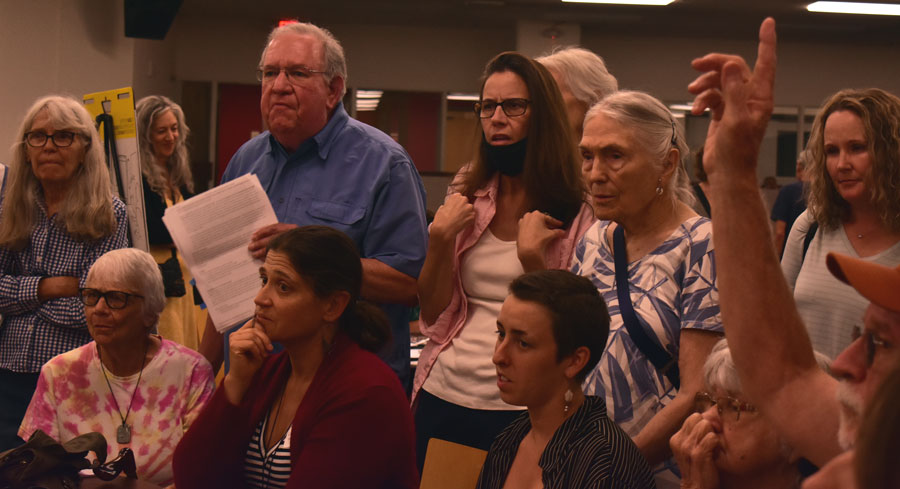
Most of the concerns directed at Graham and councilors were recitations of problems personally experienced and a fear the shelter would make them worse. Safety concerns included people thought to be mentally ill attempting to access homes, stealing from porches or verbally harassing residents; the fire hazard posed by blackberry bushes on the nearby railroad tracks; feces on streets and in Clay Street park; and used needles and other evidence of illicit drug use.
“There’s been three bodies, overdosed” a man said over the din.
“There’s been more than that,” responded Debbie Nieswander, an advocate for homeless people.
Another man who declined to be quoted by name argued Measure 110 was already attracting those with addictions to Oregon and the shelter would make the neighborhood a magnet.
“We have to deal with the unintended consequences of Measure 110,” Graham said. “We have to deal with the mental health system that is failing, we have to deal with drug abuse and alcohol abuse programs that are failing — you’re right, we don’t want to become a magnet, but they’re already here.”
Some attendees stated they had already accepted their houseless neighbors presence and hoped the shelter would mean more services and improvements for the neighborhood. Liz Adkisson said her experience with an “apocalyptic” feeling amid the mud and flooding at this year’s Burning Man festival caused her to think about community and natural disasters.
“‘Oh no! The houseless are doing this, this and this,’ and the houseless are saying, ‘These snobby rich people,’ … If s—- goes down, we are all here together in the muck with our neighbors. It doesn’t matter if you don’t like’em, you’re there with’em,” she said.
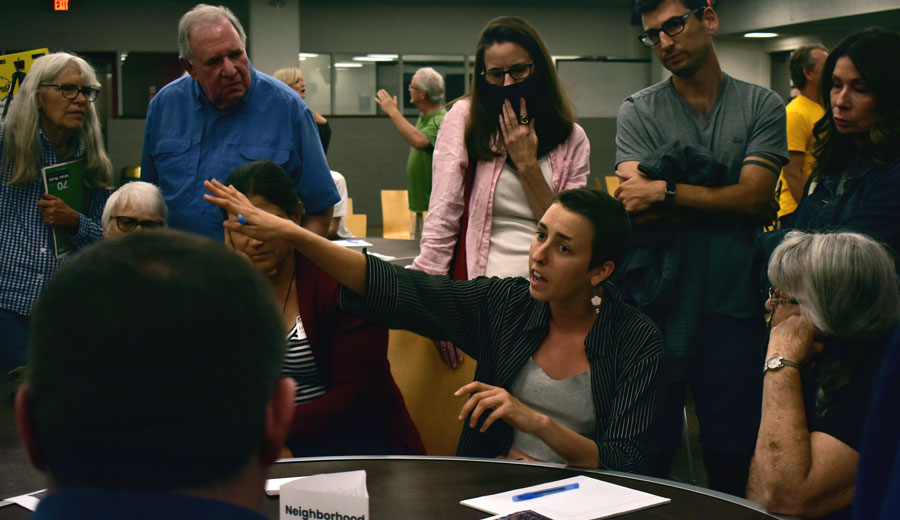
Adkisson expressed hope the shelter would be a beginning of a larger effort for greater community connectivity and cooperation.
“Solve homelessness — not like, let’s put a patch over it, but let’s all work together to solve addiction and mental health as a whole. … It’s not just the houseless who are doing crime,” she said.
As the meeting came to a close, Lessard sat at a table with only two attendees. A resident who declined to be named voiced security concerns. Lessard responded with a philosophy of adaptability.
“We have these conversations, it’s not one dimension. … How is this going to work, are we creating too inviting of circumstances or are we creating an approach that’s compassionate — but still you have to behave. The way we look at it, just take the next incremental step. … It’s a process of trying to stay in balance as you go,” Lessard said.
Graham promised attendees there would be more conversations and encouraged residents to sign up for a neighborhood advisory group to keep concerns and suggestions connected to city staff.
For more information about the shelter or the advisory group, visit the city’s shelter page.
Email Ashland.news reporter Morgan Rothborne at morganr@ashland.news.