With years of drought and high temperatures killing off trees, plans made to transition to species adapted to drought and heat
By Damian Mann for Ashland.news
A newly-released aerial survey of the Ashland watershed revealed some 20% of Douglas firs have died and more are expected to die.
In Siskiyou Mountain Park just above Park Avenue, Rogue Reconnaissance drone footage commissioned by the city found 30% of Douglas firs are dead or dying.
The Douglas-fir mortality, which is impacting many areas of the state, represents a “decline spiral,” according to research papers by both the Oregon State University and U.S. Forest Service.
Armed with stark evidence of accelerating climate change, the city is planning to ease the transition to a different kind of forest.
“We’re shifting the paradigm from restoration to adaptation,” said Chris Chambers, Ashland Fire & Rescue forest officer.
He said restoration is still relevant, and one of the goals is to encourage more growth of drought-tolerant species such as ponderosa pine, madrone and California black oak.
At the same time, the goal is to reduce fuel load on the hillsides above Ashland to prevent the kind of catastrophic wildfires that have burned through towns over the past decade, including the recent destruction of Lahaina on Maui.
Chambers said some areas in the U.S. have seen mega-fires that were so hot that the forests likely won’t come back.
“We want to intervene now to reduce fuel loads and prevent that from happening here,” he said.
This winter Ashland is gearing up to do helicopter logging of dead or dying trees and ease the transition to species better adapted to the changing climate.
Chambers said the hope is that early intervention will help maintain forest cover for as long as possible, possibly even for decades into the future.
The Douglas fir, Oregon’s official state tree, typically requires 40 inches or more of rain a year to thrive.
Over the past decade the Ashland area has received far less than its normal rainfall in most years.
Some historical evidence indicates the hillsides above Ashland didn’t host as many Douglas firs as now.
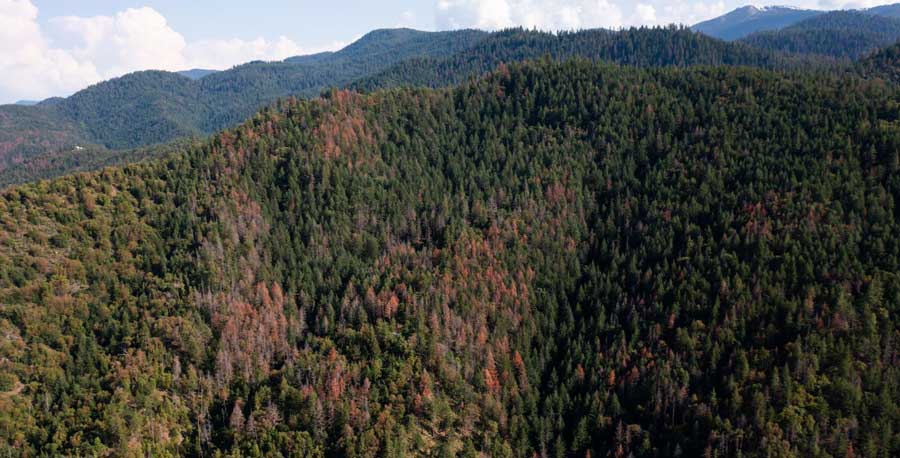
This spring, locals noticed reddish swaths across the hillsides above Ashland, the tell-tale sign that many firs had died.
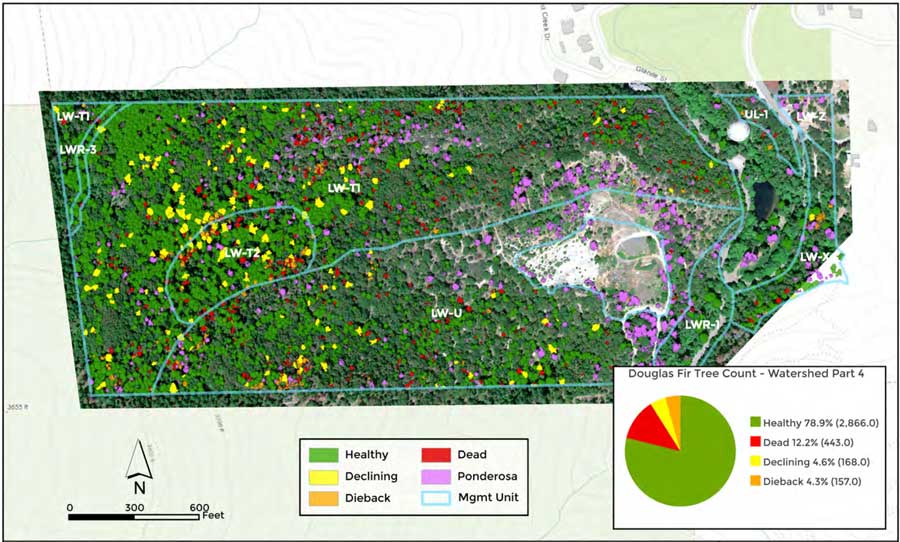
Crews will be going out to mark dead or dying trees, and trees that could become a hazard along trails will also be removed.
A similar die-off occurred in the early 2000s, also prompting a response with helicopter logging.
This summer Ashland commissioned an aerial survey of about 800 acres of community-owned forests that include popular trails such as Bandersnatch, BTI, White Rabbit, and Wonder.
The city owns 1,100 acres above the city.
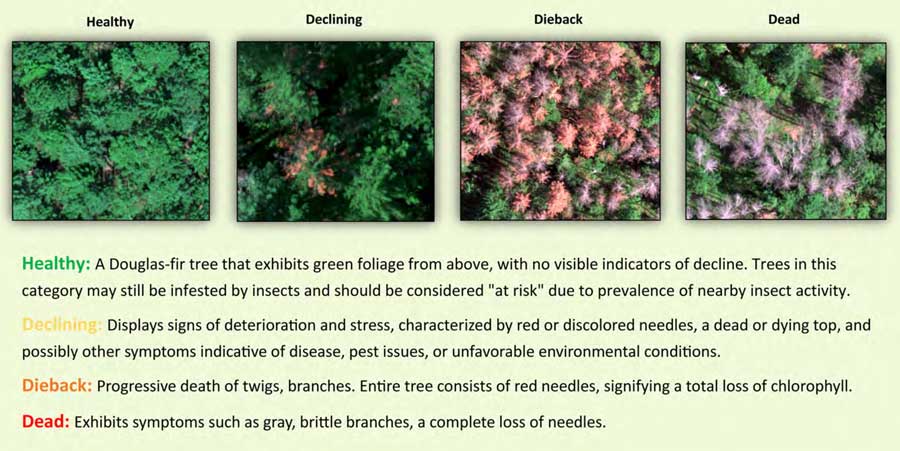
In addition, on-the-ground surveys discovered many relatively healthy Douglas firs have been besieged by the flatheaded borer, indicating that these trees are also likely to die in the near future.
Beetles and fungi are a common threat once trees become stressed by prolonged droughts and hotter weather.
This July marked the fourth hottest on record for the Medford area, following the hottest July on record in 2021, according to the National Weather Service.
Over the past 10 years, this area has notched the four hottest Julys on record.
Chambers said the city will seek public comment later this year on a plan to deal with Douglas-fir die-off.
The 2016 Ashland Forest Plan has been updated to include more evidence for early intervention as a way to deal with dying forests as a result of climate change.
High rates of Douglas-fir die-off is expected over the next five years for trees below 3,000-foot elevation, which is most of the land around Reeder Reservoir, which contains the city’s water supply, as well as around Lithia Park and Siskiyou Mountain Park.
In March, a research paper released by the Oregon State University provided a clear pointer for communities going forward.
“In southwestern Oregon, forest management that steers toward oaks, pines and other more drought-tolerant species may be warranted in places with less than about 40 inches of average precipitation a year,” said Max Bennett, a forest expert who has since retired from OSU. “But some individual trees and patches of Douglas fir will likely persist on these dry sites at least for a time, so it’s important not to use an all or nothing approach.”
In the hills above Ashland, it is expected that Douglas firs should continue to exist along northeast facing hillsides and in draws and other cool areas, though some thinning of live trees may be needed to allow the remaining firs to thrive.
Chambers said it is too difficult to predict how forests will look into the future.
“Nothing happens consistently with climate change,” he said. “It’s surprising us that it’s happening more quickly than we expected.”
Reach freelance writer Damian Mann at dmannnews@gmail.com.
Aug. 30: “Non-native” in reference to Douglas firs removed from secondary headline. Douglas firs are native to the area. Also updated Ashland Fire & Rescue Forest Officer Chris Chambers’ title.