Our response to Guatemala’s new president will be a test case
By Herbert Rothschild
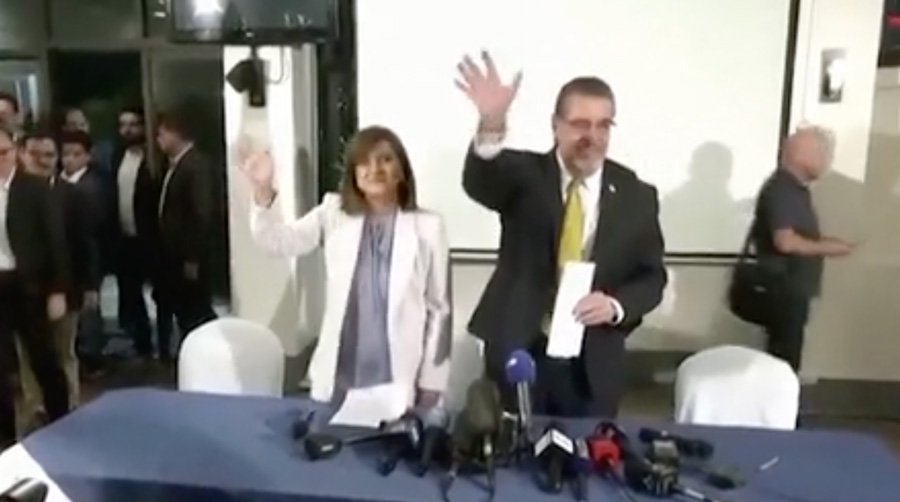
This past Sunday, Guatemalans elected Bernardo Arévalo of the progressive Movimiento Semilla party as their next president. In a runoff, he outpolled former first lady Sandra Torres 58% to 37%. After Arévalo had finished second in the first round of voting back in June, Attorney General Maria Consuelo Porras, who has been deeply involved in the governmental corruption Arévalo vowed to curb, suspended Movimiento Semilla’s participation, but she was overruled by the nation’s top court. Outgoing President Alejandro Giammattei has pledged a peaceful transition of power.

My guess is that the outcome has produced mixed feelings in our foreign policy establishment and the powerful economic interests it serves. On the upside is the prospect of less corruption, which it now understands to be a root cause of immigration from Central American countries, a vexing political problem for the Biden administration. On the down side is that in Guatemala, as elsewhere in the region, corrupt governments have served U.S. commercial and financial interests at the expense of their general populations. Indeed, that service was a major component of their corruption.
Arévalo’s father, Juan José Arévalo Bermejo, was Guatemala’s first democratically elected president. He won after a popular uprising overthrew U.S.-backed dictator Jorge Ubico, and during his years in office (1945-1951), José Arévalo instituted reforms to uplift the poor. He was succeeded as president by Juan Jacobo Árbenz Guzmán, who had played a major role in ousting Ubico. Going beyond his predecessor’s work, Árbenz instituted a sweeping land reform that incurred the wrath of the United Fruit Co. and led to his ouster by a CIA-directed coup in 1954 and the restoration of dictatorship.
Despite having the largest economy in Central America, Guatemala has one of its highest levels of inequality. The World Bank estimates that 54% of the population lives below the poverty line.
Giammattei’s administration repressed grassroots efforts by and on behalf of the poor, including those by the country’s large indigenous population defending its territories from corporate exploitation. Selective assassinations of social leaders (peasants, environmentalists, trade unionists) continued year after year, with little reaction from the justice system. In April 2022, the International Federation for Human Rights and the World Organisation Against Torture issued a report following their visit to Guatemala. The report, entitled “Guatemala: A Country Resisting, a State Torturing,” spoke of the dismantling of the rule of law there and the co-optation of state powers to advance a corrupt political and economic agenda.
What I’ve said about Giammattei’s record sounds just like those of the Central American and Caribbean governments the U.S. supported all through the last century and into the current one. And as I concluded in a column I published last year entitled “Why immigration reform eludes us,” “Comprehensive immigration reform will never be comprehensive if we don’t reform our conduct in the hemisphere.”
Unsurprisingly, during Giammattei’s presidency, emigration from Guatemala to the U.S. jumped sharply. Gratifyingly, Washington has begun to acknowledge that people leave their native lands and risk a long hazardous journey because their lives have become unbearable. It would be too much, of course, for any U.S. politician to acknowledge openly our responsibility for the conditions such people flee. Our recent official concern about conditions in Central America has emphasized internal corruption, and our primary tool for discouraging it is the Engel List.
Named for former New York Congressman Eliot Engel, the list is part of the U.S.-Northern Triangle Enhanced Engagement Act, passed by Congress in December 2020. The act reauthorized aid to Guatemala, Honduras and El Salvador, but conditioned part of it on the receiving countries’ taking various actions, including informing their citizens of the dangers of the journey to the U.S., fighting human and drug trafficking, and combating corruption. It required the State Department to promote inclusive economic growth that addresses the underlying causes of poverty and inequality, strengthen democratic institutions and the rule of law, improve security conditions through means such as the professionalization of security services, and combat corruption.
To that last end, the act requires the president to impose sanctions on foreign persons we believe to be involved in significant acts of corruption in Northern Triangle countries. Individuals who engage in such acts shall be subject to property-blocking sanctions and barred from entering the United States. Each year, the administration must send to Congress a list of those persons. That is the Engel List. Consuela Porras debuted on it in 2022.
When Secretary of State Antony Blinken published the 2021 Engel List, the press release included the following language: “As stated in the recent U.S. Presidential Decree Establishing the Fight Against Corruption as a Core U.S. National Security Interest: ‘Corruption corrodes public trust; hobbles effective governance; distorts markets and equitable access to services; undercuts development efforts; contributes to national fragility, extremism, and migration; and provides authoritarian leaders a means to undermine democracies worldwide. When leaders steal from their nations’ citizens or oligarchs flout the rule of law, economic growth slows, inequality widens, and trust in government plummets.’”
We’ll see if this effort to stem emigration from Central American countries actually does catalyze a major change in U.S. behavior in that region. For the sake of our long-suffering sisters and brothers there, let’s hope it does. One test will be our response if Arévalo follows in the footsteps of his father and Árbenz and tries to advance economic justice to the detriment of U.S. business interests.
Herbert Rothschild is an unpaid Ashland.news board member. Opinions expressed in his columns represent the author’s views and may or may not reflect those of Ashland.news. Email Rothschild at herbertrothschild6839@gmail.com.